Our first visit to the caravan storage site in quite a while to check on the caravan was undertaken with some apprehension. It had been over twelve months since we had checked on it and we expected that we were going to be in for a shock.
The caravan was very dirty on the outside but it was the inside we most feared. Opening the door….. it didn’t smell musty…. we couldn’t see any mould… and nothing felt damp. In fact inside was in really good shape. Leaving all the cupboard doors open, the bed partly raised and the roof vents cracked open a touch seemed to have worked. OK, now a list of jobs that needed doing. The leisure battery is now 10 years old and given us good service. It needs replacing… more on that later. The tyres also need replacing and the outside needs a good clean and polish.
I removed the leisure battery which was showing as dead… less then 10 volts, put it in the back of the Amarok and we headed back home to come up with a plan of action. A couple of days later we returned with cleaning supplies…
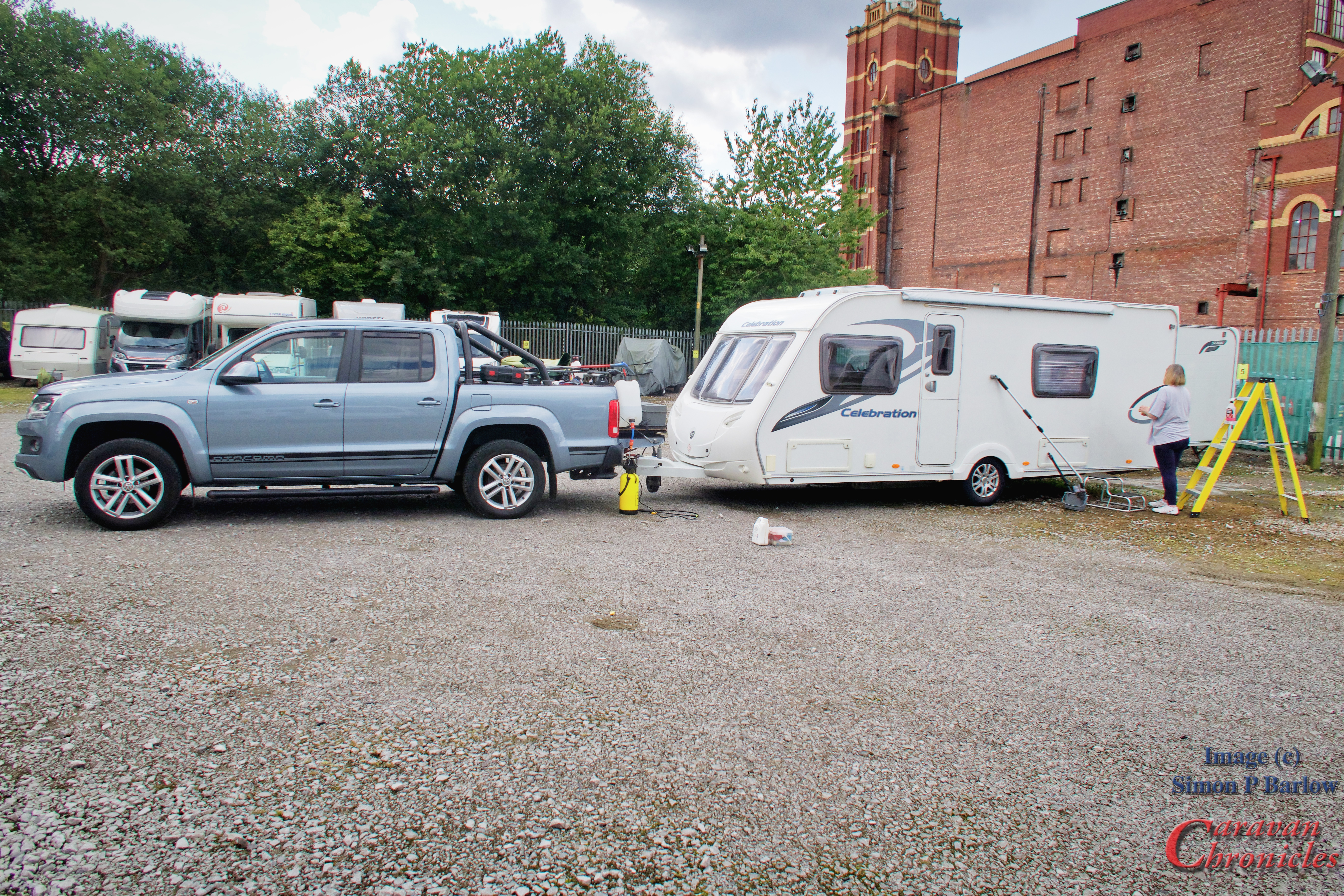
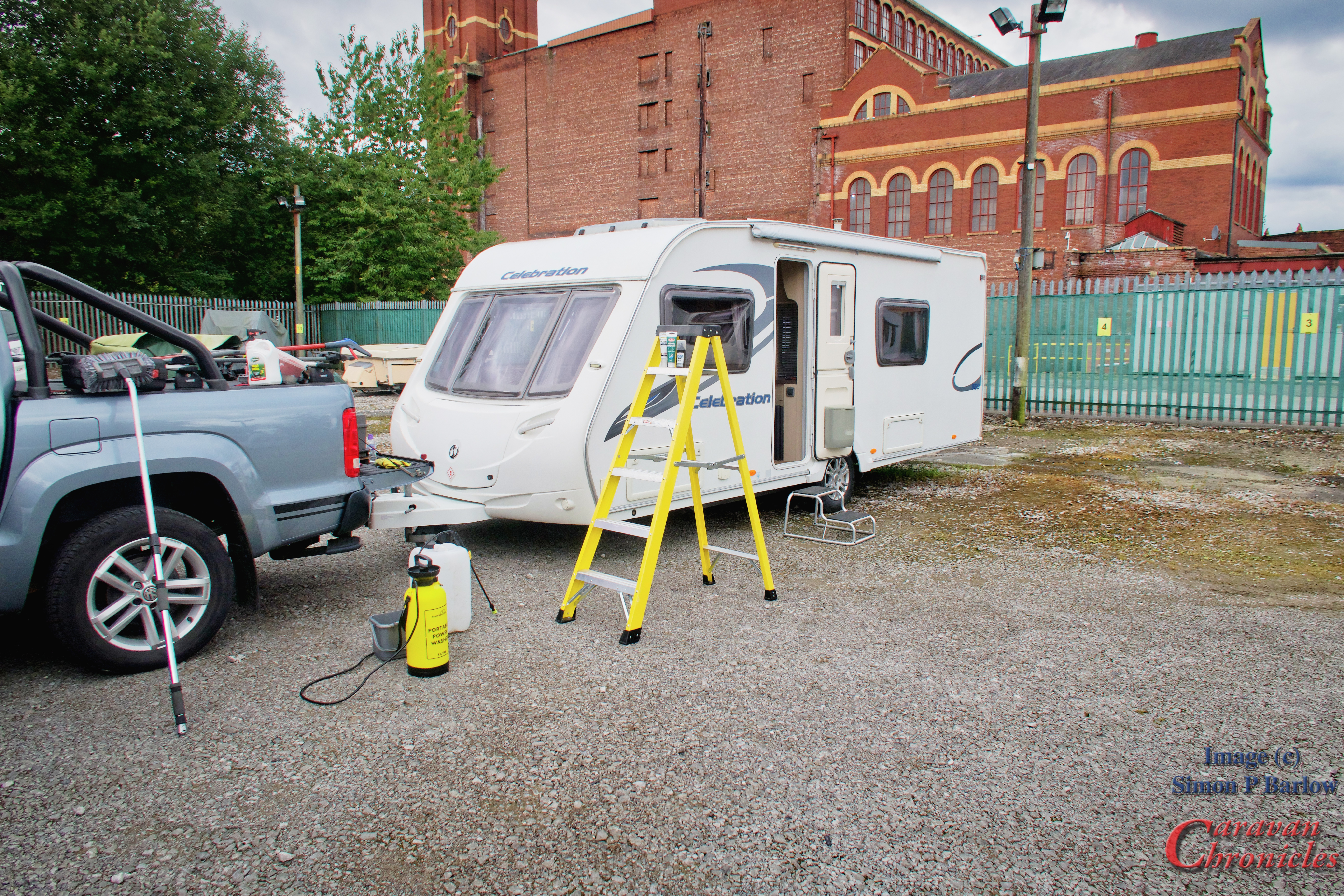
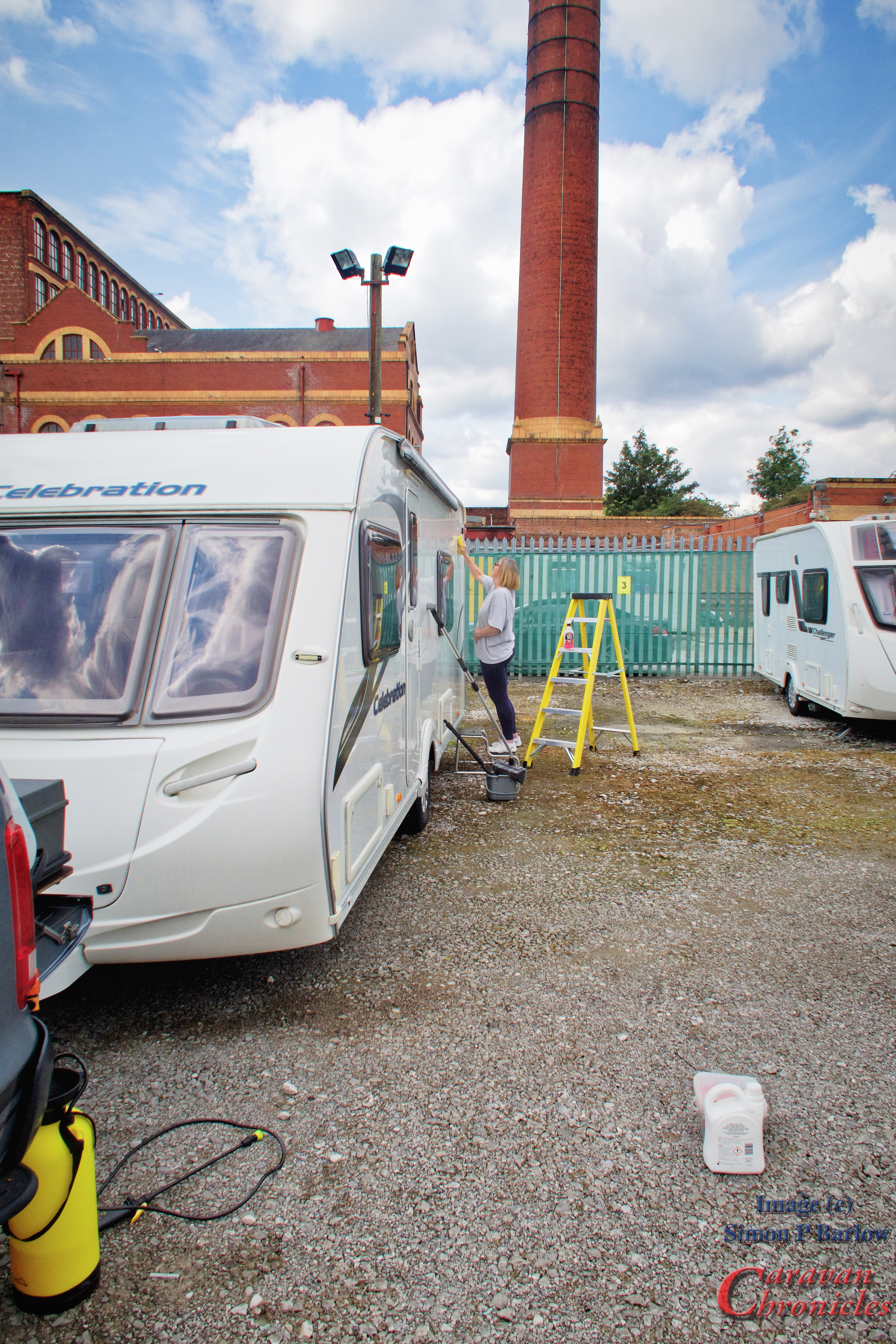
We hitched up the caravan and pulled it forward out of it’s parking spot and set to work. Over the years I’ve tried all the different products for washing the caravan (and cars) ranging from mid priced to the “how bloody much” brands, but in all honesty I have found Morrisons own Wash and Wax Shampoo (It’s bright green) to be really good and it has given me really good results on our 15 year old Freelander, the Amarok and the caravan. A long handled brush for the sides and some small detail brushes for the awning rails and tight places made easy work of the sides. It was all hosed down using one of those pump up pressure washer thingy’s
To rinse I used Car Plan’s Demon Shine (the pink stuff…. also stocked in Morrisons) diluted down in the yellow pump up spray do-hicky. Which works quite effectively. The two products – Morrisons Wash and Wax shampoo and the Demon Shine seem to work together really well and I certainly found that using the two as a shampoo and then as a diluted rinse leave a good water shedding layer on the Amarok that lasts quite a while.
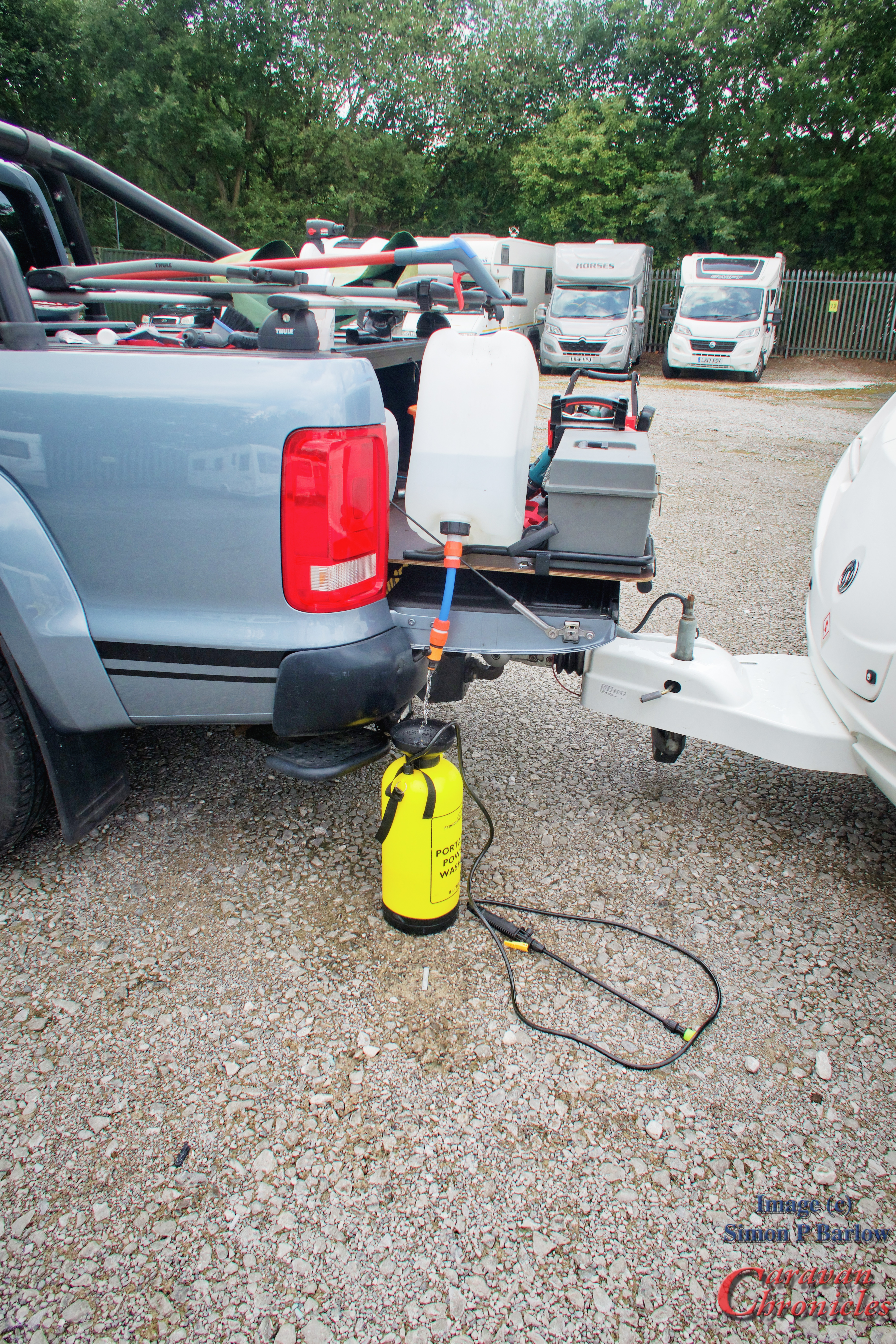
One thing we don’t have at our storage compound is running water. So I have three 25 litre containers that I fill up at home and throw into the back of the Amarok. To save lifting them up to fill buckets…. I fitted a hosepipe connector to one of the lids and all I need to do now is tip the container and open the tap. As there is no venting the sides collapsed inwards a little so tipping it back onto its side from time to time to let air back in means that when the tap is shut nothing can slosh out a vent while travelling.
On this trip we only cleaned and polished the sides… the roof would have to wait for a return visit. Putting the caravan back in it’s spot lead to the next task…. jack it up and remove the wheels. The caravan was fitted with Hankook 185×80 R14 and inspecting them closely revealed no cracks, bulges or damage of any kind. These tyres were now 10 years old it was defiantly time to replace them. We got 8 years use and just over a year standing out of them and I consider that a win. Realistically they should have been replaced at 5 years…. 7 max at a push, so getting 8 out of them with close inspections each trip I’ll consider we got our money’s worth out of them. After much searching on line and checking out the discount with National Tyre via the Caravan and Motorhome Club I called in to my local National Tyre could fit replacements and beat the price even that C & M Club discount gave us with National Tyres on line. As the Hankook’s had given us really good service and long life I replaced them with another set of Hankook’s. National Tyres also fitted new valve stems, valves and balanced the wheels. I know there is a lot of debate about balancing caravan wheels…. well the engineering bit of my brain thinks that anything rotating should be in balance, so I’m going to balance my wheels. We picked the newly re-shod wheels up the following day and returned to the compound to fit them. As it was raining, cleaning the roof was put off until we had better weather.
OK…. I know… you are all saying “Why did he clean the sides before the roof….. that’s bass acwards” OK here is my thinking…. the roof is going to take a few hours to do properly and when you have done that you then have no choice but to do the sides straight away as they are going to be really filthy with all the run off. It’s going to be a really long day to do everything. By doing the sides first, we could get a good layer of wax protection on them and as said earlier, the combination of products give a really good beading coat. So when it comes to washing the roof a simple rinse down would restore the sides back to their pristine finish we had a few days earlier.
As I worked round the roof scrubbing and rinsing, Sue followed me with a squirt bottle and microfibre cloths… using the Car Plan Demon Shine neat finished off the sides and gave another layer of buffed waxy finish.
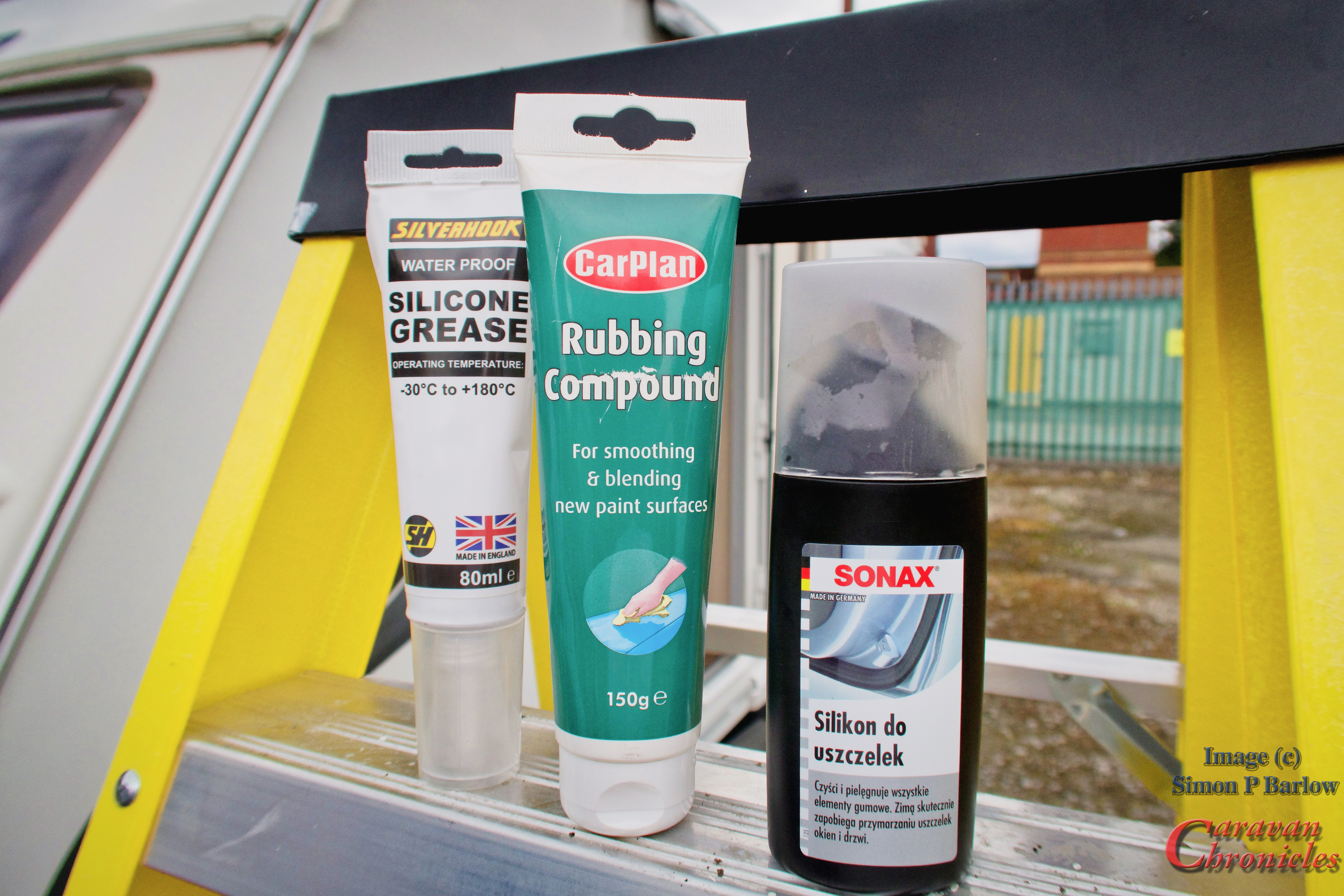
A few other jobs were completed too. All the window and door rubbers were given a good coating of Sonax Silicon… this stops the windows sticking to the rubber and keeps the rubber seals soft and supple. Some of the aluminium awning rail needed cleaning. Rather than use a metal polish (Solvol-Autosol is my normal preference as a metal polish) I used a simple rubbing compound so as not to polish the aluminium too much but brighten it’s brushed finish. And finally waterproof silicone grease for the moving and interlocking parts of the 13 pin plug.
What next?…
I mentioned earlier that our leisure battery had died… well after some tender loving care in the workshop… It’s alive! Well it’s OK for light duty. So the next project is to go lithium. I have planned out a course of action and the first step is to install on the Amarok a 50 Amp feed to the rear of the vehicle and terminate in an Anderson connector. This will allow me to use the full capability of the Amarok’s large alternator to charge Lithium batteries in the caravan via a dedicated DC to DC charger. Next stage will be installing a solar regulator and panels followed up by an inverter and changing the on board charger for a dedicated lithium charger. I also want to remove the inbuilt charger to save weight and make room as I won’t be installing any lithium batteries in the existing battery box.
I’m still in the process of doing my due diligence on equipment for this so watch this space. I’ll go through my thought processes in a later post.
The other change is going to be the rear lights on the caravan. The reversing lights are not very useful when reversing on to a pitch in the dark so I’m going to install two LED wide beam lights just out board of the rear steadies. That leaves me with the existing reversing lights. A quick search on the internet led me to replacement Hella lenses for the existing reversing lights that would allow me to convert them into fog lights with a simple lens change and a wiring change at the fuse block. Swop the reversing light cable with the fog light cable and use the old fog light as a connection point for the new reversing lights… after removing the bulb of course!
I guess this is going to be a bit of a catch up! It’s been about 16 months since I posted anything, I kinda guessed that with everything going on my blog was not on the top of peoples reading lists. That said, I have been pleasantly surprised that the daily and weekly page hits have stayed fairly constant all the way through this and the number of comments and emails has over the last few months started to increase as more people are finding the blog and asking techie questions or trying to problem solve issues. While some you-tube channels have struggled producing the usual relevant quality content that the you-tube algorithm demands to keep them in the ratings… we seemed to have faired OK.
…And a big thanks to everyone that has used links in the Caravan Chronicles Amazon Shop page… you have covered last year and this year’s WordPress costs for hosting the blog and also allows me to increase the amount of space I have available for all the drawings and pictures… I was starting to get close to my limit!
While we are on the subject of emails… thanks to everyone just simply checking in to see if we were OK as I hadn’t posted anything. We are both fine, both had our infusion of Pfizer…. twice and have shown no symptoms of anything. We do mask up and probably will continue to do so for the moment.
On a sad note, on the first of March our chief safety officer Oscar (19/10/09-1/3/21) passed away. Oscar was a quiet cat and always happy to let his brother be the one to get into trouble first while he watched on… with those blue eyes.
Henry his brother from the same litter misses him even now. Oscar was always the one to settle down for a nap first and Henry would go and snuggle down with Oscar. Now if you open a door or cupboard Henry is there just to see if Oscar was trapped and we have found him and very vocal when he discovers Oscar isn’t there.
We decided that rather than leave Henry on his own with a cat-sitter (our usual cat sitter has retired too, so that made this decision for us really) when we are away in the caravan we are now going to bring Henry with us. This is going to be a whole new adventure for us all… the only journeys Henry has done in a car have been the usual check-up’s at the V… E… T… so getting him into a carrier for a journey is going to be interesting… along with how he’s going to react to the caravan. We tried him on a harness for the first time today and it wasn’t as bad as it could have been. At least he walked round and went outside and didn’t just collapse as an immovable furry blob on the floor.
Henry (right) and Oscar (left)… inseparable since birth.
A number of people have asked the same thing….
Over the last 12 months a number of people have had similar thoughts but more recently some friends of ours asked the same question…. “What do you know about setting up a storage site?“
This has generally gone along the lines of me chipping in a bit of info that generally starts with “Not much really…..” and after passing on my 15 seconds of knowledge remembering much later that I might have missed telling them something vital. So when a friend of ours was asking, I decided to commit my vast knowledge of information on the subject to a web page and you can find it on the drop down menu link above… hover your mouse over “Help Guides” and it should appear… or you can always click on this: Storage Sites and have a read. You won’t need to put the kettle on as it won’t take long but at least now I have somewhere to point people to when they start out with ” I have been thinking of setting up a caravan storage site… what do you know about it?“
So what’s next?
Well a major service on the caravan which will include new tyres and probably a new leisure battery. I’m just looking at options for going over to lithium, there are some ‘drop in’ replacements that include battery management and the price is starting to get within reach. One other thing I’d like to look at is maybe replacing the fridge for a compressor type… if we go the lithium route. Not sure if it will be 12 volt or 230 volt via a small inverter. I’m working on the options and costs.
What have I been up to?
Well answering a LOT of emails. There is obviously a lot of new people taking up caravanning, camper vanning and motor homing which is absolutely fantastic for the industry although reports of fully booked sites and on the horizon long delays on new caravans and motorhome delivery…. not so good.
I’ve also been using something called EZ Hot Spot extender from EZ WiFi. Simply calling it a hot spot extender is not doing it justice… it is much much more and allows me to have a full WiFi routing internet, TV and network storage from a simple box that connects to an existing WiFi network or as I have done via a MiFi unit. I can even connect my printer to it and have network printing all from a small box that can be powered directly from a 12 volt socket. It’s that good… you could have a zoom meeting from the back of your motorhome while someone is driving it down the road! Now that is what I call a mobile office! I’m going to do a full review in the next couple of days.
Wrapping up…
We have both been fine and getting a lot of DIY projects completed and hopefully after the school holidays have finished will be back on the road again… this time with a very loud Siamese cat…. apologies now incase you are on a pitch within earshot.
Something that caught my eye a couple of days ago really got me excited…. no not a new caravan ( I wish) but a Kickstarter project that I think is one of those simple ideas that has countless applications in all sorts of areas. In fact I keep thinking of more uses for it… and it’s not even my idea!
OK, so what has got me all worked up then? Well imagine getting messages direct to your email or phone telling you the voltage of your leisure battery, motorhome starter battery, canal boat battery, ATV battery, bike battery, solar powered shed battery, aircraft battery, golf cart battery, horse box battery or trailer winch battery. All from a little device that can simply be clipped on or permanently installed. Got you curious?
The company has recently been at the Scottish Caravan and Motorhome Show where they received lots of interest and loads of positive feedback. Still curious?
OK here the disclaimer thingy bit for Caravan Chronicles: I have no connection to these guys except I decided to back the project on Kickstarter. I have taken all the text and images below from IonOT’s kickstarter project page…
If you want to see the full project, follow the link toBatbot and see what you think.
Invented in Scotland by David Richie, Batbot came about from wearing two hats – one, from a career working in the technology sector, and the other, as a livery yard owner. With horse lorries stored on site in between use, he noticed a regular problem occurring. On the day of an outing, more often than not, there would be an early morning knock at the door from liveries needing help… their vehicle battery was indeed… flat.
They had walked past their lorry every day, but had no idea that the battery was running low. This sparked an idea. Wouldn’t it be great if there was a device that could avoid this problem?! Batbot was born. After many hours, days, weeks and months developing the concept and prototypes, here we are today, with a brand new product that will ensure flat batteries (and early morning wake up calls) are a thing of the past.
Batbot is a device that every equestrian, marine enthusiast, motorhome or vehicle owner has missed… until now.
This clever product monitors your vehicle’s battery and sends alerts to your mobile device or email when the battery requires charging.
How it works
Batbot simply hooks up via two croc clips (provided) to the battery points under your vehicles bonet and can be secured in place with a cable tie.
Once installed the device then sends your battery’s data to the cloud where alerts are generated and then sent to your mobile device or email address. Unlike other products, Batbot uses the Sigfox or LoRaWAN radio networks to send this data, so no bluetooth connection is required.
Key Benefits of Batbot:
Quick and easy to use
Keeps track of your battery state
Alerts you when action is required
Saves destroying batteries with deep discharge
Regular daily “All Ok” status for peace of mind
No monthly SIM contract
First year subscription included
Low further yearly subscription (£7 ~ £10)
Chose Sigfox or LoRaWAN version of product
LoRaWAN has Home Gateway option to provide cover in remote areas
Helps identify when your battery or vehicle has an electrical fault.
Avoids the vehicle not starting when needed for emergency or planned use
Save’s garage call out charges to jump start your vehicle
24V lorries can be difficult to find a suitable jump start source for, or require a garage call out. Batbot helps you avoid this problem
For all the details and to see the full project go and visit the Batbot Kickstarter page and maybe you too might want to invest a few beer tokens.
My email box tends to get a wide variety of questions covering all sorts of subjects. The most frequent one is to do with wiring and electrically related problems. Sometimes trying to diagnose issues via email and a few photos is a bit of a challenge, but hey who doesn’t like a challenge! One thing that I do see a lot of is electrical work that is…. well, quite frankly not up to scratch in my opinion. So here is my attempt at a basic guide.
So many projects start by adding one or two things… extra 12 volt outlet here… maybe another light and then something else comes along that needs adding in. Before you know it you have a mess of spaghetti that the local Italian restaurant would be ashamed of. It is all too easy to fall into the trap of adding circuits to existing fuses…. or installing a new fuse and a few weeks later adding another circuit to it as it’s easier than installing another fuse.
Start with a plan…
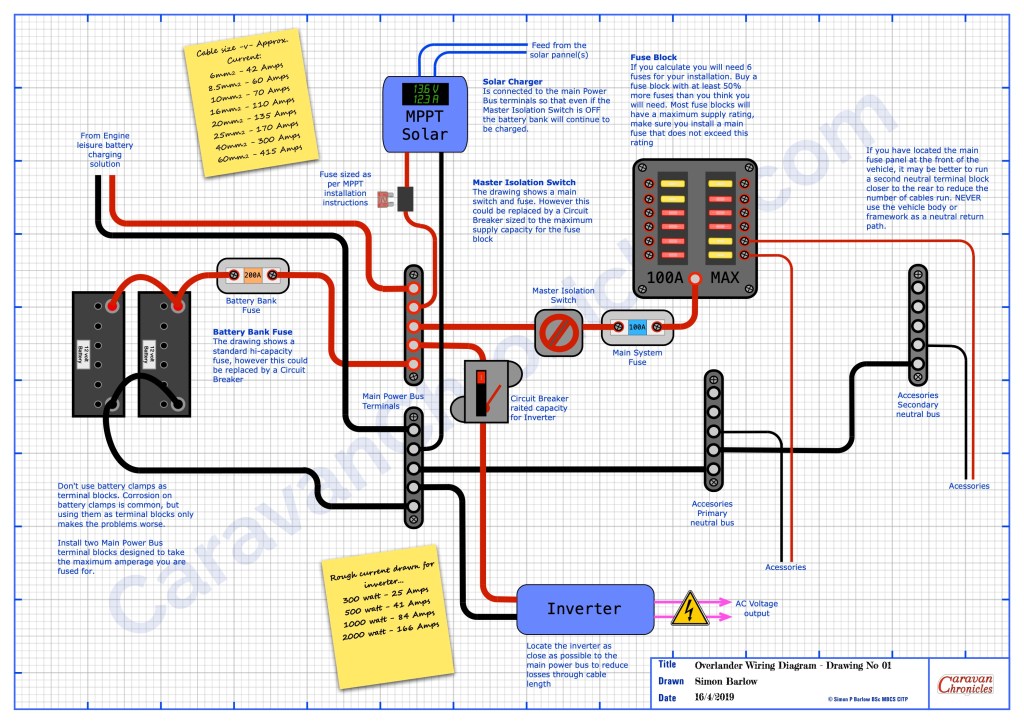
You can download these and other drawings from the Electrical Drawings page in the drop down menu under “Document Library”
You need to draw out how the major elements are going to connect together – leisure batteries, solar charger, DC to DC charger, inverter and include all the big fuses, buss bars and fuse box. Don’t think about where any of this goes for the moment just get the basic layout and how everything interconnects worked out. It might take a few goes but paper is usually cheaper and less frustrating than sorting out the mess afterwards.
Once you have all that figured out you can start working on the details… just how many fuses will be needed… and what ever number you come up with add half as many again as a minimum. Having a few spare fuse positions that maybe never used is way cheaper than in twelve months time having to install an additional fuse box. A this point you can start adding details…. what size cable is needed for each link, what sort of fuse box do you need.
You can also now start to think about specific facilities you might need. For example, many overlander vehicles will have a button on the dash that when pressed and held down activates a high current relay that links the house batteries to the engine cranking battery. Very handy to have… jump leads are not much use if you are 200Km from the nearest vehicle. If your only trip ‘off road’ however is the muddy car park at the local car boot sale than maybe not a priority.
Don’t use the vehicle chassis as a ground.
Modern vehicles are constructed using different materials and quite often panels and sub frames are glued together. Back when virtually all the panels were spot or seam welded steel, using the body and chassis as a ‘ground’…. which really isn’t a ground but the neutral return path… this was acceptable. However now, sections can be glued together and are often sub assemblies of aluminium and other light weight materials bonded together. Just because you see a neutral bonding point (earth terminal) don’t assume this is is capable of being a suitable point to bond the neutral side of a circuit or accessory you are installing. Modern vehicles often have small bonding straps between sections that can carry the current that the vehicle manufacturer rated the bonding point for. Adding additional equipment and accessories might exceed the original design spec.
I did see a spectacular failure due to a 3000W inverter having it’s neutral lead ‘grounded’ in the rear of a vehicle. Running at about 2000W the neutral side was trying to ‘return’ a current of about 170 amps through the body of the vehicle, which lead to serious damage to some of the vehicles wiring and a number of vehicle components… and a ‘repair’ bill of nearly £1500.Putting a riv-nut in a body panel that is mastic bonded to the body is not a suitable negative bonding point!
Additionally a number of vehicle circuits are now negative switching or operation and installing additional equipment or accessories could have unforeseen issues. Always from any accessory or piece of equipment you install, add the neutral return path back to a suitable single common point or buss bar you install for the purpose and connect this directly back to the leisure battery.
Ideally all the ancillary leisure circuits should never rely on any of the vehicle wiring and the negative side of the leisure wiring should only ever connect to the negative side of the leisure battery.
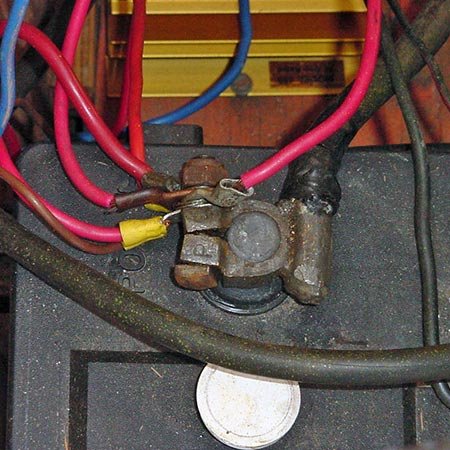
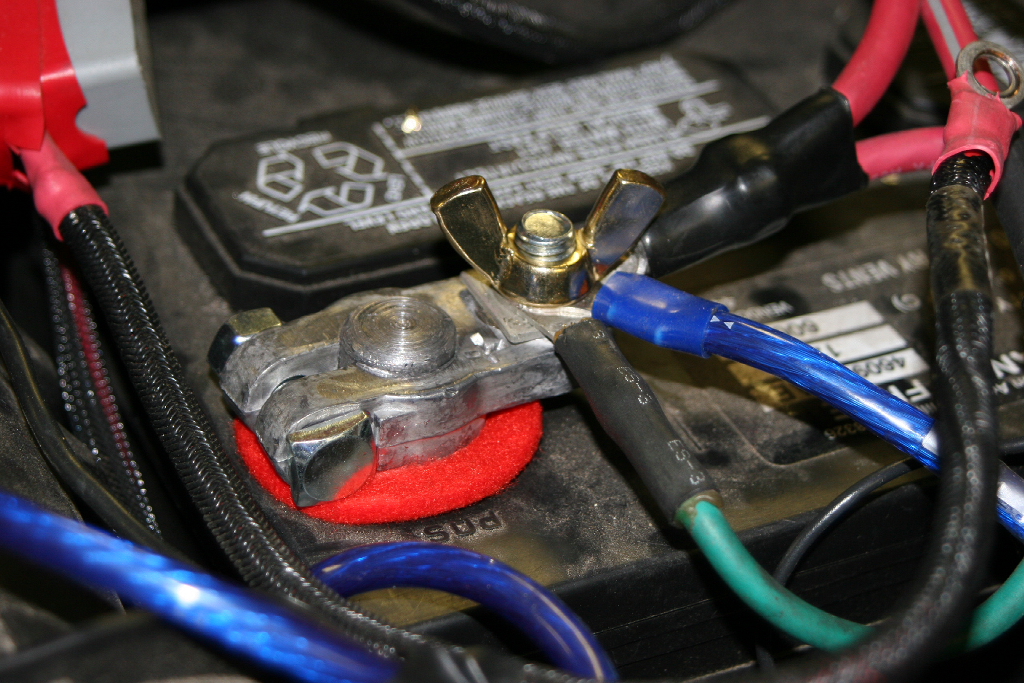
Don’t use battery terminals as a junction post.
Both the leisure battery and engine battery should only have connections that lead to either in the case of the positive terminal a master fuse /circuit breaker and isolator switch. The negative terminal should only have the connection to a master negative terminal point or buss bar.
Nope…..Not OK…. it’s a terminal not a junction post (image from the Internet)
If you want to install any sort of battery monitoring, it is convention to install the shunt on the negative return to the battery between the negative buss bar and the negative battery terminal. If you have multiple circuits terminated on the battery terminal it makes future changes and upgrades, including installing a battery monitor very difficult.
Just NO! (image from the Internet)
Using the battery terminals as connection points for multiple services also makes fault finding very difficult. Each circuit may or may not have it’s own fuse and it’s difficult to isolate circuits….. plus I’ve had enough sparks flying round when trying to disconnect a battery because someone did not install an isolator to know that it’s only a matter of time before one goes ‘pop’.
Just because it’s shiny…. NO!!! Not OK (image from the Internet)
Please, just don’t do it.
Have a think on this. If you had to go to an auto electrician to get a fault traced and corrected, they would immediately put at least an hours time on the invoice just to figure out what was going on with all the cables on the battery. Also, If you don’t have a battery master isolator installed, get one installed now. It’s a safety item that must not be missed out. Having the ability to quickly turn off all the leisure circuits in an emergency might just save you from the unthinkable happening.
Cable Termination
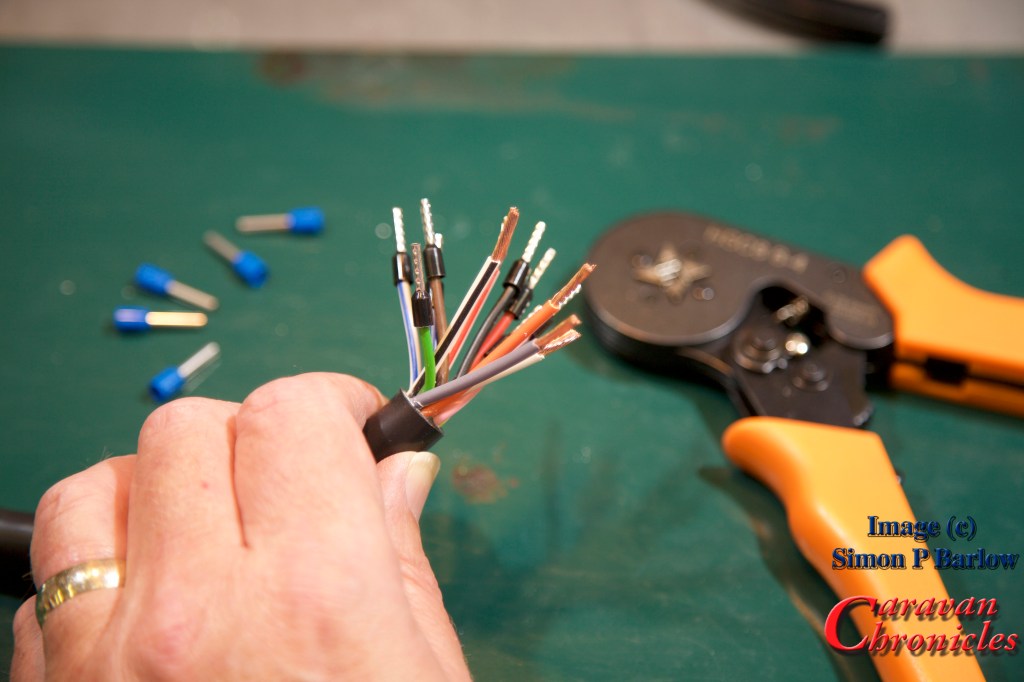
Every cable should be terminated. Period. There shouldn’t be any cables in an installation that don’t have a crimped (or soldered) termination. Even if it’s a screw terminal such as those found in joining blocks or 13 pin plugs.
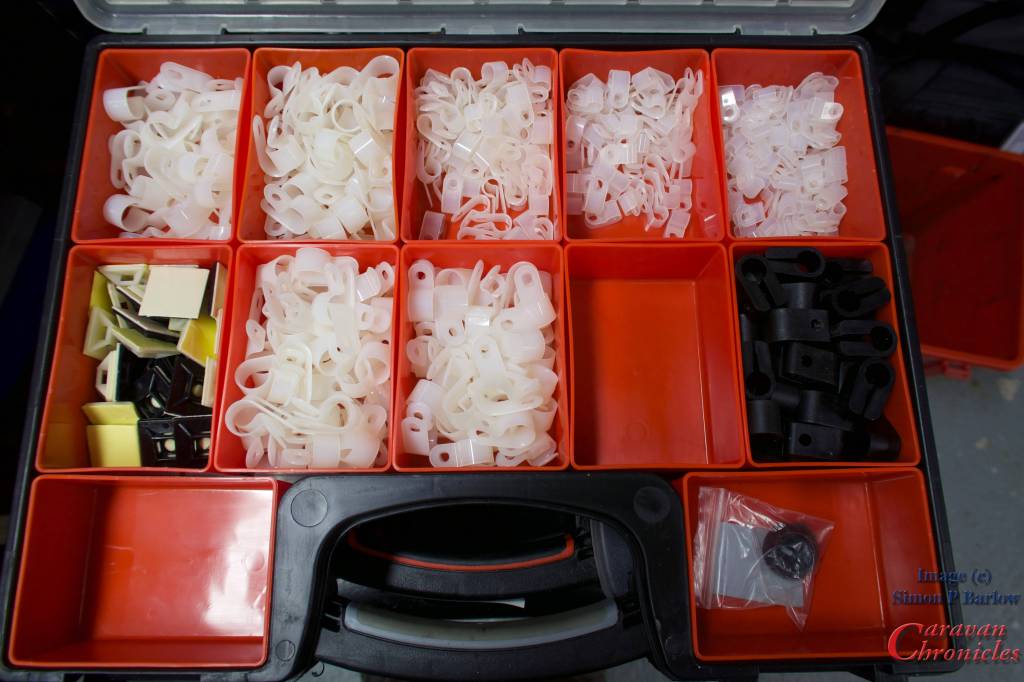
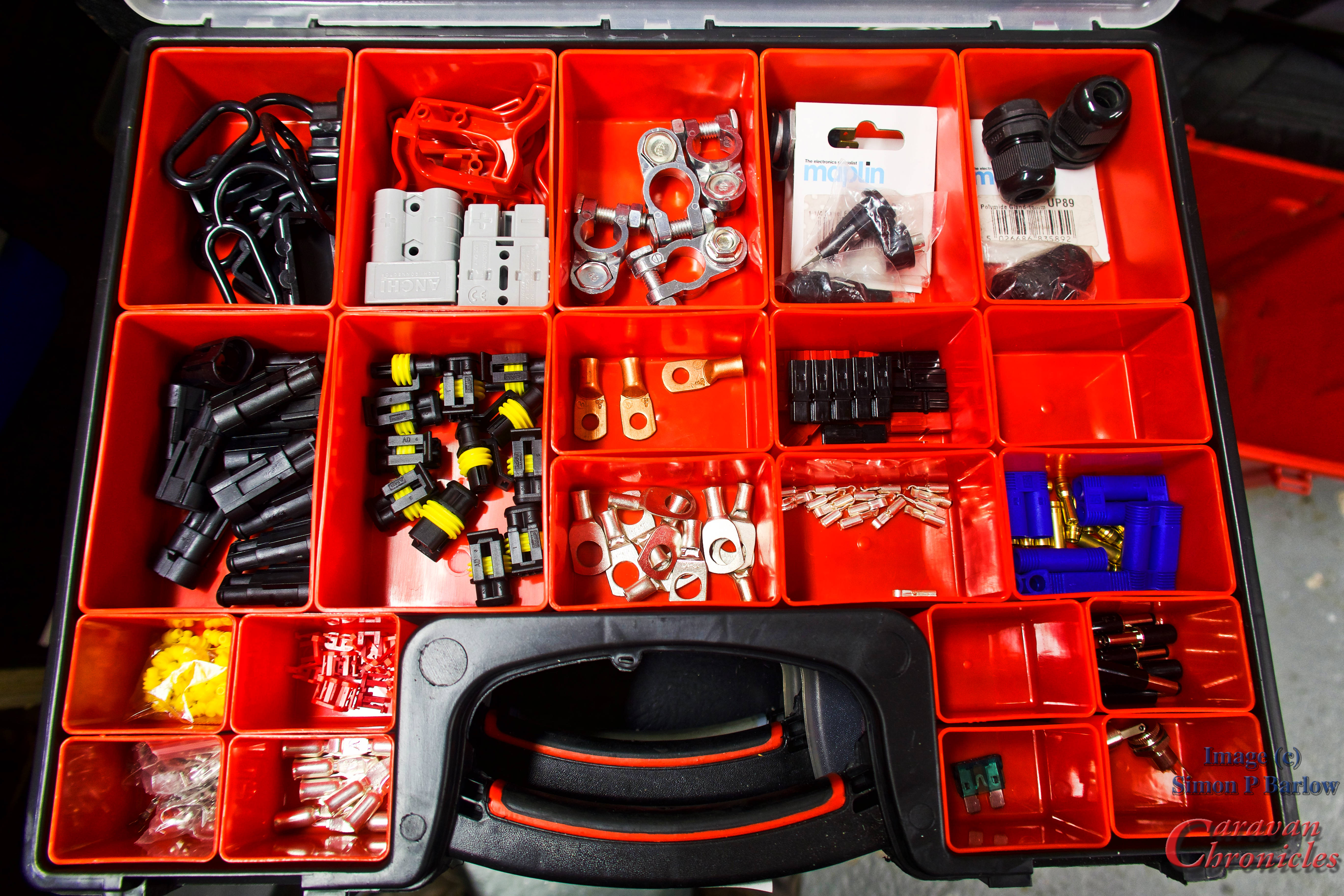
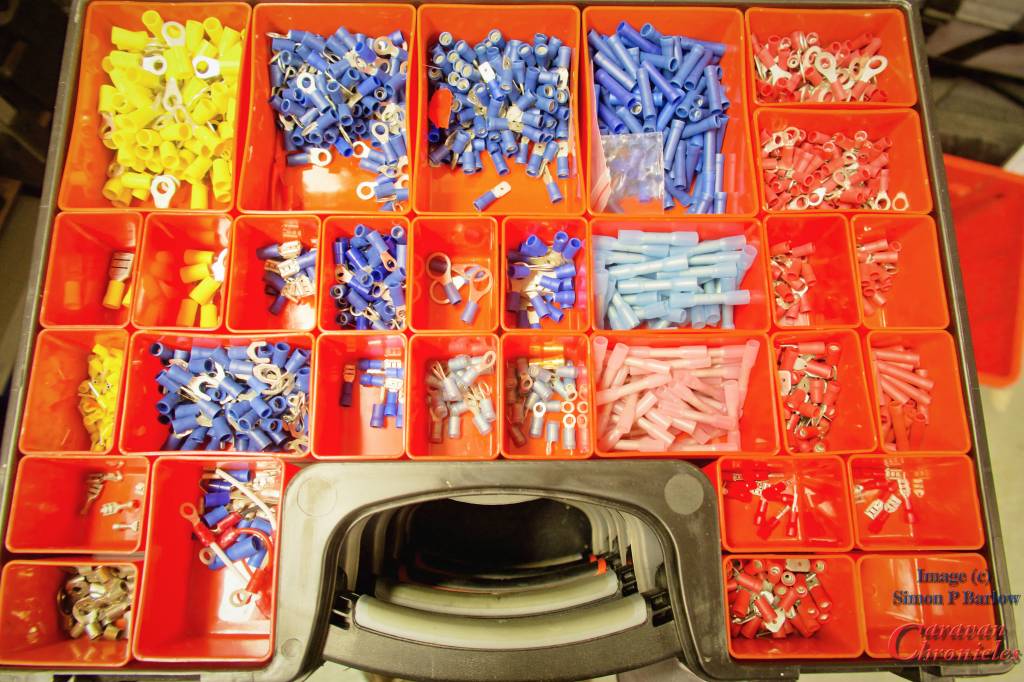
If you are embarking on a wiring project, its always best to start building up your stock of terminals. I usually buy selection boxes of terminals on line and supplement these with bags of single type connectors for the more commonly used ones. To keep everything organised tote organiser boxes are my preferred option.
A few of the 20+ of my storage boxes with wiring components
There is nothing more annoying than running out of the something and its always just as you want to finish a project off so you end up cutting corners.
For some of the larger cables, if you don’t feel up to making your own terminations there is usually a local auto electrician available that will terminate them for you for a small charge. However, a crimping tool that will terminate up to 50mm cable is not that expensive – around £27 and will probably work out cheaper in the long run. I’ve a link to the one I bought via Amazon and regularly use in the SHOP page.
Get the size right…
Selecting the right size or gauge of cable is critical. There are two factors that determine what gauge of cable to use for a installing any particular circuit. The maximum current that’s going to be drawn and the length of the cable. Once you have selected the right size cable then means you can select the right size fuse for the circuit. Never fuse a circuit greater than the current capacity of the cable.
Handy wall chart of cable size and terminal sizes.
You can download these and other drawings from the Electrical Drawings page in the drop down menu under “Document Library”
I generally tend to list what is going to be installed, then work out all the gauge for the cables for the circuits. From there it’s easy to see which is going to be the most popular gauge and rather than buy several different gauges of cable try to select a limited selection of gauges.
Always go for the safe option of over specifying the gauge of cable for any particular circuit. If it’s a 10 amp circuit and you have used cable suitable for a 16 amp circuit, it doesn’t mean however you need to use a fuse greater than the 10 Amp circuit requires.
Something else to consider too. Most 12 volt cables are copper, however if you are installing them in a less than ideal environment, such as a boat, you may want to opt for tinned copper cables. These are far less susceptible to cable corrosion. Even in the best marine installations I’ve seen copper cables corrode through in less than a couple of years.
Cardinal Sin! – Never ever use two smaller cables to make up the equivalent of one larger capacity cable. You would be surprised how many times I’ve seen this… sometimes done by “professional” tow-bar installers when reported poor leisure battery charing or poor fridge performance is reported and the voltage drop is too great.
Wiring Looms – wrapping it up properly!
Dressing cables into looms is not difficult nowadays. There are many options available on the market to help you produce a professional looking finished product. I personally like for looms within the vehicle using a felt finished looming tape. You don’t wrap it so it overlaps but at a sharp enough angle so as it spirals round the cable bunch it leaves some of the cables exposed.
Felt is good as not only does it keep the loom together, it allows quite a bit of flexibility and prevents cables from rubbing or banging on flat surfaces making a noise.
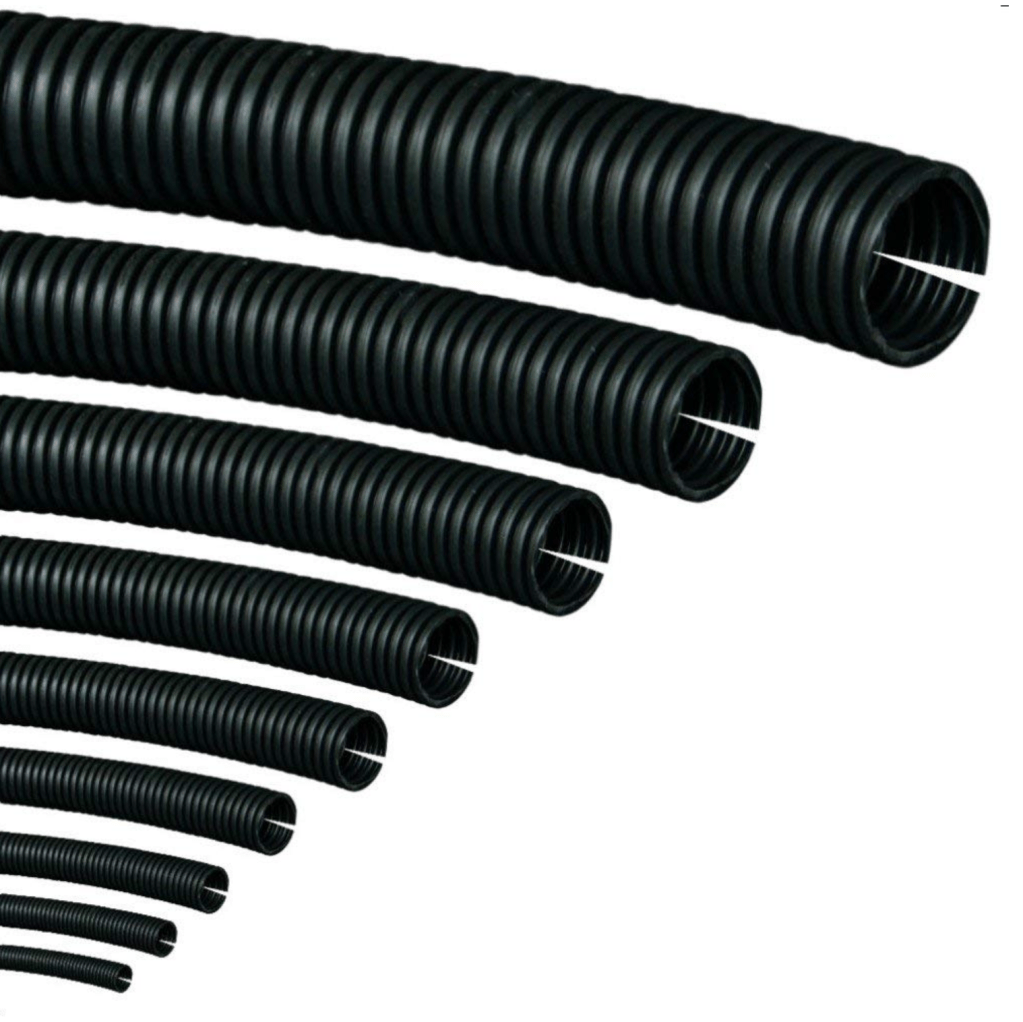
For any cables outside the vehicle body there are two options depending on use. In the main I’d go for split tube conduit. It’s available in various sizes and can be bought in either cut lengths or rolls. The other option is to use self amalgamating tape. It looks like ordinary PVC tape but as you wrap it round you stretch it and it releases a chemical which when overlapped onto its self becomes a permanent bond, effectively making a sealed tube. It is generally however fairly inflexible. Both have their place.
Anything in the engine bay or underneath the vehicle I use split tube and generally only resort to self amalgamating tape to seal inline joints.
Relays….. yes or no?
For me its Yes. I much prefer locating all the relays in one place therefore minimising the amount of heavy cable. By using relays to do the heavy switching you can use smaller and sometimes more attractive switches. I have in the past used 7 core trailer cable to connect 4 switches including LED indicators back to a relay bank rather than make up a custom wrapped loom.
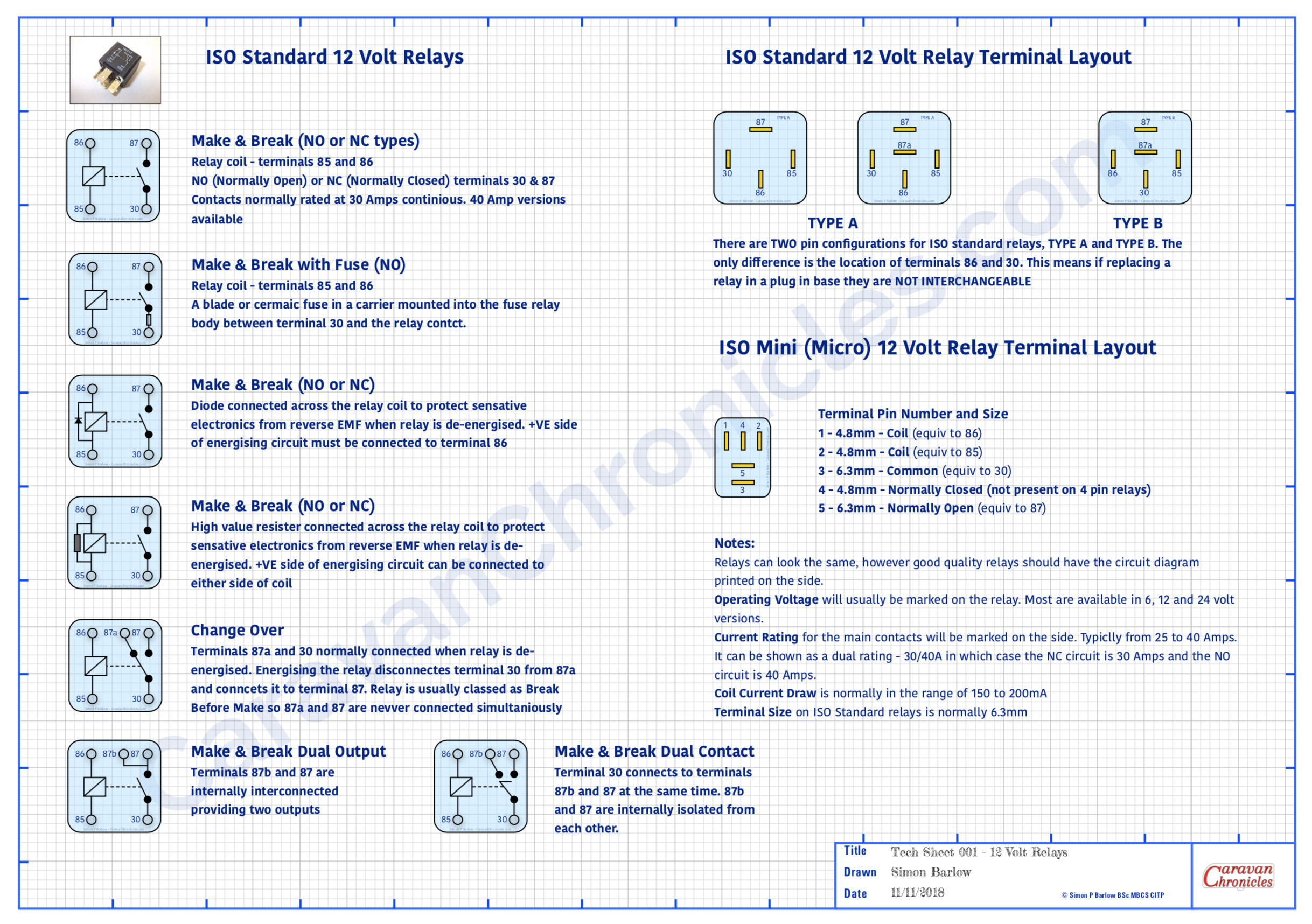
Handy wall chart of relay types
You can download these and other drawings from the Electrical Drawings page in the drop down menu under “Document Library”
It also makes tracing faults easier, as it’s simple to test if a switch is working, you can hear or sometimes feel the relay operating as you operate the switch. Its unusual to have a fault with a relay but quite simple to test… just unplug and swop over with a known working relay. If all the relays are located together it makes this task and testing the feed to the relays so much simpler. From that point all you need to check are the two wires going out to the device and the device itself.
Obviously some circuits don’t require a relay or if it’s designed to be turned on for a long period… such as a diesel heater, then adding a relay will just increase current draw, albeit small, on the leisure battery. A bit of common sense can easily determine if you should opt for a relay or not.
Grommet?…(no not Wallace’s friend!)
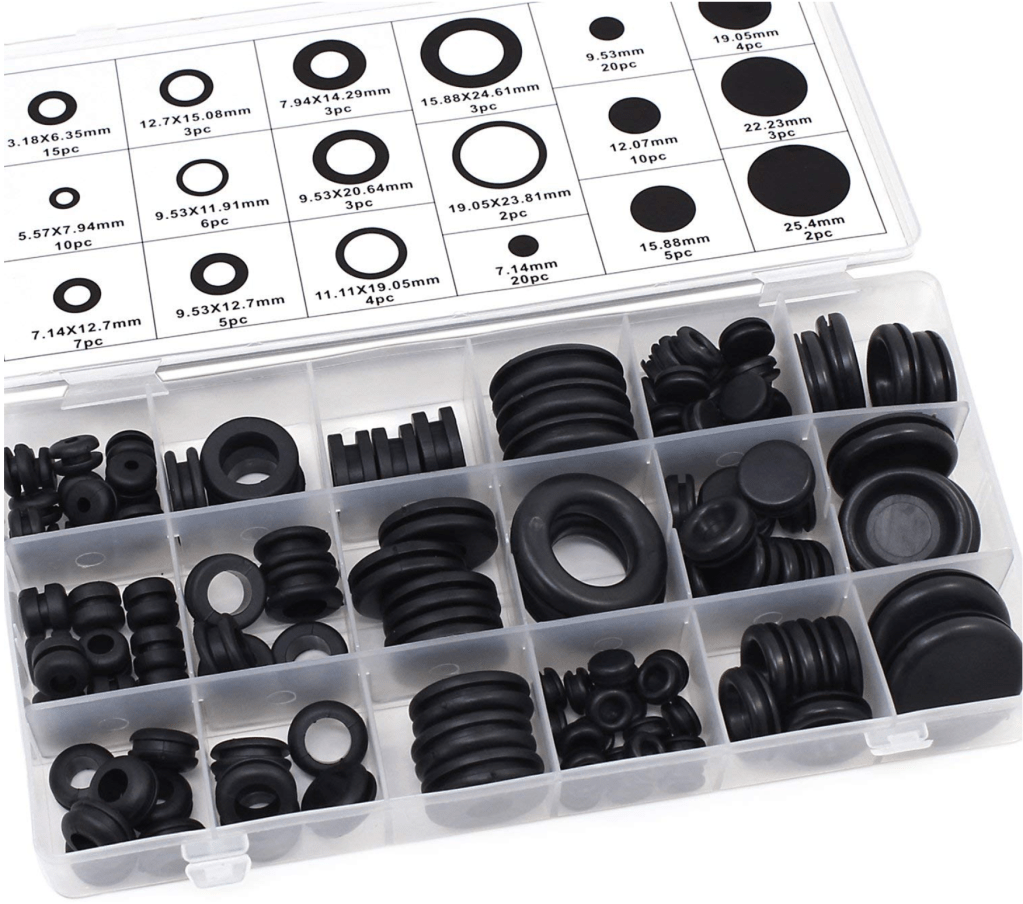
Whenever a cable or cables pass through anything solid you should use a grommet. You would be surprised at the amount of damage I’ve seen to cables due to either not installing a grommet to an insufficiently sized (too small usually) grommet.
When ever I pass either a cable or loom through a bulkhead for example I like to supplement a grommet with a bit of heat shrink sleeving over the cable as well. Even passing a cable through an existing grommet from the engine compartment to the interior, adding a length of heat shrink sleeve won’t do any harm.
There’s a link to these in the SHOP… only about £7 for the full box.
Having a handy selection of grommets available before you start threading wires through is far better than trying to install protection afterwards. You’d also be surprised at how many cables I come across that have been damaged while pulling through holes in metal and wood panels. Always better to start with a grommet or two! Where a cable or loom passes through a grommet, it’s aways best practice to try and anchor the cable or loom either side of the grommet to something solid using “P” clips. This will reduce the chances of ‘fretting’ with the movement of the vehicle.
While we are on grommets…. a quick note about cable-ties (zip-ties). Stop doing them up so tight! I’ve come across cables cable-tied to a chassis rail so tight that the cable-tie has cut into the insulation and is fretting the conductor inside. Cable-ties are generally made out of a harder plastic than the cable insulation so will over time wear away at the insulation.
Get yourself a cable-tie tool that not only allows you to precisely control how much tension you put on the tie but also cut the end off so that there isn’t a wrist slashing booby trap lying in wait for some unsuspecting person. I use a fairly cheap pair (left). I think they were around £8. So not really expensive. But they make a nice neat job of installing multiple cable ties with the correct tension and the ends cut cleanly off level with the lock tab. You can buy ones that have a tension dial built in so you can set them to a pre-tension, but I find after a bit you know just how much to squeeze the handles to get the correct tension.
So what is the correct tension… well if you are doing them up so tight an elephant could dangle on the cables then that is too tight. They should be tight enough so as not to slip but you should be able to spin them round the cable(s).
Cable-ties really should not be used to make looms or anchor cables or looms to anything solid. If you want to make a loom, wrap it in specialist loom tape. If you want to anchor cable or a loom to something solid use a “P” clip. If required… use a length of heat shrink to make the loom a tighter fit in the ‘P’ clip.
I know you are dying to ask…. when do I use cable-ties? Well generally at the installation stage to get things to stay in place before installing P clips or if I have to run a new loom along the same path as an existing loom, I generally opt for cable-ties to hold them both together (as long as the original is suitably anchored to support both)
While we are talking abut cable-ties… I have seen the worst kind of mistakes in the use of them. It is not OK to cable-tie anything to brake lines, fuel lines, vacuum lines, hydraulic hoses, coolant hoses or steering components (yep one bright spark cable-tied his front LED light bar wires to some of the steering components!)
Heat Shrink Tubing
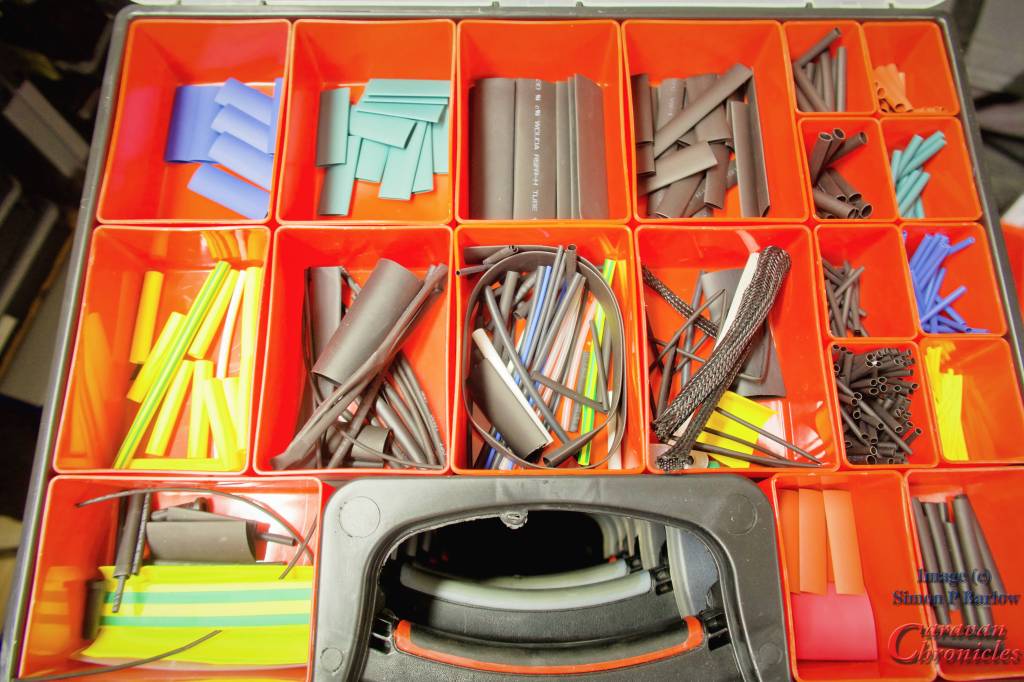
An absolute must have in my opinion. There are two main types – plain and pre glued. The plain are the main one you would use, while the pre glued are great if you have to over sleeve a connection to make it waterproof. As you heat up the pre-glued type, the glue softens as the tube strings and bonds to the cable as everything cools. They can be a little more rigid when installed, so make a service loop in the cable. The finished covering is usually waterproof enough for brief submersion if done correctly.
Having a selection of sizes and colours is handy and assortment boxes of multiple sizes and colours can be bought on line cheaply enough. In the workshop I use an old paint stripper heat gun on low power as I find that is more controllable than a flame.
Bridging the gap… something in the future?
Although not so common in the UK, in Australia and the USA wild camping (boon docking) is probably as popular as campsites. To this end trailers and caravans usually have much larger battery capacities than anything found in Europe. It’s not uncommon to find outfits with 600 to 800Ah battery banks recharged mainly be solar, buy increasingly (especially in Australia) an additional bridge between tow vehicle and trailer is made using heavy duty “Anderson” connectors and cables capable of supplying upwards of 60 Amps from the vehicle to the leisure battery bank.
With the cost of lithium batteries reducing almost daily, I can foresee very soon that light weight lithium batteries will be installed in caravans. The down side of this currently and trying to retrofit Lithium is the existing charging setup of current European vans is not really suitable for looking after these type of batteries. We have a Sterling Power Wildside unit installed in our caravan which allows us to charge any type of battery chemistry, including lithium when connected to the tow vehicle. The draw back is the caravan’s inbuilt charger is only capable of wet lead acid or AGM. I think that a high capacity DC to DC charger installed in the vehicle and an additional cable to supply the caravans battery banks may not be too far away. It’s something you might want to keep in mind for the future. It’s something I’m looking into currently.
Well, that’s a bit longer than I anticipated and there is still a few things to cover. If you made it this far…. take a toffee out of the jar… well done! If you think I missed something or would like me to cover something specific, drop me a comment below.
As Christmas draws ever closer, both Sue and I would like to wish you all a Merry Christmas… or Happy Holiday….. or Happy Hanukkah, or what ever festival you celebrate this time of year.
Whether you are away in your caravan or motorhome celebrating the season or at home planning family memories to be made next year we both wish you safe travels.
We will next be out and about for the Caravan & Motorhome Show 2020 at Event City. I will be there on Thursday 16th January for the opening – hopefully with Sue too, and the show is on through to Sunday 19th January 2020. Don’t be shy and say “Hello”…. it doesn’t have to be an Andrew Ditton “Hellooo”…. honest.
Back at the start of July we had an invitation to travel up north to visit Erwin Hymer Group at their manufacturing facility in Consett, County Durham for the first look at the 2020 caravans and motorhomes.
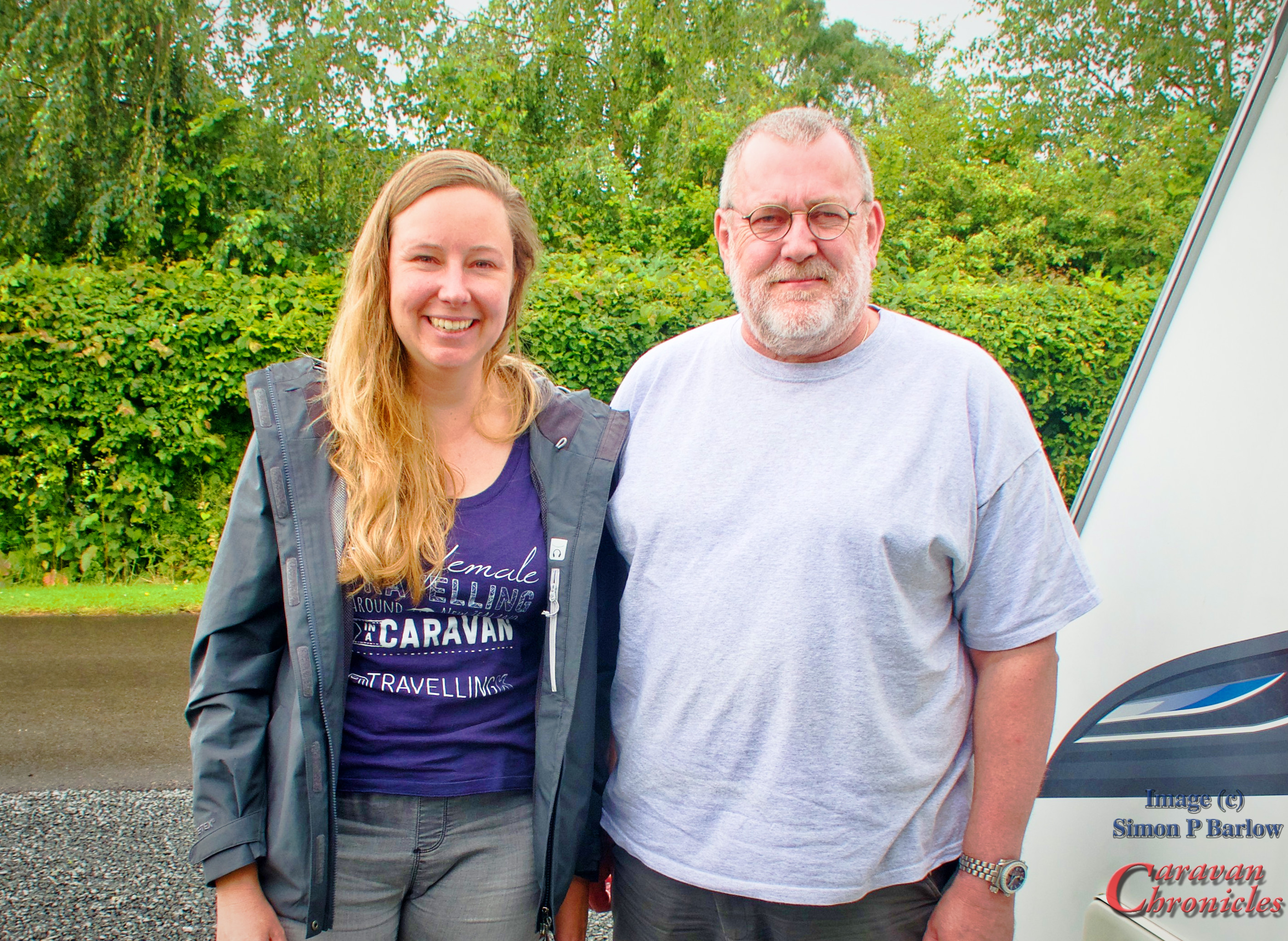
By coincidence a young lady that I had been ‘chatting’ with via email for several months was visiting from the far off land of a thousand landscapes. We had provisionally planned to meet up in Derbyshire but after realising we would both be staying at the same site – C&MC Teesdale Barnard Castle for the Erwin Hymer event we could catch up there and travel to the event together, woo hoo… go us, saving the planet.
The last time Sue and I were at Barnard Castle was back in 2011 or 12 (link here) I think and we were staying at the C&CC site a little further along the road. We drove past the C & MC site and both remarked at the time that it looks either new or recently redone, as you could see all the pitches from the road and the planting was nothing more than two foot tall twigs with a few leaves. What a difference a few years and careful ground maintenance makes.
As the event was scheduled for the Monday, we opted to travel to the Barnard Castle site on the Sunday. This would hopefully allow us to traverse the Pennines when the traffic was the lightest on the M62. Usual prep saw us hitched up and ready to roll by 11:20. Selecting the Barnard Castle site in the Garmin GPS gave us the option of two routes – east ofer the M62, then north uptimes he A1M or North M61, M6 and east via the A66. Now two things at this point… one, my own internal navigation had never considered north than east… I’d always thought of the north east as a M62 – M1 route. The second was being given the option of two routes with an overview map with distances and timings on the Garmin, our previous TomTom GPS just gave us a route.
A stop around 12:45 for coffee saw us arriving at Teesdale Barnard Castle after 128 miles of towing around 14:45. The traffic being light all the way.
I flirted off a text message to say we had arrived and shortly after received one back.. a few minutes later a familiar, yet never met person came wandering up.
Ignore the idiot on the right!
It was course Karen, from the great YouTube channel “Travelling K“. Karen was over travelling around the UK meeting up with some of her followers and some of the people she follows.
We sat outside for around three or four hours chatting about all sorts including caravanning (duh that’s a given) and New Zealand and everything else in-between. I’d previously offered a lift to Karen with Sue and myself over to the Erwin Hymer Group preview of the 2020 Elddis Caravans & Motorhomes and we confirmed details. It was about a 50 minute run from the C & MC Barnard Castle site to Consett through some spectacular countryside.
2020 Elddis reveal…
Nope… not going to see it. At the time of rising there is still an embargo on any release of info or photos. That’s why you haven’t seen Karen’s video about it yet and I’ve not posted some of my usual trivial scribblings on the subject. Save to say…”Hmm, that’s new”.
We did meet up with Karina & Jules (Here We Tow) , Stephen and Karla (Adventure Wheels Blog) to name a few (well I don’t want to drive my google stats crazy by name dropping too many!)
So no photos or comments about the reveal for now. It is fairly new territory for many caravan and motorhome manufacturers to invite the great unwashed bloggers and vloggers to their events. Traditionally it’s been members of the esteemed market sector press, dealers and suppliers. However over the last couple of years most of the manufacturers are catching up (I think Bailey were one of the first) realising that the traditional outlets for marketing are changing. For instance the ABC figures (Audit Bureau of Circulations) for Practical Caravan Magazine shows issue sales around 18,000 copies per month Practical Motorhome12,300 per month, Caravan Magazine7,500 per month and Motorcaravan Motorhome Monthly (MMM) around 28,000 per month. If you look at those figures, revenue for the publishing house has to come from advertisers, the cover charge cannot cover the printing and publication costs alone, therefore advertising brings in the main source of income and this brings the marketing budget into focus for a lot of manufacturers. Now I don’t know what the figures are for other blogs and vlogs but Caravan Chronicles gets around 200,000 page hits per week. At some point I probably get more people reading something I’ve written than an article in one of the magazines. Same goes for video blogs on YouTube. At some point more people will watch something about caravanning than will read about it.
This has not been lost on marketing departments. It’s now becoming easier (read cheaper) to invite a number of social media “commentators” for want of a better word, to launch and reveal events that it is for a printed press campaign and get a far wider reach across to people that may not buy printed publications.
Don’t have a problem with it… we might get a freebie buffet now and again but as I’m not being paid for it I can basically ramble on as I like. However there are a couple of rules, one being you don’t break ‘publication embargo’ dates, the other is if you are in a position to take photos or videos of something and the company requests not to publish as its privilege or proprietary then you don’t. Not difficult rules really.
We ( well I ) had promised Karen an evening meal after the Elddis event and that boring I’d put all the ingredients for a Rogan Josh curry into the slow cooker.
I might have set Anglo-Kiwi relations back fifty years…
Unfortunately the recipe was untried although from a reliable source. It smelt good and the nan bread was placed int he over for a quick warm up. Wine was opened, the smell form the slow cooker was enticing. Rice was microwaved, plates laid with associated ironwork and finally the slow cooker brought to the table. OK insert screening to a halt sound.
It was awful… no flavour, no bite, no heat, not enough seasoning and watery, not thick. It couldn’t cling to a wall if you threw it. Karen was very diplomatic and said bugger all… mind you that might have been something to do with the…. ‘would you like another glass of wine” tactic to divert attention from the curry. This night may have done bugger all for Anglo-Kiwi relations.
Just to prove Karen survived the “Kiwi Curry Incident”
Well I had ordered some and in the aftermath of ‘the curry incident’ I decided to work off the excess “argh” and give it a try. Well what can I say, but what a fantastic product. It took a couple of hours of work but the first results on the fibreglass front cap are amazing. It’s has removed that powder feel coating and actually started to put some shine back into the gel coat. (a subsequent second go improved things again). I’m not saying it should used every time you wash you caravan but two or three times a year should restore and maintain the gel cote on your fibreglass front cap.
PS.. f you haven’t watched any of Martins videos, go ahead and give them a go “The Caravan Nut“. I like videos about doing stuff, repairing stuff, installing stuff, making stuff and inventing stuff. Martins videos have stuff.
Saying goodbye…
Wednesday saw Karen heading off in the general direction of Hull. We had talked about maybe trying to meet up at Dusseldorf for the Caravan Salon however it may not be an option as Sue is a bit limited in the time she can take around then. I did think about going on my own, but if you look at the cost and logistics it wasn’t really worth it. Been trying to get there for the past three years but for one reason or another never made it. However there is always next year!! If you want to catch up on Karen’s video for Barnard Castle you can find it here… just ignore the idiot part way through… I’m He’s only on for a few seconds thankfully!
We didn’t have to head back until Thursday and took the opportunity to catch up on a few other chores around the caravan. I still need to finish off the window edges that I started in Betws-y-coed, but I did manage to stick some of the top cupboard door edging strips that were coming adrift.
Thursday morning the weather wasn’t so good. It was dry but rain and strong wind were forecast for the East coast, so rather than head count down the A1M and west over the M62 Pennine route I opted to take our Garmin SatNav’s other offering, west over the A66 to meet up with the M6 then turn south for the M61 and M60 around Manchester. All in all the milage worked out the same but the route was far more scenic, especially coming westbound over the A66.
Epilogue…
” The Kiwi Curry Incident” as it shall henceforth be referred to…. I re-created the curry… same slow cooker, same recipe, same everything – except slightly shorter cooking time. The result? The same… it was awful. That recipe now banished and shall never be cooked or spoken of again. In other news I can do a mean chilli in the slow cooker, and my slow cooker slow cooked spicy chicken casserole with chorizo and rice is a bit of a hit too.
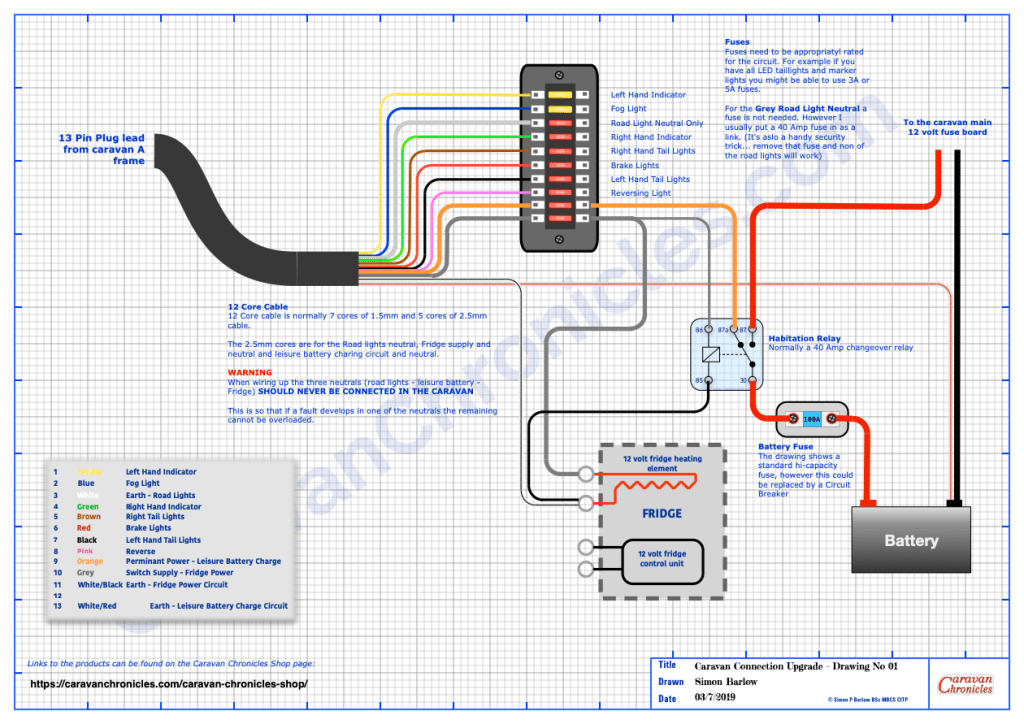
A short while ago two people contacted me separately asking if I had any information relating to rewiring restoration caravans so that they could plug into a modern 13 pin electrics tow car and take advantage of leisure battery charging and run a modern fridge or coolbox.
This was followed up be someone asking me how they could upgrade a late 1970’s caravan and still incorporate and use the “CAR-VAN” switch to change between using the leisure battery or vehicle battery.
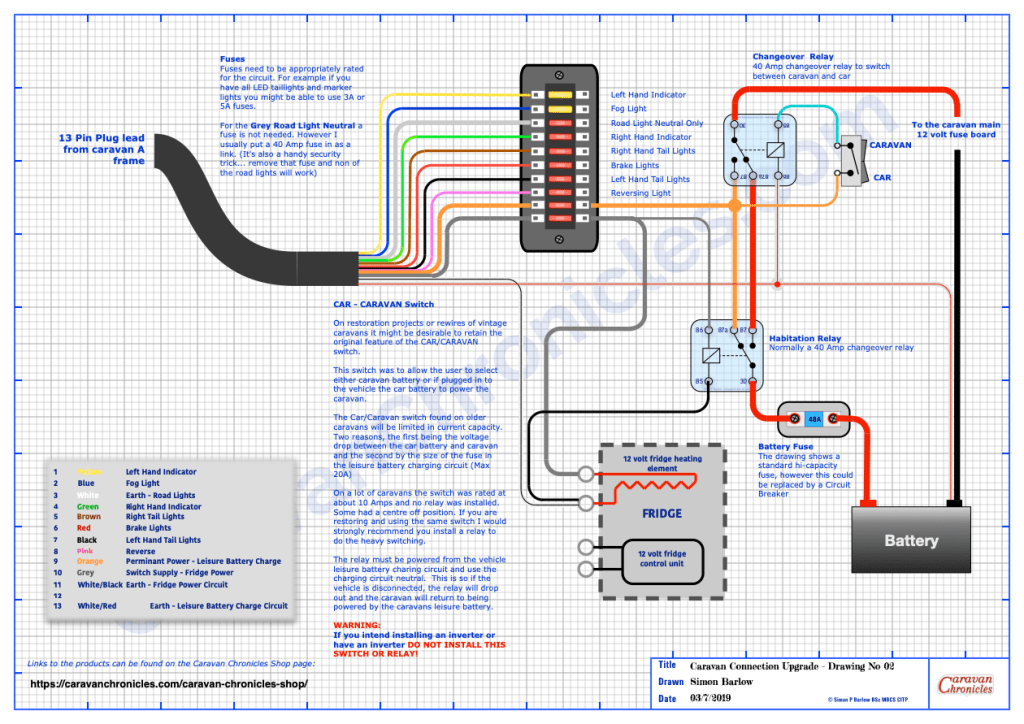
I came up with a couple of drawings that covered the basics to show how they could be upgraded to modern tow vehicles. The one above is a basic ‘front end’ from 13 pin plug back to a fuse block for the road lights and a habitation relay.
The drawing below add in the option of a “CAR-VAN” switch (sometimes labeled as CAR-CARAVAN) which uses the same 40 Amp relay as the habitation relay rather than a chunky high amp switch found in some models. However installing a CAR-VAN switch does have limitations… for example you could not install an inverter.
If you want to download these drawings (or any others I have done recently) they are now in PDF format sized A3 and can all be found on the “Electrical Drawings” sub menu below “Document Library“. I kept getting emails asking where such and such a drawing was, so I decided to put them all into one place.
I don’t normally do electrical drawings for specific projects (unless being paid), however if you have something that you think might be of interest to a wider audience drop me an email.
OK a bit of a rhetorical question really. Caravan Chronicles now has a bit of a shop. Well I call it a shop, it’s really just one page of links to stuff I have bought and used throughout the blog from Amazon.
I started a while ago adding a few links here and there at the end of my posts for bit’s and bob’s I’d used in any particular post. I got a few emails asking where I’d got so and so from and it seemed the best place would be a single page to list everything. So here it is… Caravan Chronicles Shop.
It’s not a real shop, I’m an “Amazon Associate” (fancy title!) but all that really means is I get a small… and I mean small percentage if you buy anything via Amazon by clicking on the link. So far this year I think it has paid for a couple of Grande Latte with Extra Shot from Costa.
Fear not, don’t think I’m going to load it up with “Merch” (I think that’s the term) it’s only going to be stuff we have bought and used so no teddy bears wearing tee shirts with the Caravan Chronicles logo emblazoned across their furry chests.
That’s it for now. Off in a few days to meet up with Travelling K (yep all the way from NZ!) for a super secret event… Schhhh.
As usual Henry and Oscar would like to thank you for following along. Here they are checking out their new cat shelf I made from some of the 12mm tube and bending tool left over from the “Mirror Mirror” project. (Links to both can be found in the shop!)
You know how sometimes those little jobs come along that you put off as you think that it’s going to be a bit of a pain to do…. well this was one of them.
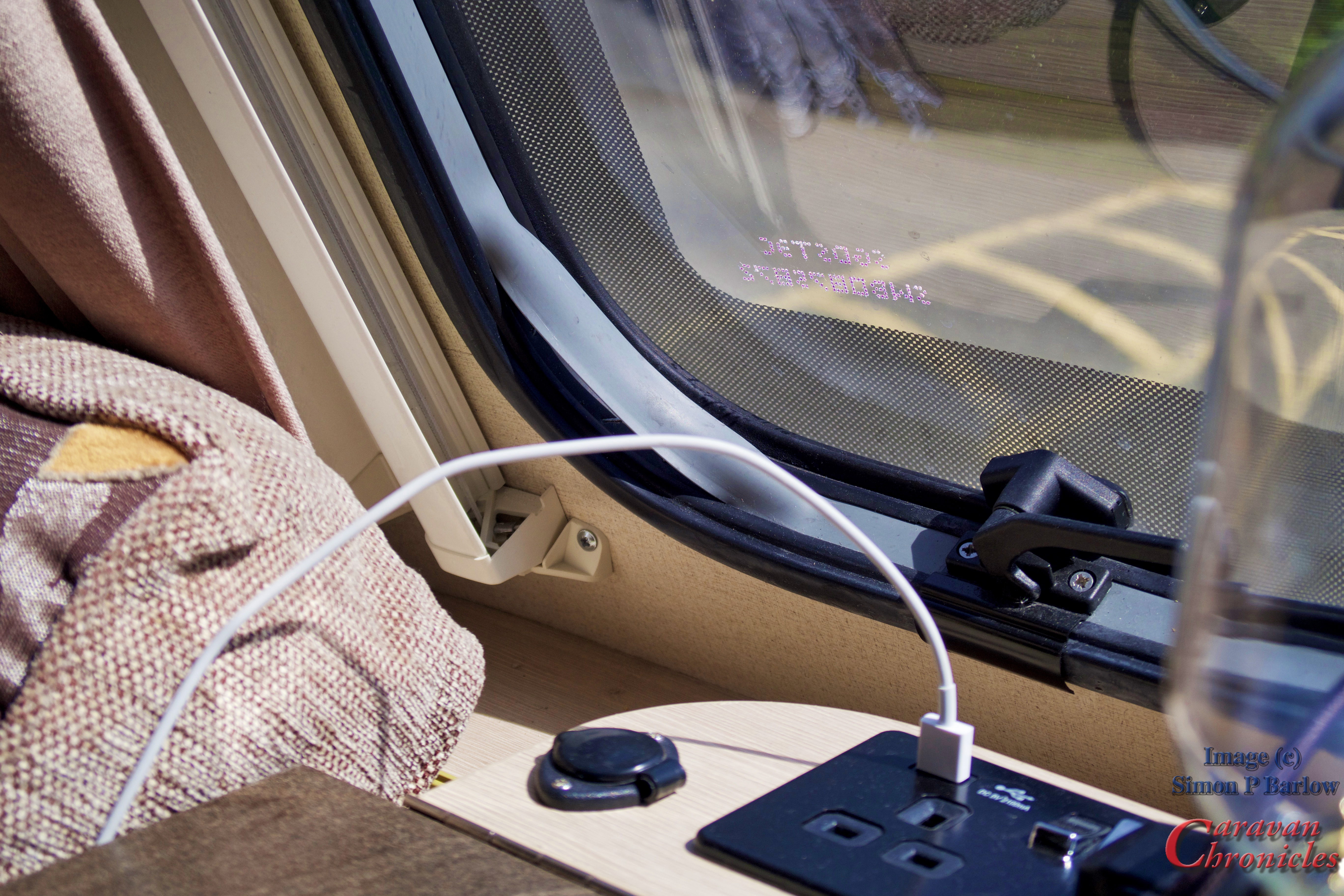
On all three of the front windows the plastic insert trim for the rubber window surround was slowly pulling out of the corners. The worst was the front lower corners on the big central window. I’d ordered 15 metres of replacement from Leisureshopdirect.com(the part I ordered can be found here) for about 99p per metre. It was one of those jobs I’d been putting off for a while as I thought it was going to be a bit of a nightmare to do.
However on a recent jolly to Riverside Touring Park at Betws-y-Coed, one afternoon sat looking at it I decided I’d sat looking at it far too long and that it just had to be attacked head on.
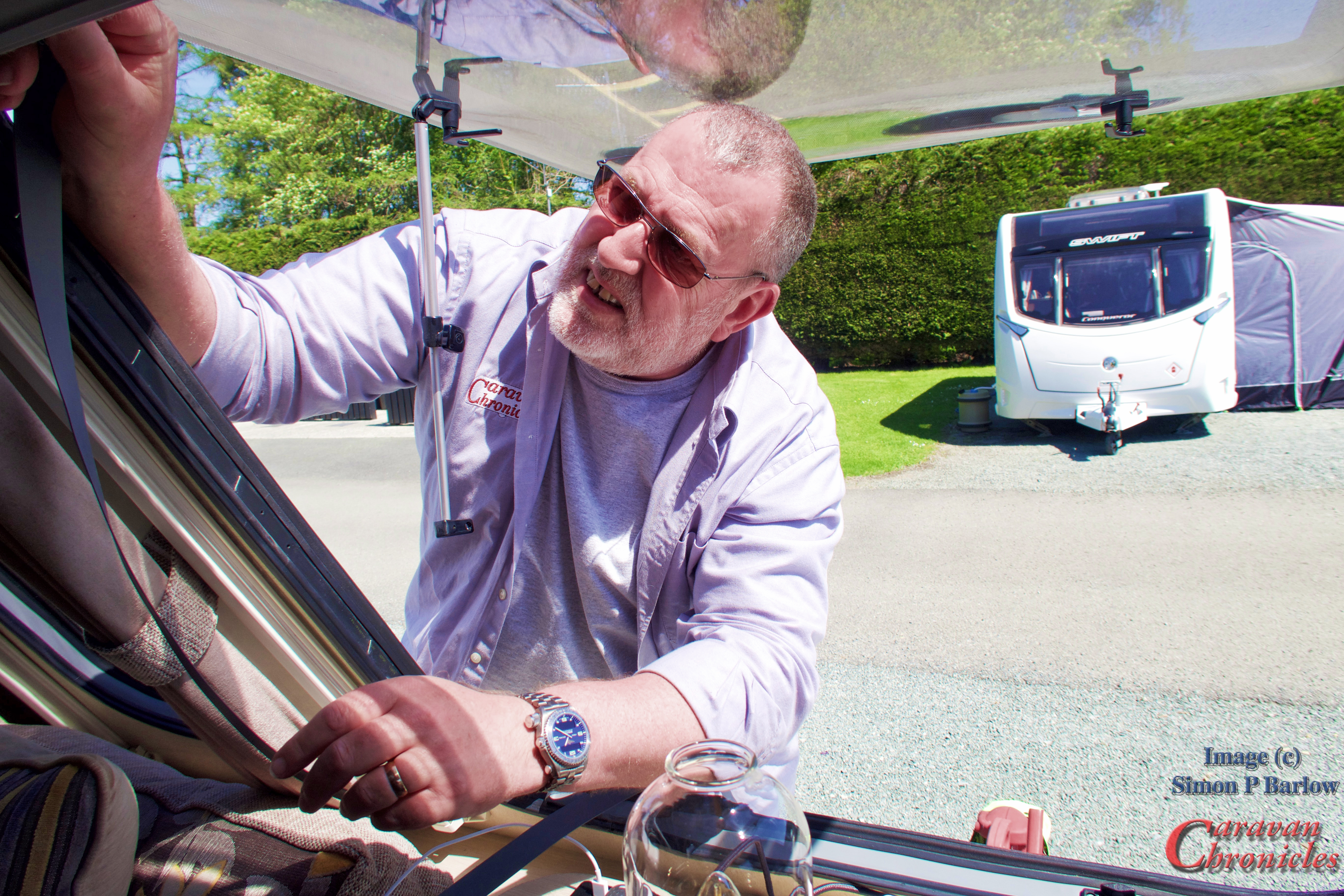
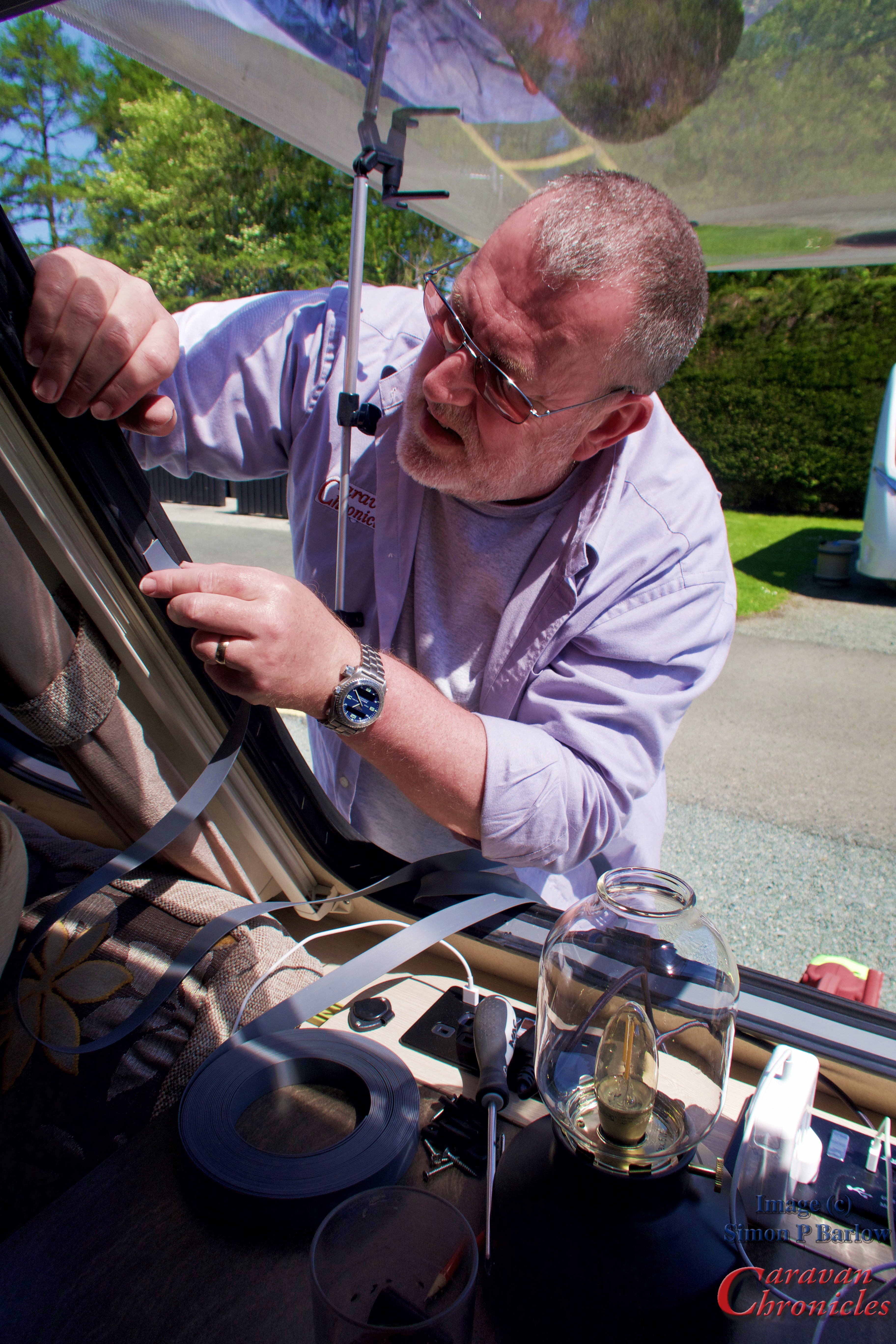
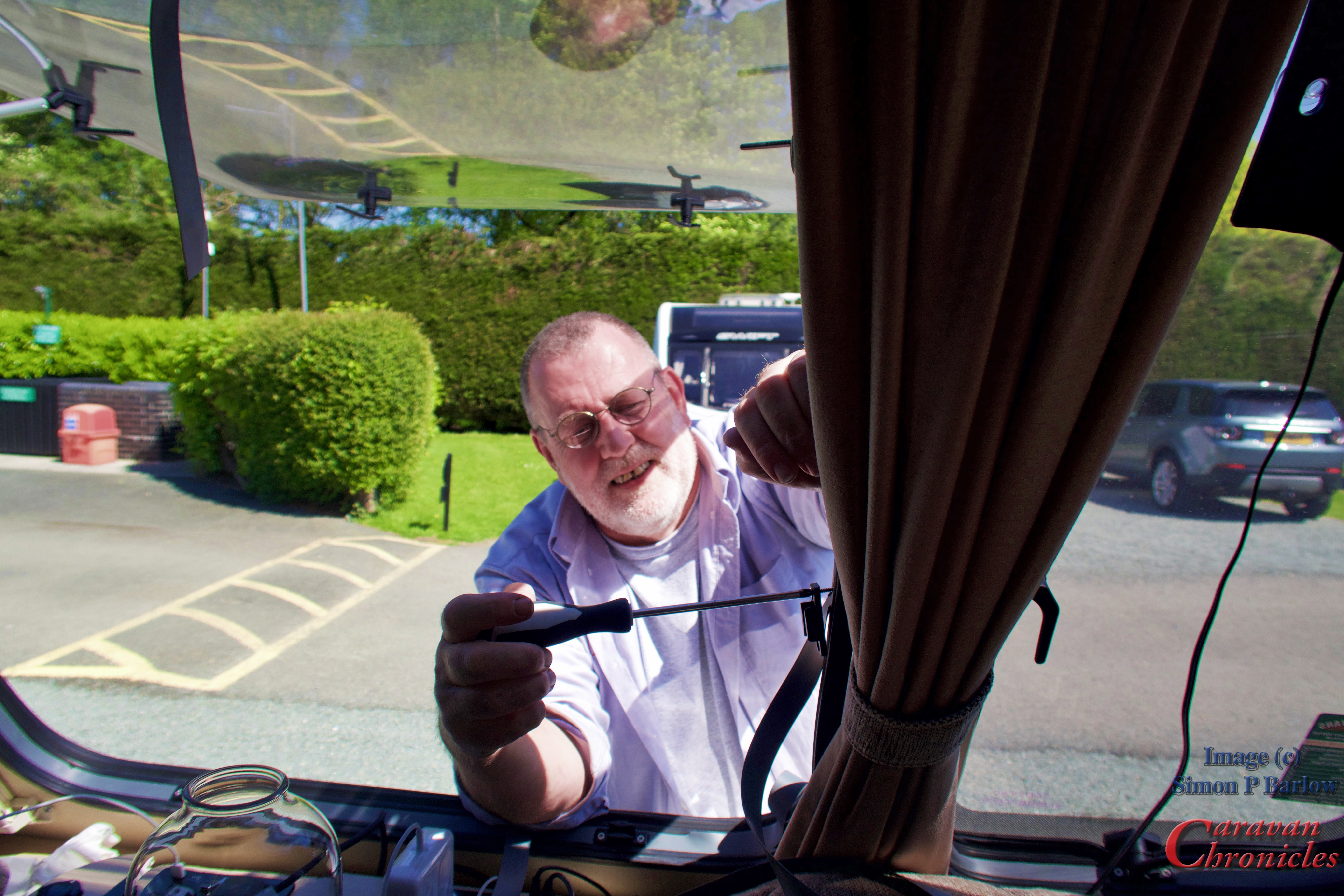
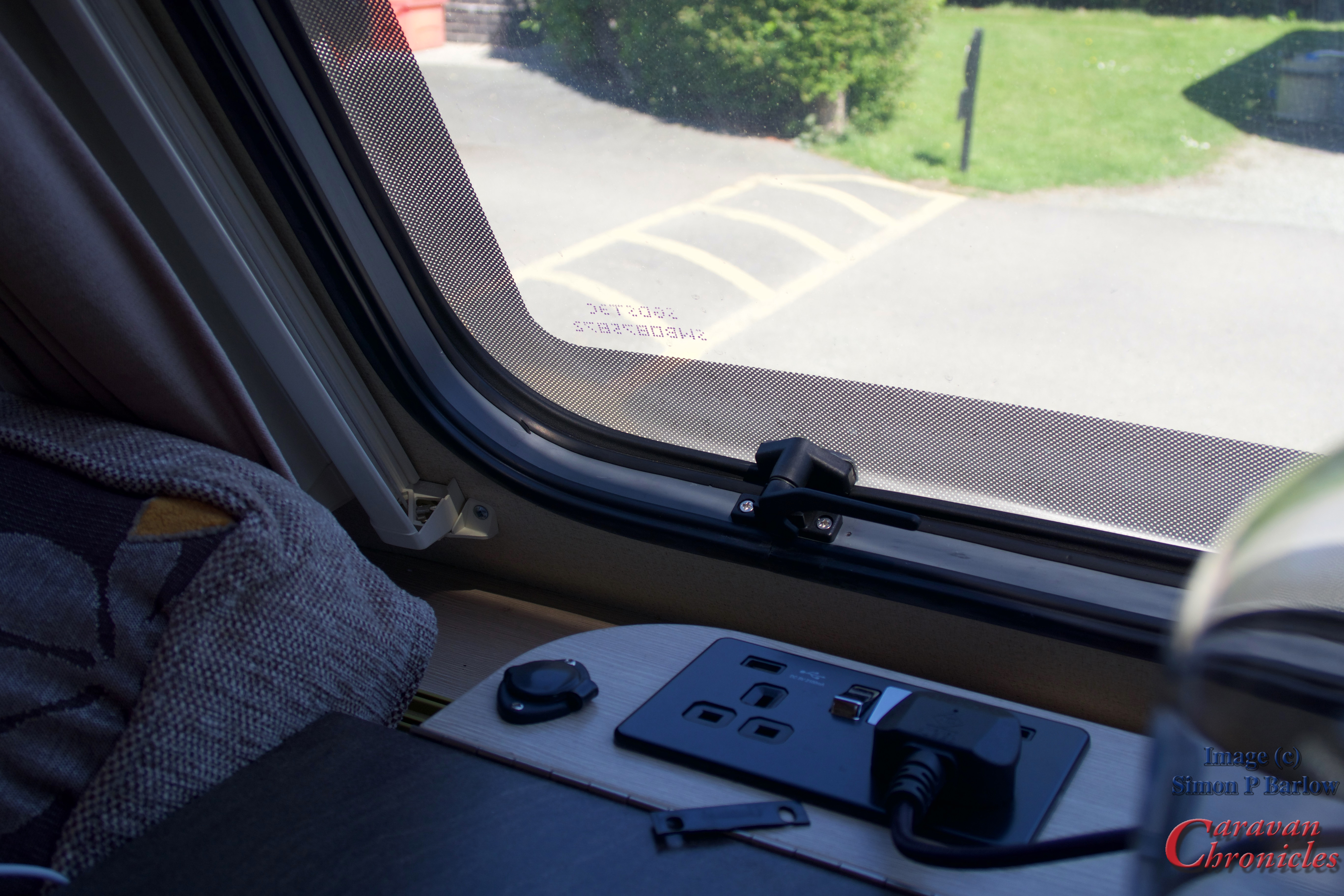
Tackling it from outside, releasing the window hardware on one side – marking where the screw holes were on the rubber in pencil first, was easy enough. Two cross head screws held in each window latch and window strut to the frame of the caravan. The join in the old strip was in the centre at the top and getting a small flat blade screwdriver under the edge was easy and the the strip simply pulled out across the top and down one side.
I started by checking the width. When you order there are two widths available and two colour options. I’d previously checked the existing strip and measured it to be about 23mm wide. On the web site it was listed as 23 mm or 25mm and available in grey air white.The replacement was however around 50% thicker making it a lot stiffer to insert.
However it soon worked out that this additional thickness was to my advantage. I could now push the strip into the recess on the caravan side and simply run a small cross head screwdriver round the outer ‘flange’ (I had to get “flange” in there somewhere… silent nod in the direction of Miranda Hart) and flip it over the edge of the strip. The first corner was a bit tricky but my technique was improving all the time.
Once I’d completed the first section from the top down to the middle of the bottom of the frame, I re-attached the window hardware and removed the opposite side…
This was all going terribly well! It didn’t take too long to remove the hardware from the other side of the window, pull out the old strip and continue around the frame fitting the new strip in.
I wasn’t sure what caused the original material to pull out of the corners but I guessed there might have been some stretching when it was originally installed and maybe repeated heating and cooling over the last 8 years caused it to return to it’s original dimensions. With the new strip, I did try to ensure I’d not pulled it tight and used the handle of a large screwdriver to try and massage the strip into the corners as much as possible.
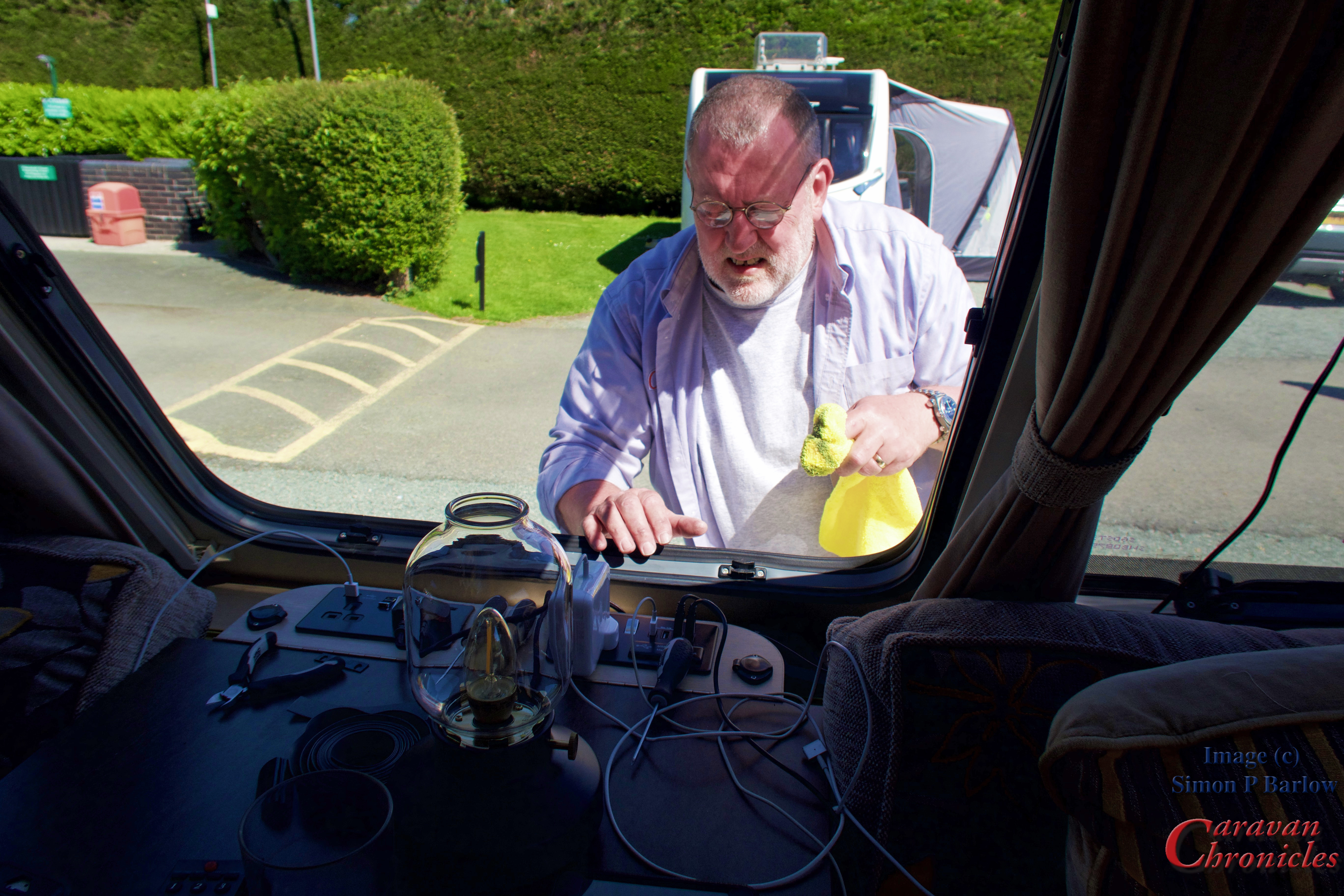
All that remained was to re-install the window hardware on this side and check for fit and finish. Everything seemed OK and Granville was summoned with his cloth…
A light squirt of silicone designed for rubber window seals and a quick polish with a microfibre cloth finished the job off nicely.
All totalled the main centre window took about 30 minutes to complete start to finish. Next trip out up to Barnard Castle in a couple of weeks time…. I’ll get the other two smaller windows done.
Finally, before anyone asks, yes I did choose to do this on the warmest day in North Wales so far this year!
















 Caravan Chronicles