A lot of new caravans now have the ability on a ‘super pitch’ to be able to attach a mains water feed directly to the caravan without having to have an Aquarol as a water reservoir, and this seems like a good idea. I started looking at the options available and was surprised at the cost of the only suitable system for our caravan. I also wasn’t keen on the plastic regulator. This got me thinking, maybe it was time for a little Caravan Chronicles DIY project.
I wanted to come up with some sort of contrivance that was assembled from stock components that were easily available anywhere. After a brief search on Amazon I came up with my shopping list and ordered everything (see links below).
The result was a simple to use commercial pressure regulator that I could use our existing blue water hose that originally connected to the Aquarol and standard hose fittings that allow me all the options for connecting up.
As a temporary mount I used a couple of the small plastic hangars that Fiamma sell that slide into awning rails allowing you to hang things from. In this case a couple of cable ties held it in position. I’m currently in the bat cave folding a small aluminium plate to mount the regulator on that slides into the rail and has a foam padded back to protect the caravan. I opted to use brass fittings for the hose connections rather than plastic just for durability.
So how did it work out?
Well on a recent trip to Southport Caravan Club site (where the photos were taken) it worked extremely well. The initial set up was easy and to start with I reduced the pressure using the small screw on top of the unit to about 0.5 bar (7 PSI) to ensure I didn’t over-pressure the caravan plumbing. I increased this to about 1.5 bar and this gave an excellent flow rate with the added feature of not having to run the internal water pump.
Something that was in the back of my mind however was what if the regulator failed and full mains pressure was allowed through to the caravan’s internal plumbing? As I’d used a commercial unit, hopefully the chances of this would be very slim to non-existent as these units are designed to be permanently installed in commercial and domestic plumbing installations however I also added another little handy gadget at the tap end…
This ‘Y’ fitting has two small ball valves, one of each outlet. So when we go out, I simply turn off the appropriate ball valve. Having a ‘Y’ adaptor also allowed us to fill up our Brita filter jug or draw water off without having to turn the tap off and disconnect the caravan hose. All in all everything worked out perfect. (note I have since changed the blue hose adaptors shown for brass ones for durability).
One last thing…
If you are at all worried about water quality in your caravan, connecting up this way will allow you to thoroughly flush out your caravans water system and give you clean water from your caravan’s taps, (especially In summer too, when the sun has been warming up the water in your Aquarol all day) all you need to do is just run the tap for a minute or so to get cold fresh mains water.
I am often asked where to buy some of the products we use. Here are the links to the products. If you click on the links and purchase any of the items, a few pennies will go to helping the cost of running CaravanChronicles.com
As it’s now the ‘off season’ for a lot of caravaners and thoughts turn to sorting out those problems that we put up with on the last couple off trips, I thought I’d look at cable terminations. One of the problems that I’m asked about revolves around cable termination in trailer sockets and plugs. Like most things there is a right way and a wrong way of doing it and there is also the compromise.
So what’s the problem?
Well the problem is terminating a cable to a solid metal part. You will most likely see cables that are striped down to the copper conductors and the individual strands twisted together then inserted in a hole with a screw tightened down to hold the conductors. So whats the problem with this? When you tighten the screw it’s turning obviously and the end of the screw twists down on to the strands of cable, often breaking a few off and pushing quite a few out-of-the-way, usually in an average termination about a quarter of the strands are not held under the screw tip. The 2.5mm square cable you thought would reduce volt drop for the battery charging circuit is now reduced to something less and its current carrying capacity is reduced. Is there a solution?
The obvious one would be to solder the ends of the cable to stop this happening and it’s a great solution, but is does have drawbacks. When you solder the end of a flexible cable the point where the solder stops becomes a weak point and is susceptible to vibration and flexing stress and the thin copper strands transition from being flexible to a solid mass. This is why in aviation, marine and military applications soldering is not usually permitted.
The correct way that flexible conductors should be terminated is by crimping on a “boot lace ferrule”. These are simple brass tubes, sometimes nickel-plated that are slid over the untwisted strands of the conductor and crimped tightly. Some ferrules are just small tubes or ‘U’ shaped section machine crimped and some have a plastic insulator to help isolate the conductor when several are installed in close proximity.
Here’s a simple step by step guide to crimping and terminating a 13 pin trailer socket. It could equally apply to a trailer plug.
For the photos I used a spare socket and short length of standard multi core cable. I have links to all the items, including tools used in the article in “Caravan Chronicles Shopping” at the end.
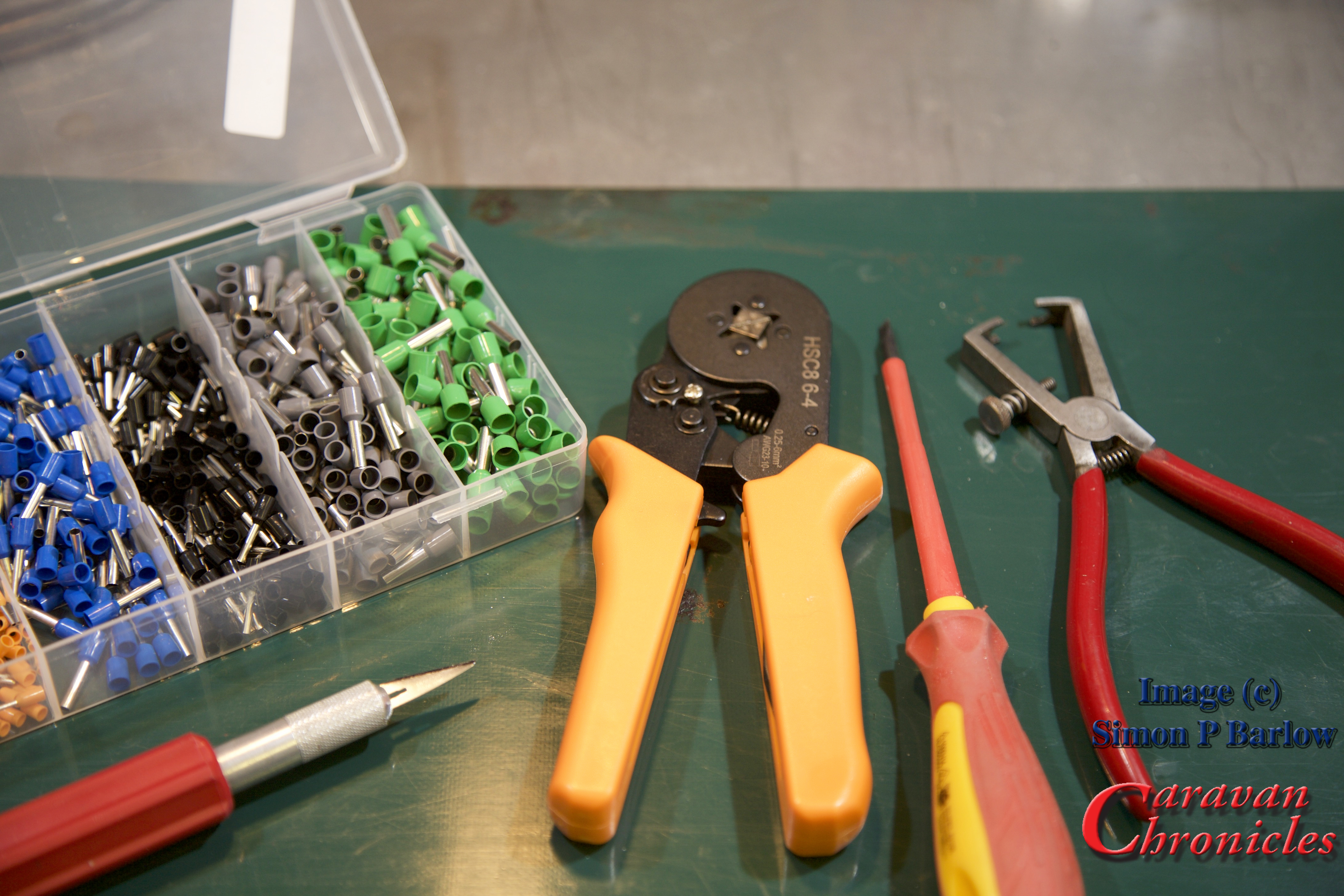
The tools required are a sharp knife, cable strippers, screw driver, ferrule crimps and the ferrules. (tip: make sure your screw driver is a ‘terminal driver’ with flat parallel faces and if fits snugly into the screw head. As the screws are brass, it’s easy to damage the head using the wrong screwdriver)
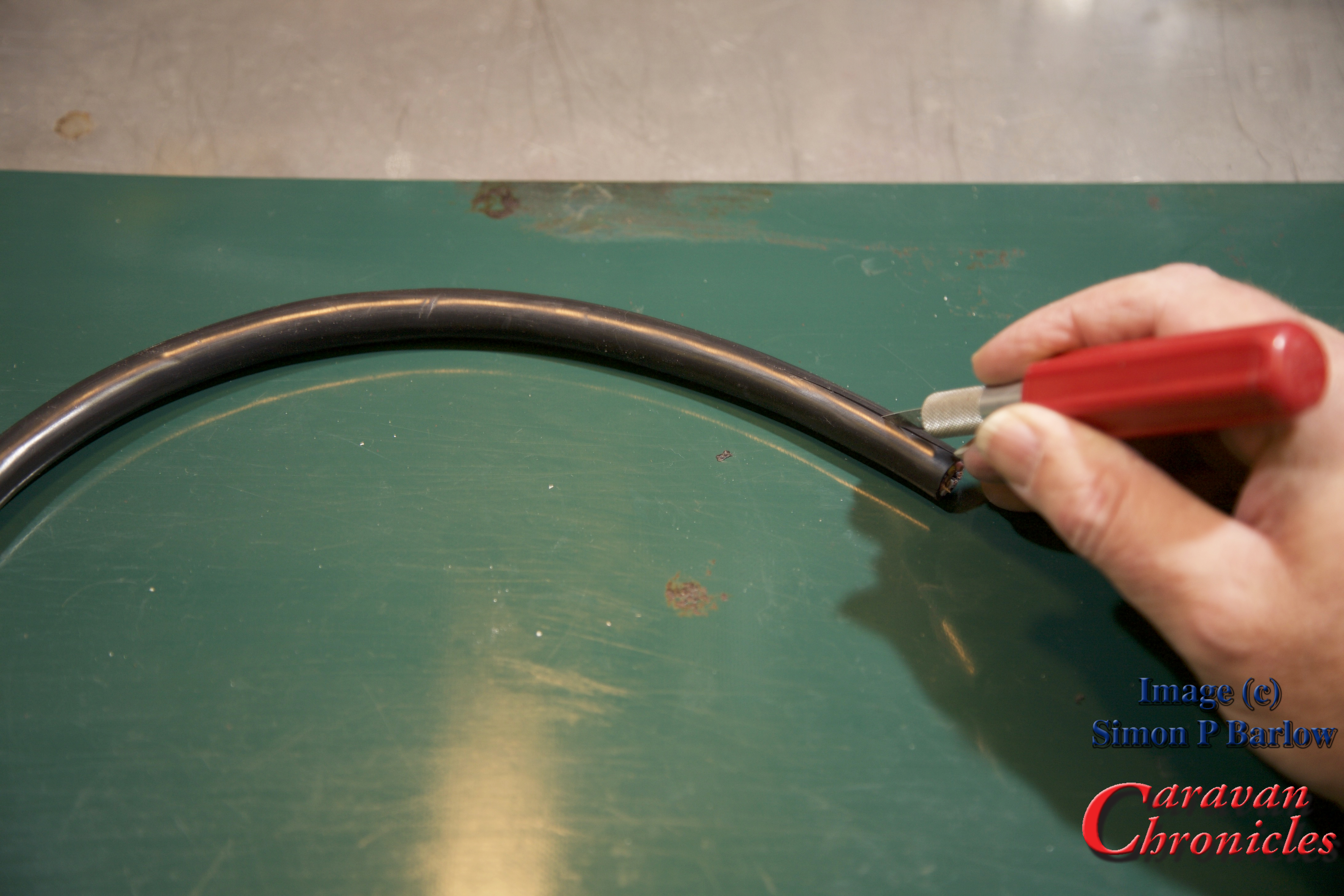
The first step is to trip back the outer cover for the cable. Strip back enough so that the individual cables are long enough to trim to length:
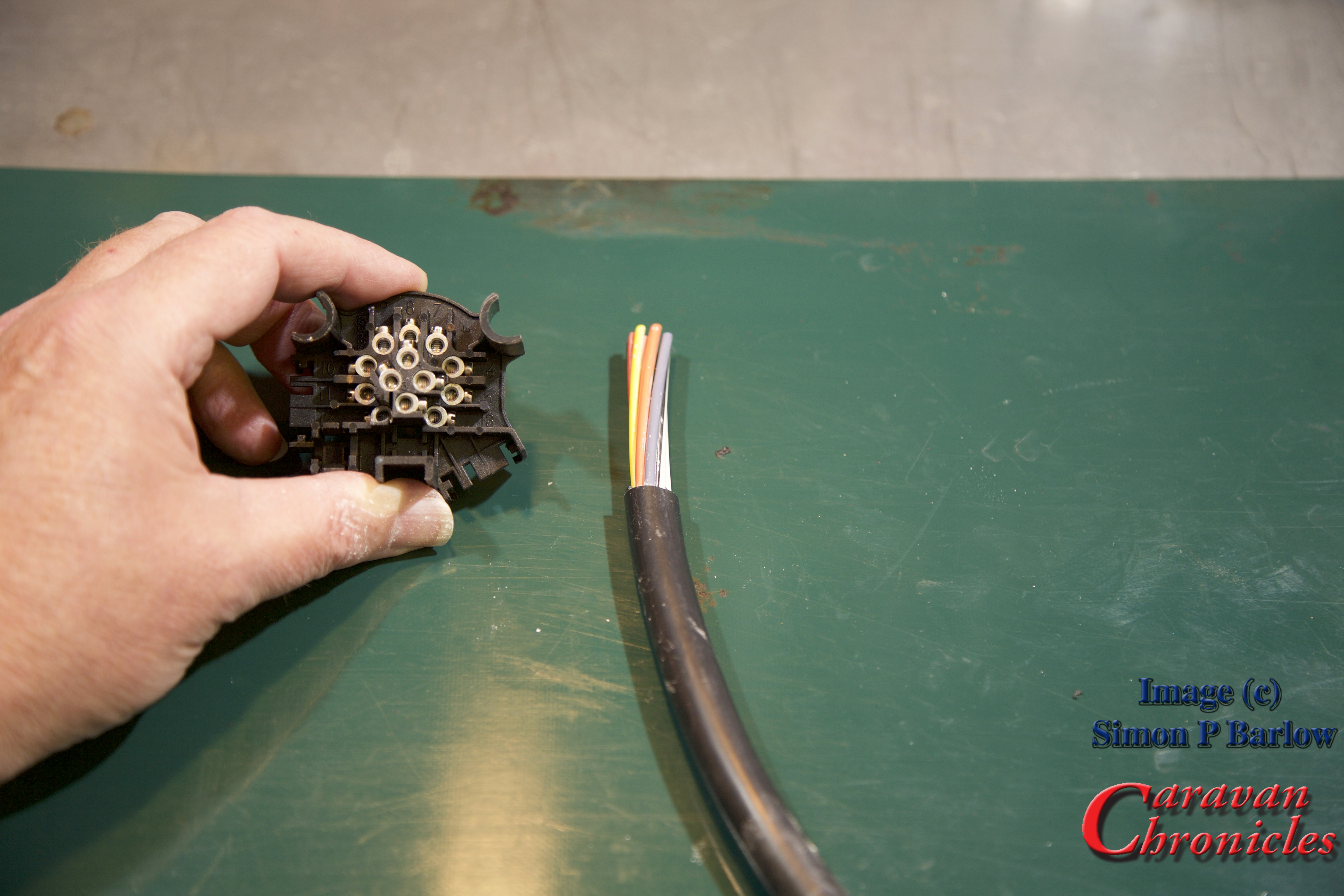
The next thing to check is have you got the right end of the cable? The cable manufacturers lay the individual conductors in a specific pattern so that when stripped, the pattern of colours is in the right order for the end you are terminating. If you have the incorrect end of the cable you will have to cross all the colours over each other to install them correctly in the plug (or socket) As you can see, this is the wrong end for a socket:
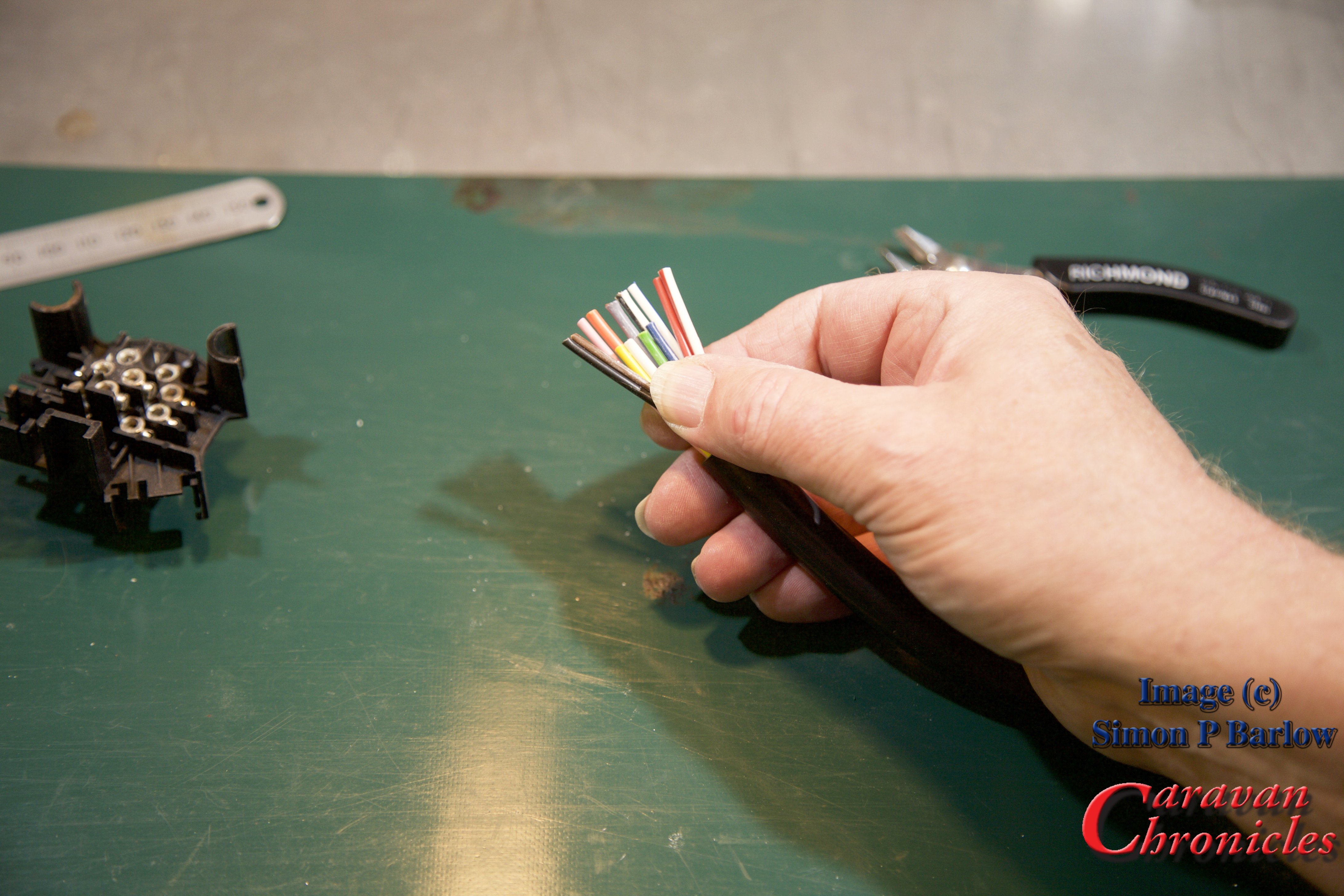
Ok, I’ve stripped the other end and you can see the colours are in the right ‘order’ for terminating a socket:
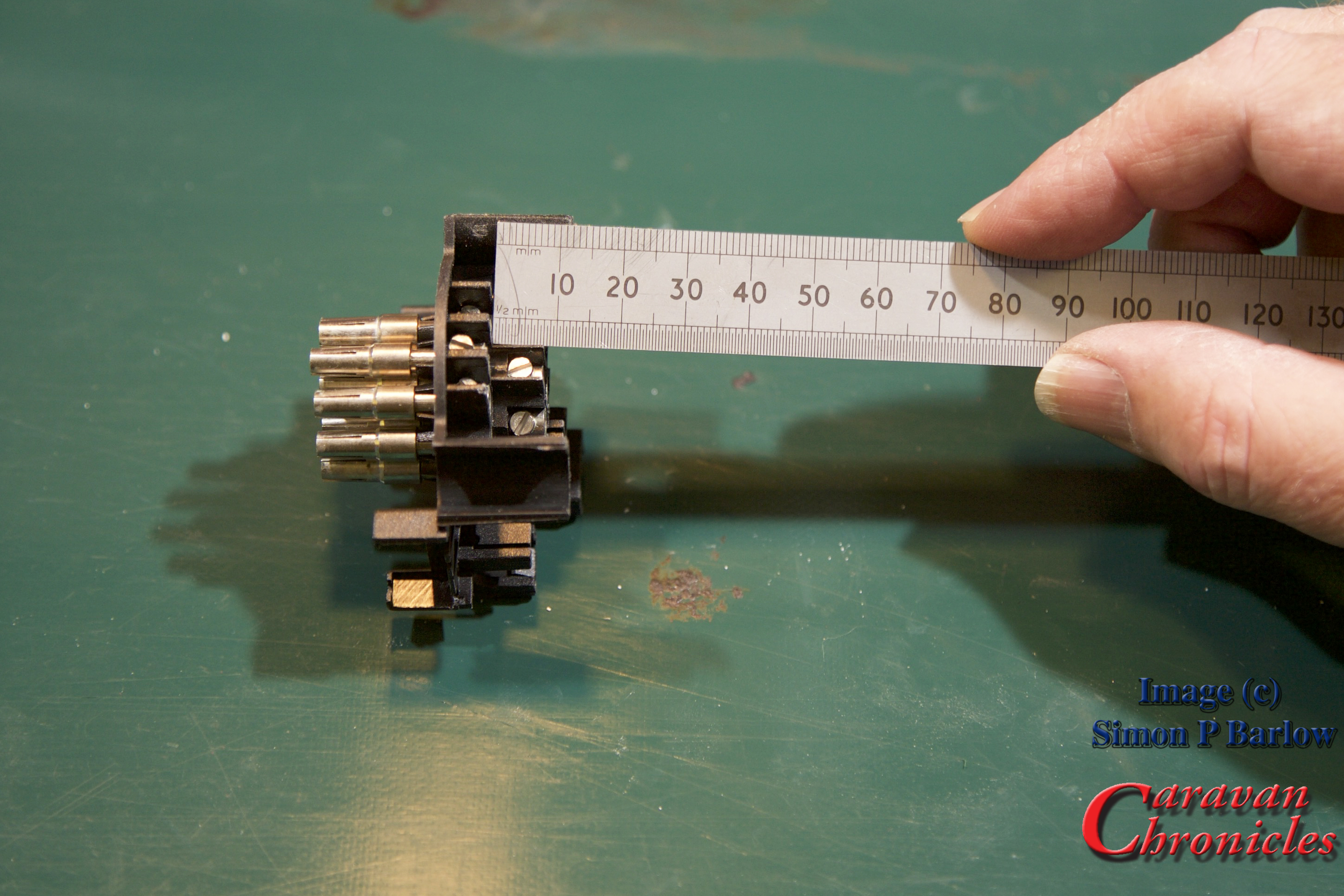
Next we need to measure the difference in termination length between the four centre line and the 9 outer pins… here it’s about 8 mm:
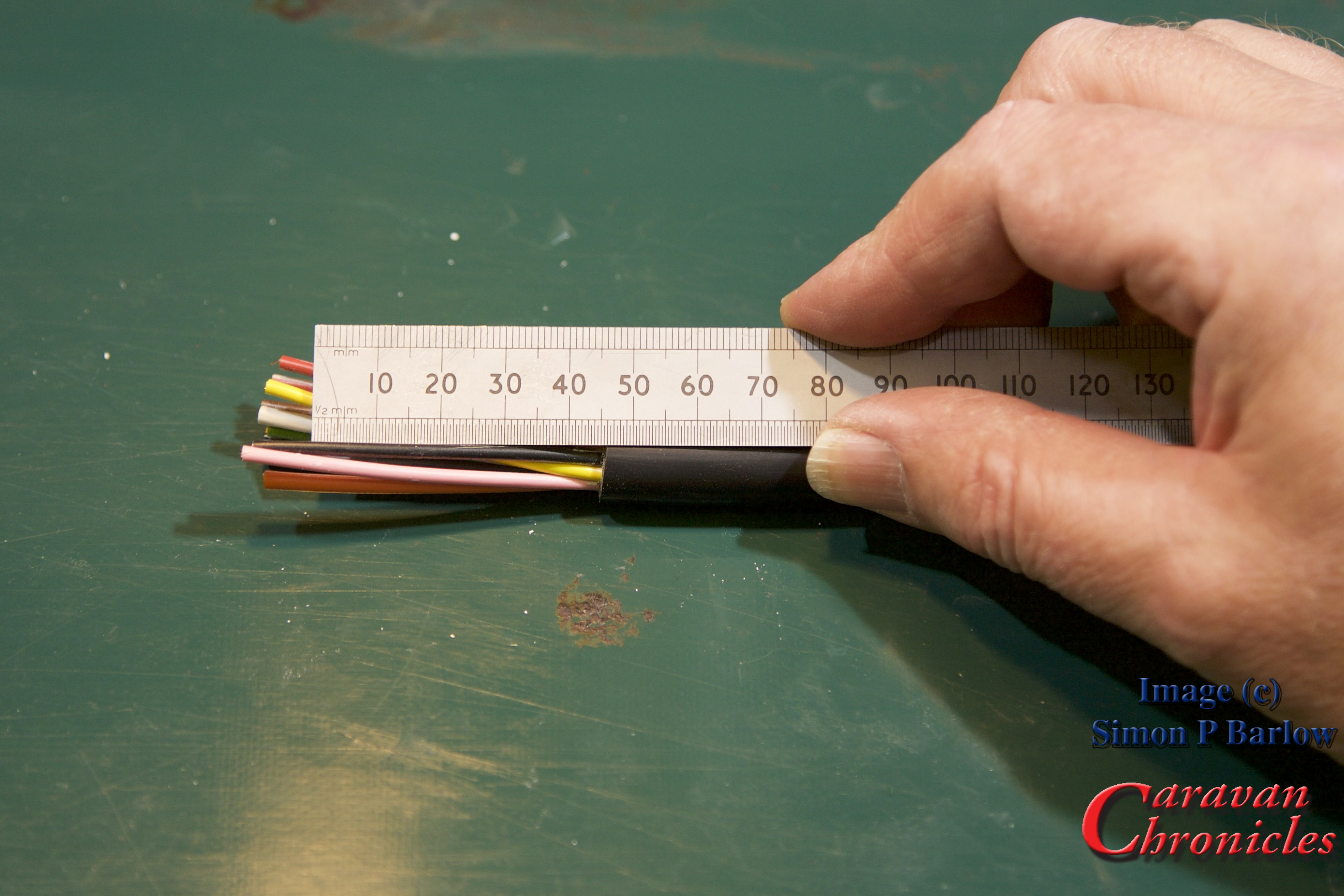
Measuring the back waterproofing cover I know the outer jacket needs to be a maximum of 45 mm from the 9 outer pins and the 4 inner pins need to be trimmed back to 37mm:
Now the cable is cut to the right length so there should be no short or long cables causing problems when assembling the socket:
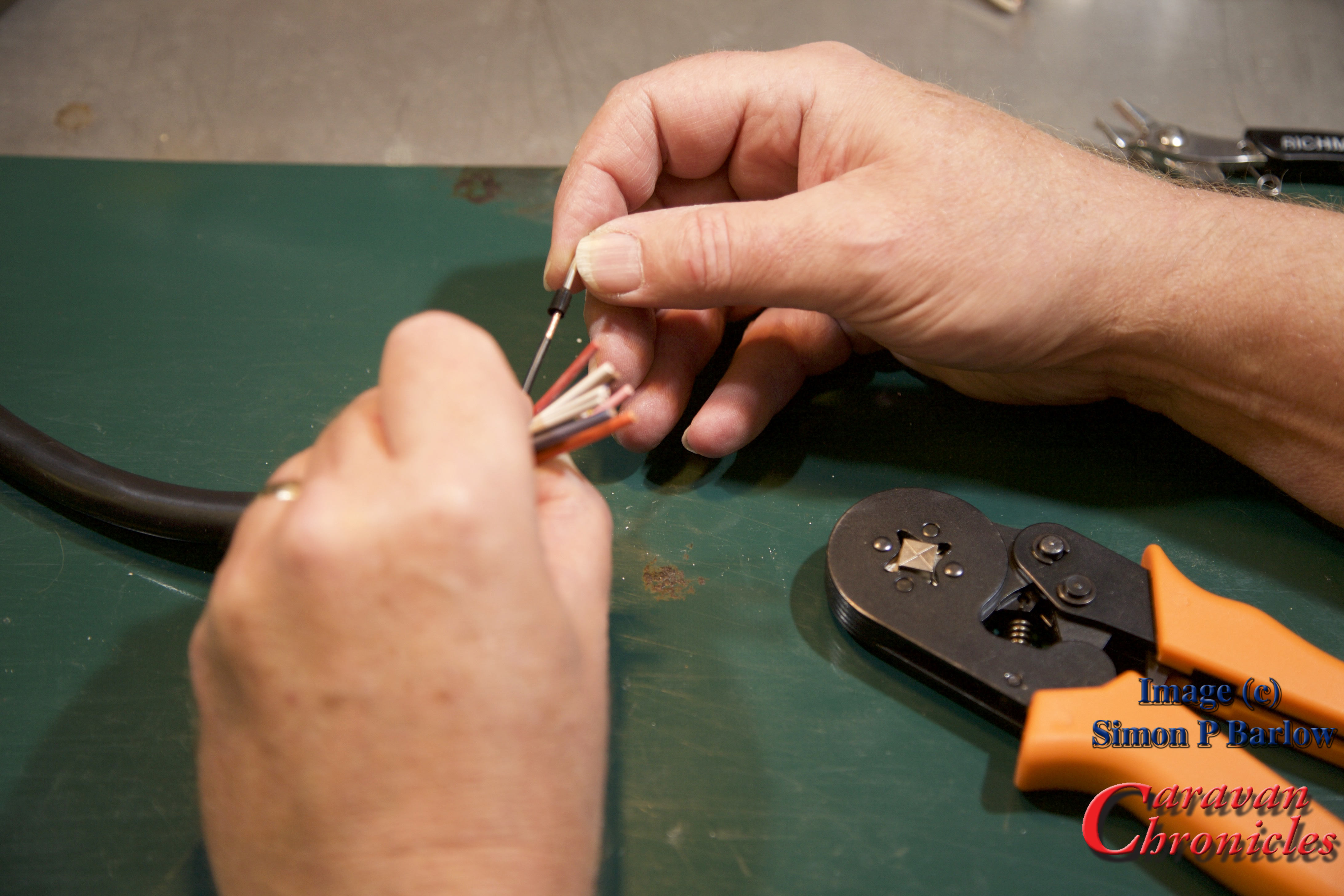
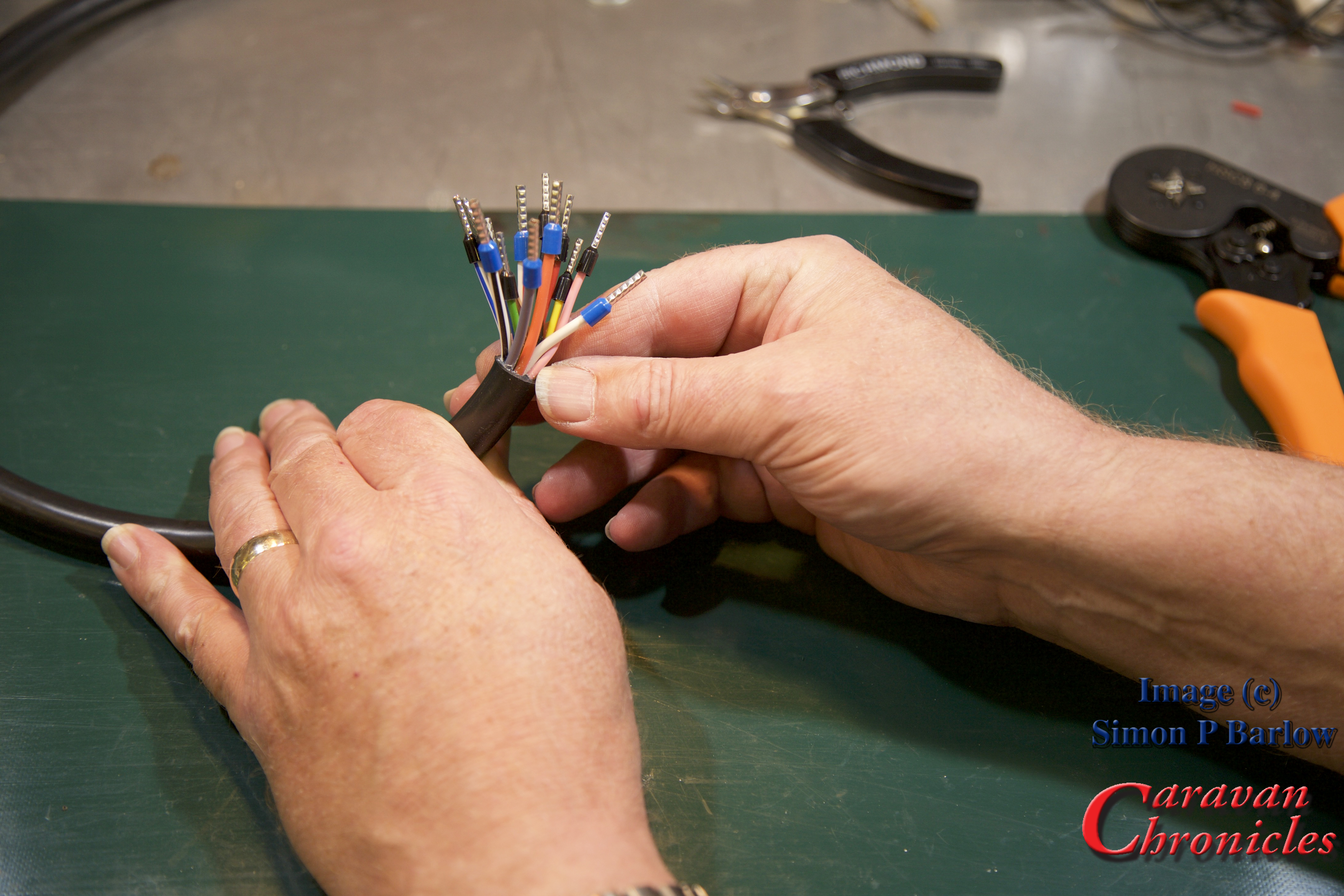
Strip back the individual cables so the exposed conductors are the same length as the ferrules:
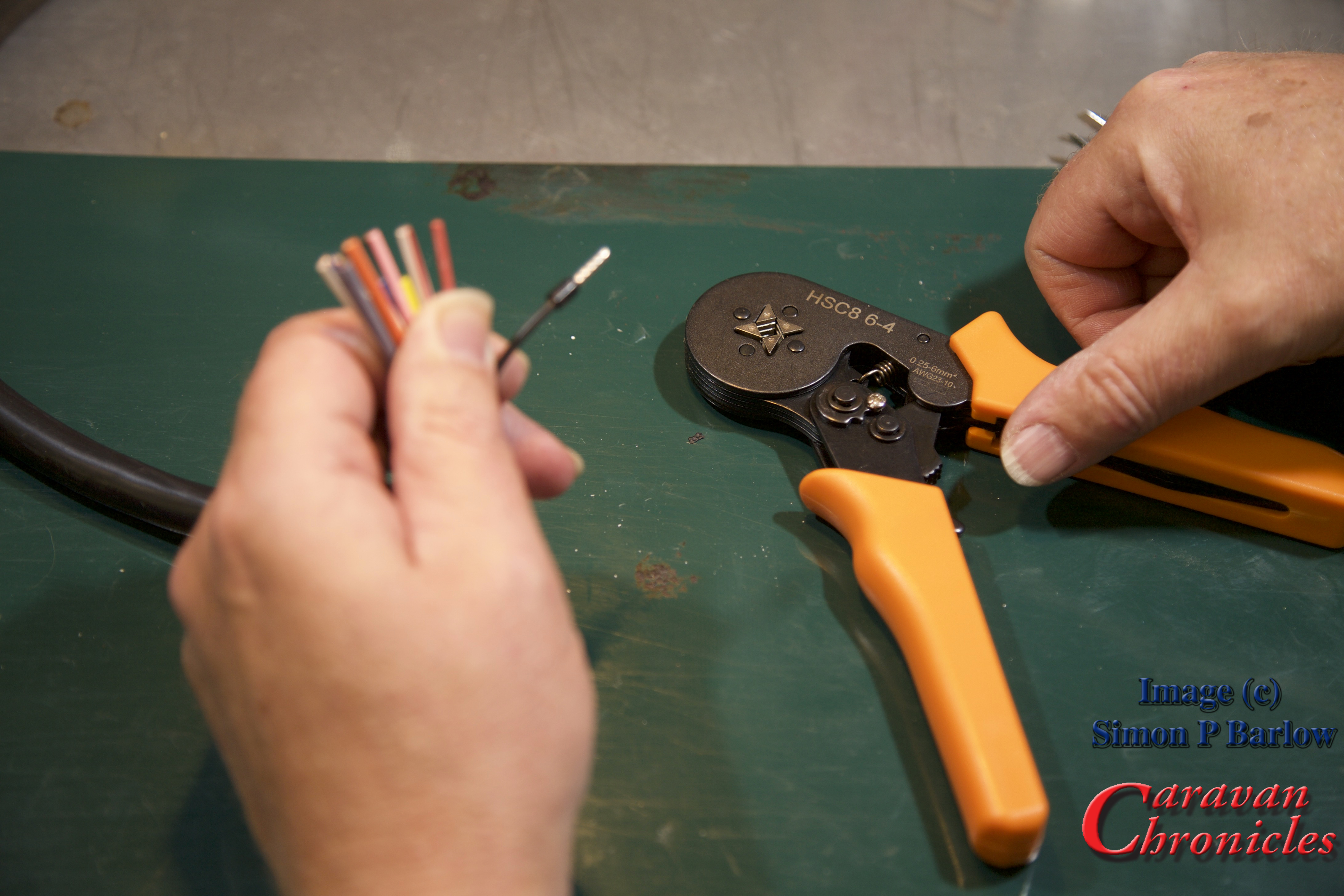
Slide the correct diameter ferrule on to the exposed conductors:
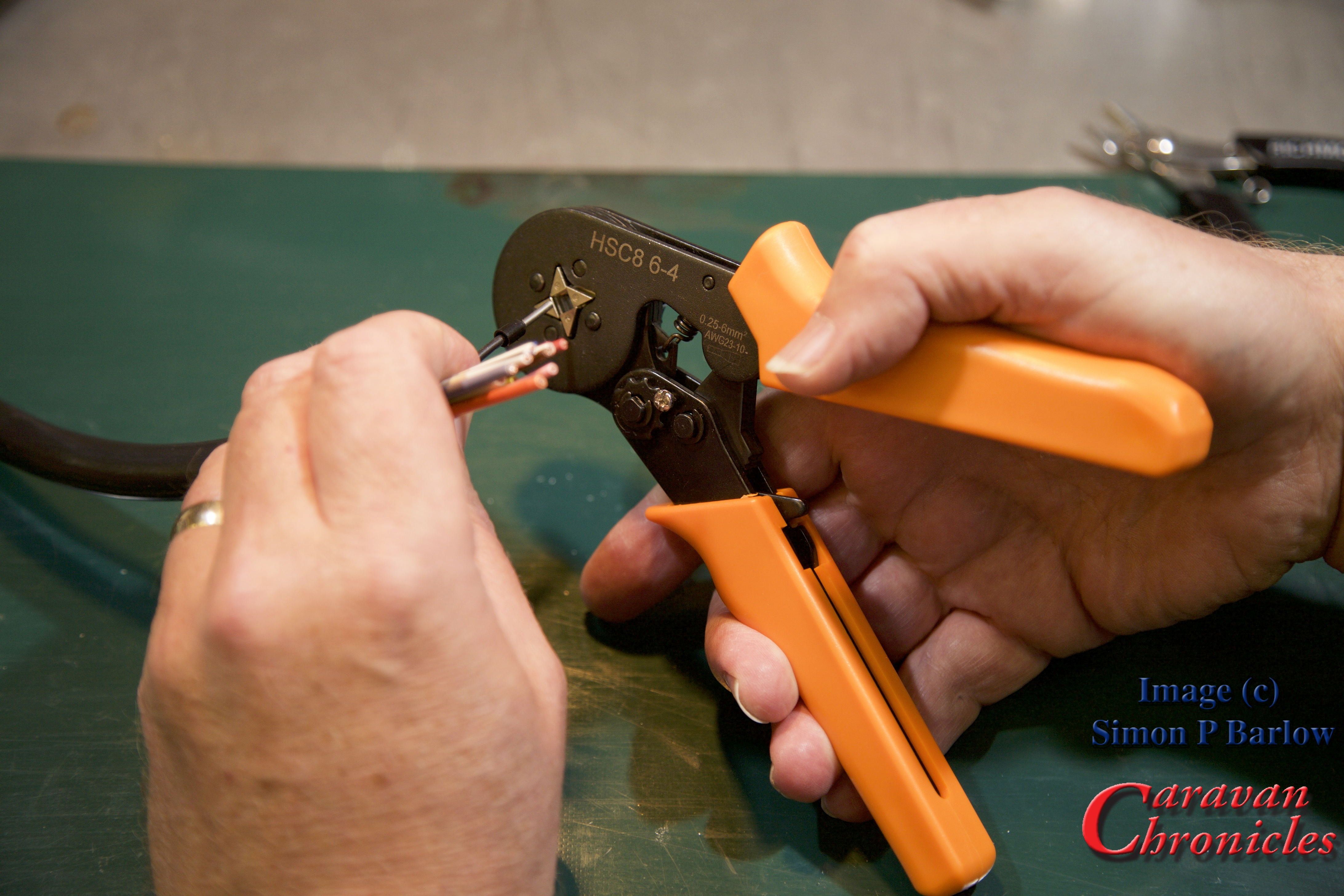
Crimp into place:
The crimp tool is set so that it will only apply the correct pressure to compress the exposed conductors the required amount. Squeeze the handles and the four jaws close on the ferrule and compress it, continue squeezing and once the jaws have attained the right pressure the ratchet mechanism in the handle releases.
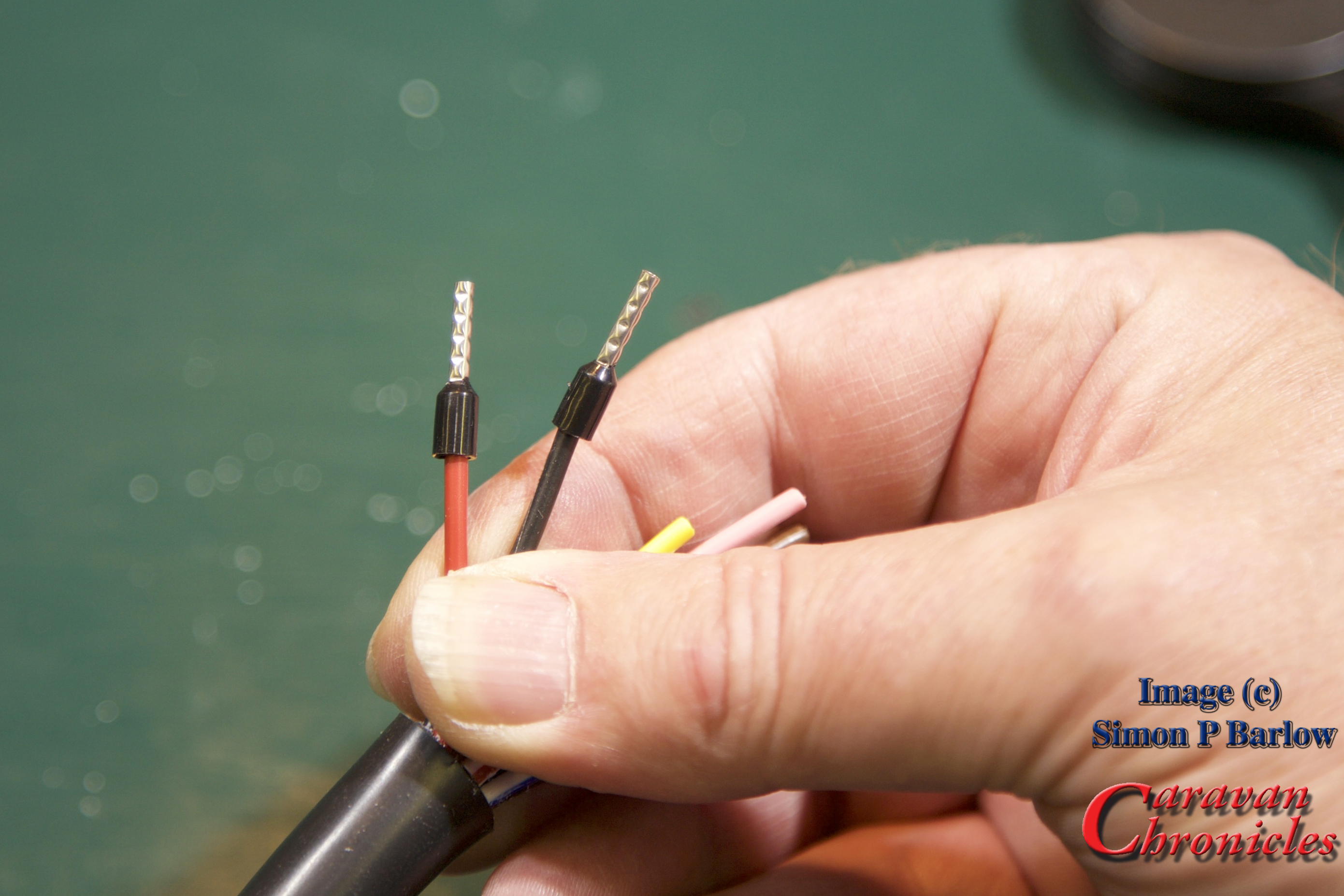
If you look at the picture below you will also see that the crimp tool also presses several ridges into the tube, this is to increase the mechanical grip on the conductors and help stop the tube distorting under the pressure of the terminal screw tip:
Continue until you have all the cables completed:
One last check… look for stray strands and anything that doesn’t look as though its crimped correctly… give them the ‘tug’ test if in doubt.
I always like to back off the screws so the ends are just visible in the holes:
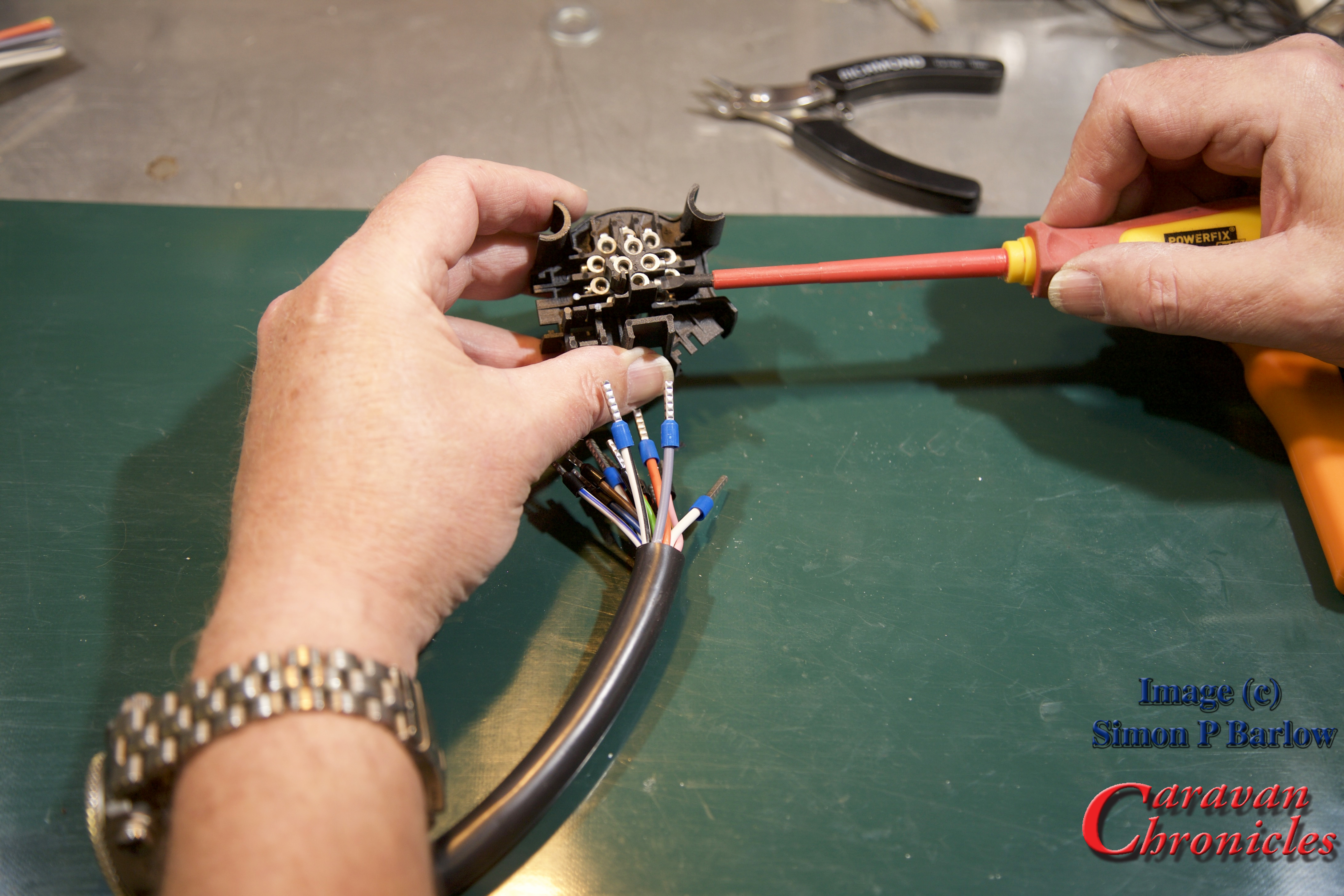
The next thing you might need to do is correct the length of the ferrule. I have used standard length ferrules and as the holes in the socket terminals are not as deep, I had to trim off the excess. The ridges pressed into the ferrule body help gauge how much to trim off. In this case I only had to snip off to the first indent:
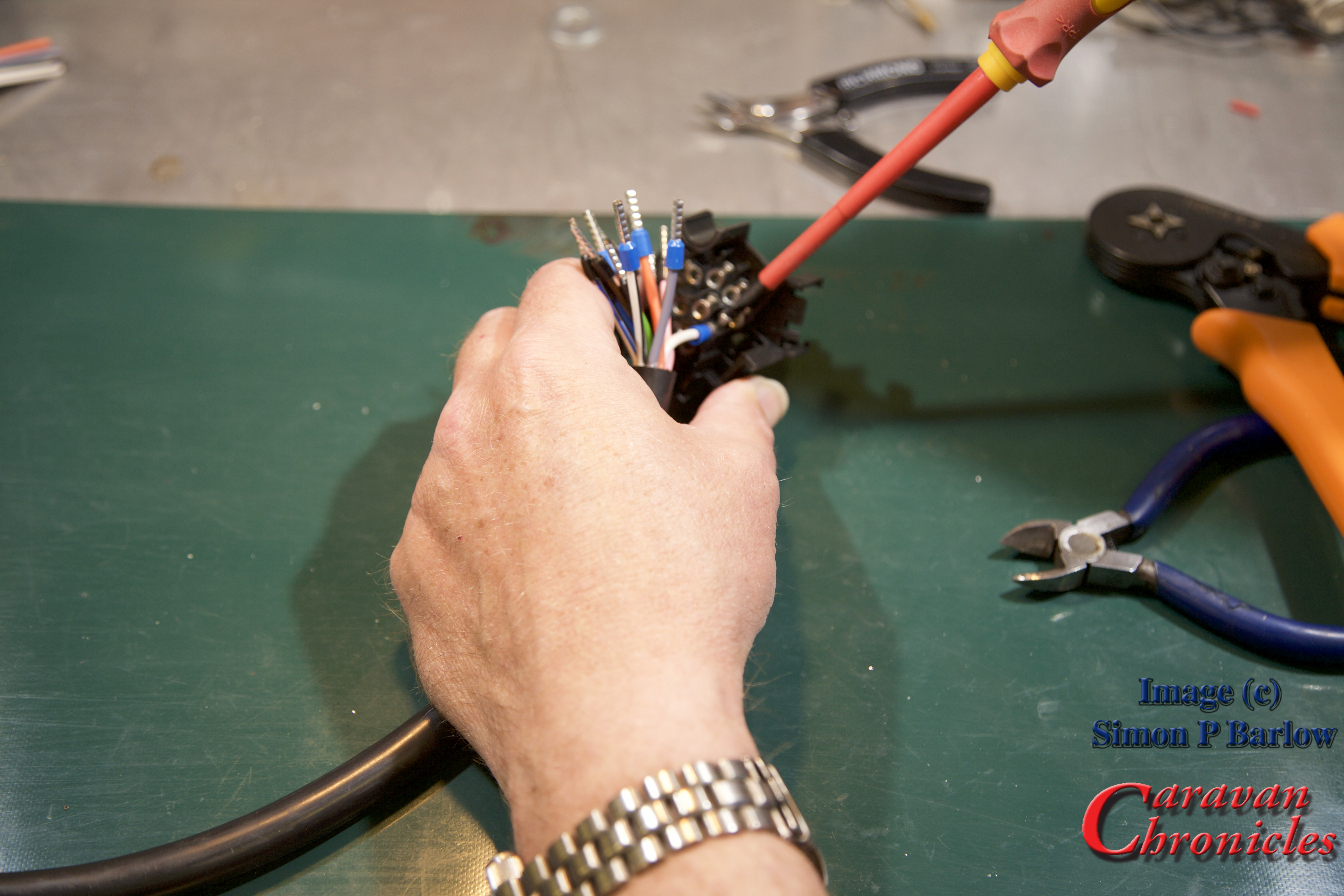
Once trimmed to length, it’s a simple matter of following the colour coding and inserting each cable and tightening the screw. I always start with the four pins in the middle:
Once all the cables are terminated, have a good look to see if all the screws are tight, and of course check the colours are in the right place!
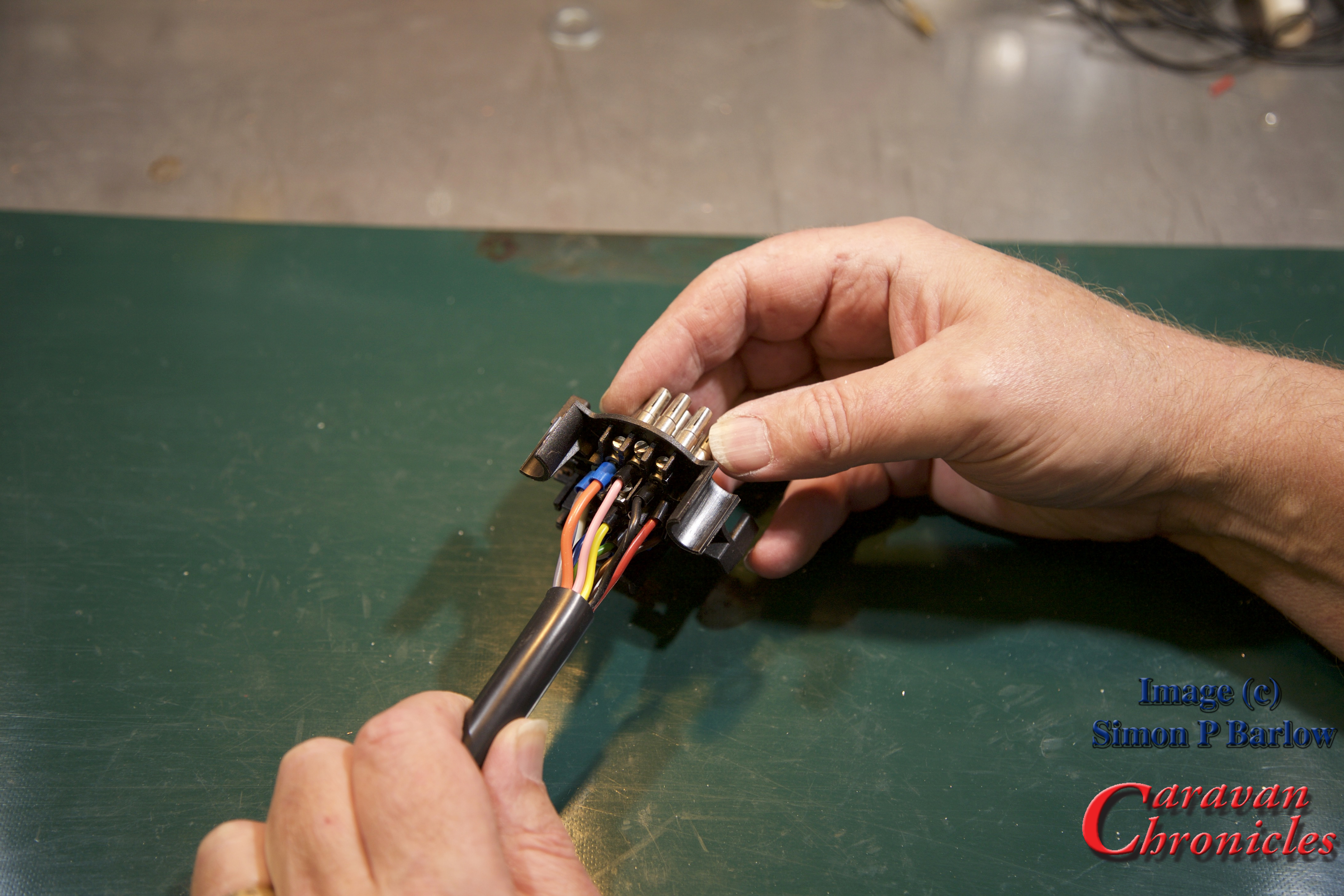
Because the cable was trimmed to the right length before we started there are no loops, so the cover can slide on neatly:
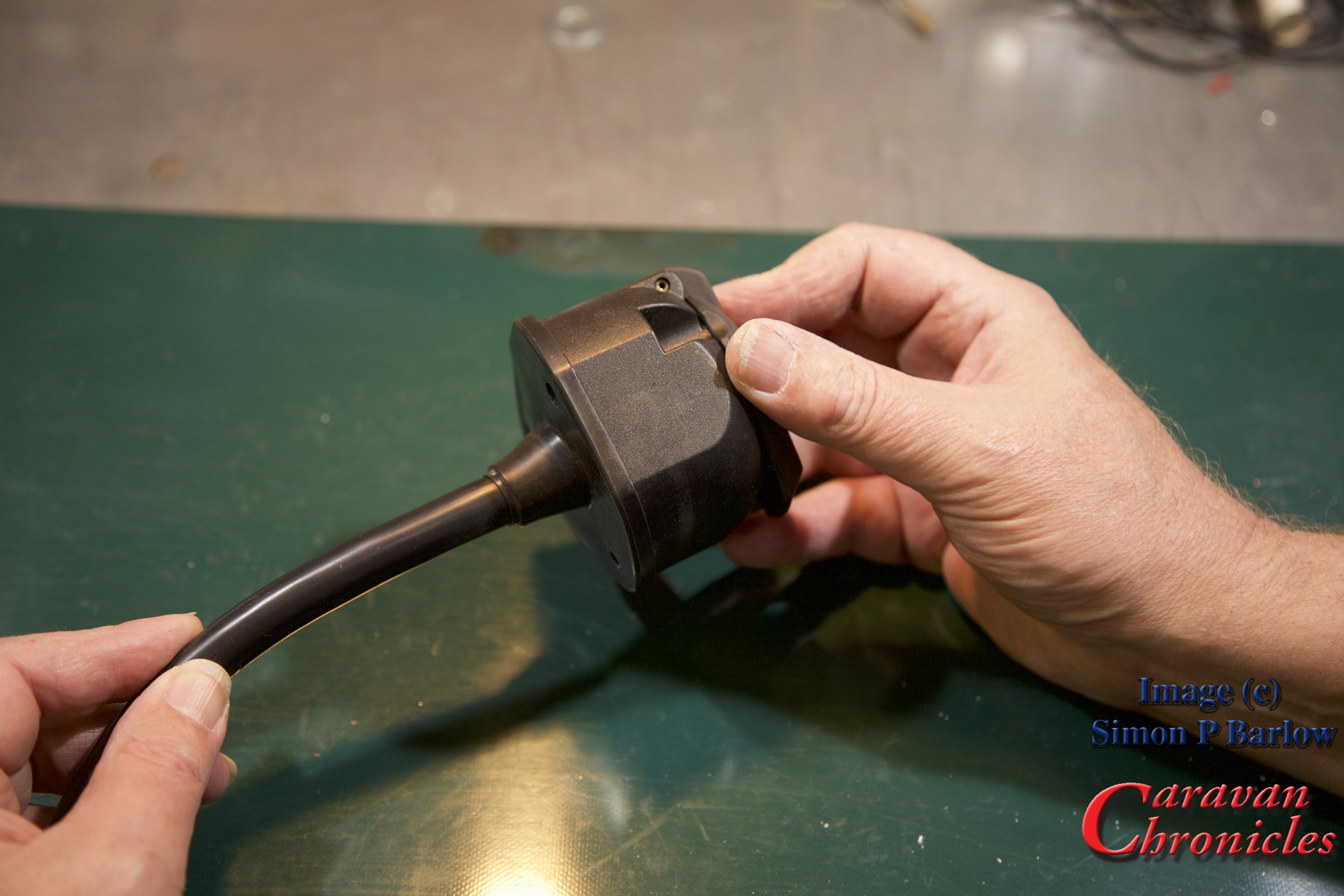
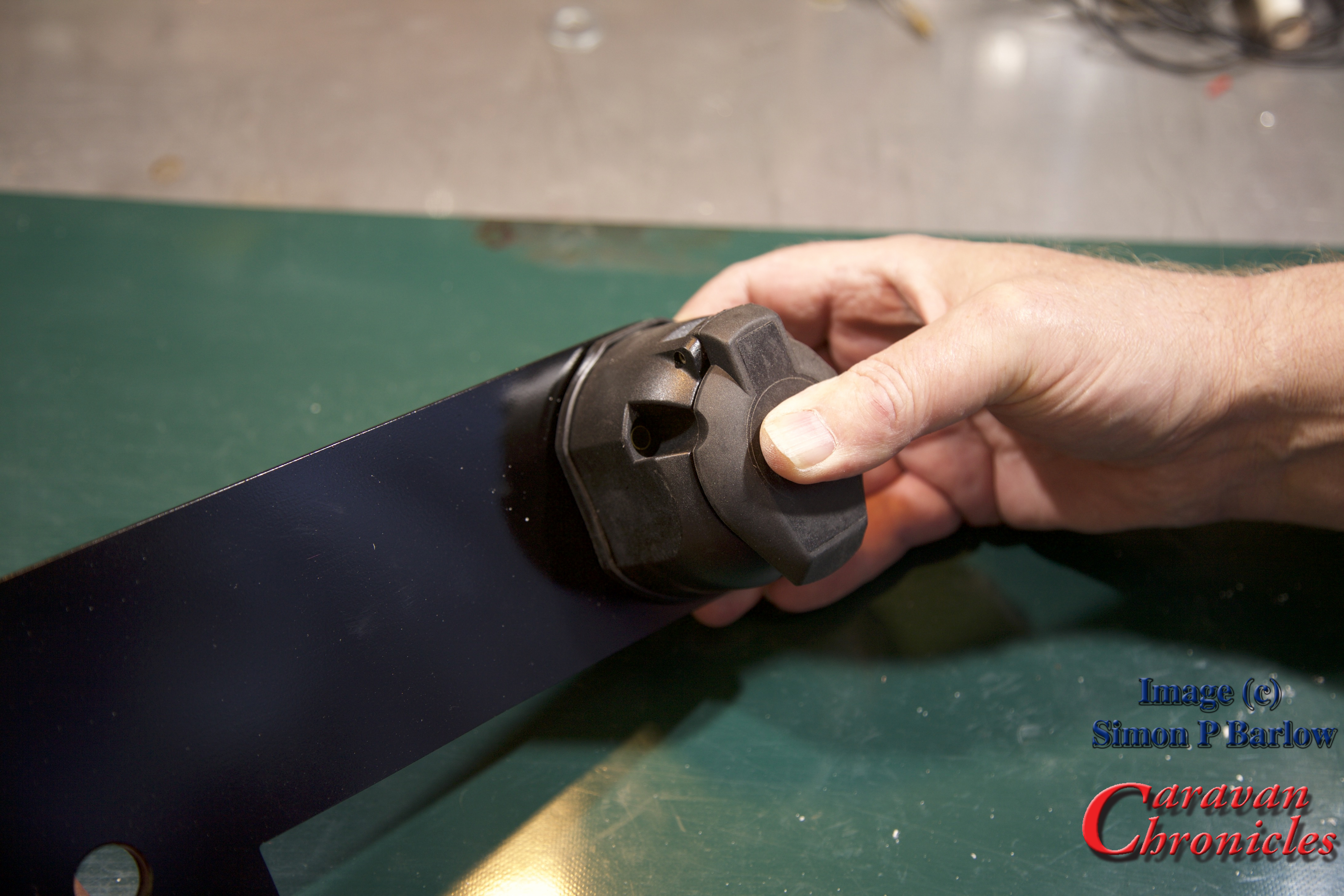
There we go, a finished socket all ready to mount onto the bracket:
To terminate the socket from start to finish and while Sue (thanks `Sue) took all the photos took no more than 25 minutes. Ok it was on a bench and doing outside at the back of a vehicle will take a bit longer, but it’s not that difficult to get a professional result.
The ‘Compromise’
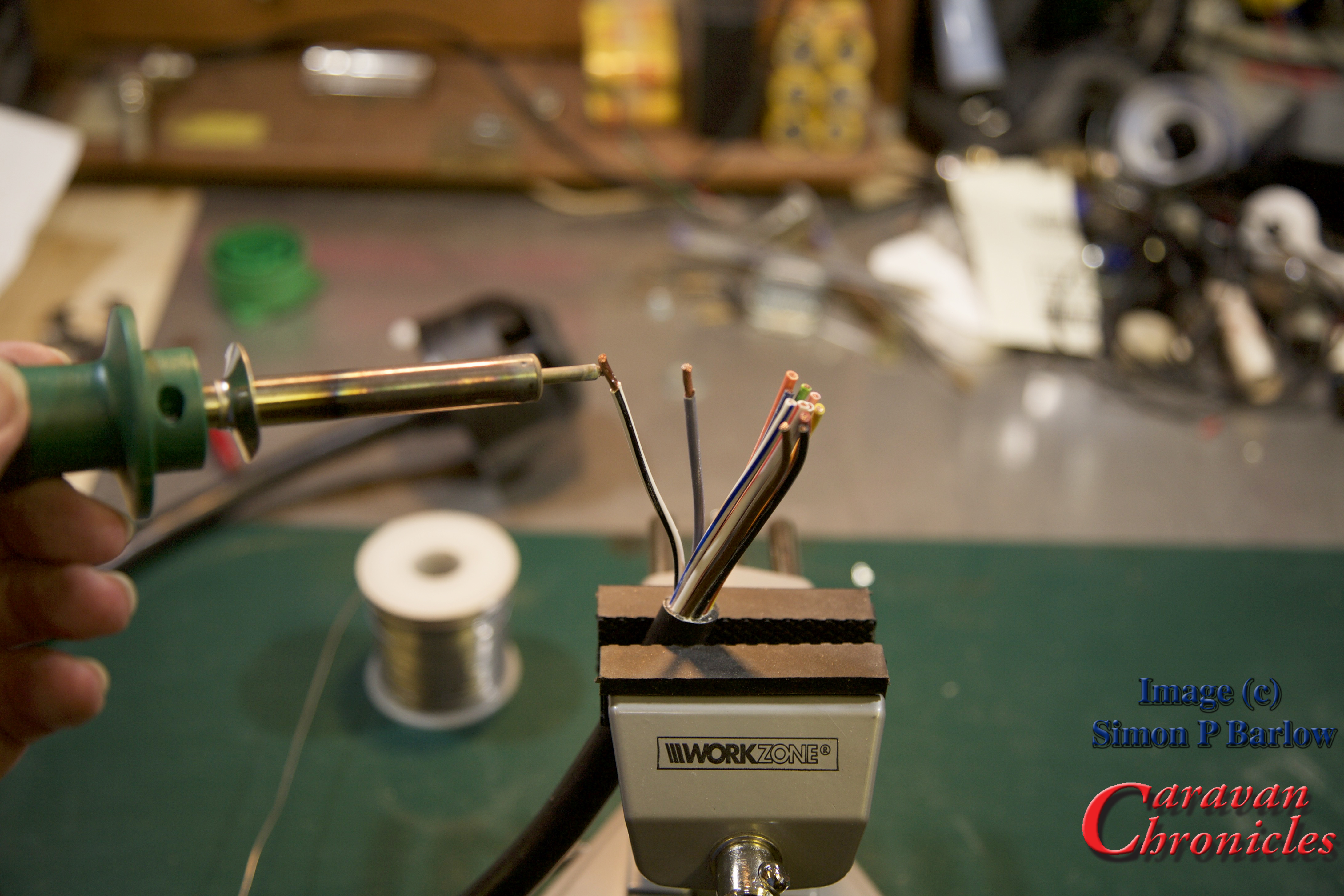
Right back at the start I said there was a compromise – soldering. It’s not difficult to do and achieve and end up with a professional result.
Practice makes perfect and its worth having a go on a scrap length of cable first.
Here’s a few of my tips for successful soldering:
Don’t apply too much heat to cause the insulation to melt (turning down the temperature of the soldering iron or reducing the contact time between the soldering iron and cable helps)
Don’t try to melt solder onto the tip of the iron and run it in to the cable you will burn off the flux too fast… instead touch the solder onto the hot strands of the conductor. Capillary action will pull solder into the strand bundle.
Don’t allow too much solder to be drawn in. You are looking for just enough to still be able to make the outlines of the strands of cable, not a big ‘blob’ of solder on the end.
The solder should look shiny not dull. If it’s dull, the solder cooled too soon as the conductors were not hot enough, this is commonly known as a ‘dry joint’ the solder sits on the surface of the copper.
Avoid breathing in the fumes given off from the flux and the solder. Solder is an alloy of tin and lead… and the flux is pretty nasty too. ( I have an old computer cooling fan that I use to blow the fumes away if I’m doing a lot of soldering).
If you have made the soldered cables too long, you can always trim them back to the correct length. Soldering all the conductors in a caravan cable like this usually takes me no more than five minutes from start to finish.
A few practice runs will soon get you producing good results.
Finally to finish off, I usually give the finished connections a spray of ‘liquid plastic’. It comes in an aerosol can and when sprayed on form a thin plastic coating over everything. You can usually find it in motorbike and automotive shops for waterproofing electrics and HT leads.
It easy to get a good professional result, and I still can’t understand why some tow bar fitting companies don’t either crimp or solder their connections. They usually do when it comes to connecting the other end of the cable to the vehicle. The cynic in me wonders if they are hoping for repeat custom when sockets or plugs start to have problems in the future.
I have been asked where you can purchase some of the products featured above. Here are the links to the products in the Amazon store. If you click on the links and purchase the items, a few pennies will go to helping the cost of running CaravanChronicles.com
Just finding time to catch up on a few things that I haven’t had time to write about over the past few months.
One of the things we bought a while ago – sometime last year I think, was a cheap de-humidifier from ALDI. I was a little sceptical about the performance of such a small and low priced device initially but it seems to work as advertised. We haven’t been leaving it plugged 24 hours a day but just using it when we are out for the day and in the evening. Usually we just plug it in when we get up are and leave it running stood on in the bedroom area on a low shelf near the bathroom door and in the evening move it into the bathroom and put it on the floor. We don’t leave it running overnight.
Each day it averages just over two cups of water. Now that doesn’t seem much, but that water was in the air and it has to go somewhere, usually in the form of condensation. One thing we have noticed is that in the morning when we open the blinds, even when it’s down to a few degrees above freezing outside there isn’t any condensation on the lower edge of the windows or window frame. In the colder months usually we put the towels used from showering over the heated towel rail in the bathroom to dry and I’ve always worried about condensation forming in the caravan, but I think this little unit might have eased my concerns somewhat. I don’t think a de-humidifier is worth running 24 x 7 in a caravan as there are so many vents, but taking the moisture out of the ‘van from day to day living can’t be a bad thing!
I’m sure that anyone that is a four season caravanner will recognise this… in winter you arrive on site around six in the evening in the dark, in the pouring rain. You get to your pitch and it’s a tight reverse manoeuvre on to it. Your partner gets out with a torch to guide you back. In the rain it’s hard to see out of the side windows and mirrors and you partner disappears into the blackness with only a point of light from their torch to give you any idea where they are. You put the vehicle into reverse and the reversing lights on the rear of the tow vehicle light up the front of the caravan like a National Trust stately home but not much else. You now struggle to see the corners and edge of the pitch in the contrast of the brightness of the floodlight front of the caravan. The darkness down each side caravan and the illumination from the reversing lights of the caravan just seem so far away the little orange side marker lights are not much help in lighting up the area around the van.
This has happened a few times to us and I’ve been pondering over it for a while. What I’d like is not only the normal LED awning light but one on the off side of the caravan and on the rear too with the ability to be able to switch on all three to give a general illumination around the caravan when manoeuvring at night. The LED awning light on our Swift caravan is quite effective at providing enough illumination on one side so what about two more being fitted? Or giving the side marker lights the option to be changed from orange to bright white? They could be controlled from just inside the main door and a simple electronic circuit to turn them off after a few minutes or when the caravan is disconnected from the tow vehicle could be incorporated or even off the key fob remote so you could turn them on when returning back to the caravan in the dark.
Off side and rear illumination would be handy too when it comes to the late night “Oh God it needs emptying/filling” moment just as the full moon disappears behind a cloud and the batteries are a bit run down in your torch (or flashlight for our American cousins) and you just happen to be next to the EHU bollard that the light doesn’t work.
Now while we are on the subject….un-hitching or hitching in the dark is also a bit of a black hole, pun intended. Hitching or un-hitching using a torch becomes a bit of a pain and if you wear vari-focal or bi-focal glasses, using a head torch means constantly adjusting it to get it in the right focus area to see. So, while the additional awning lights are being installed, what about a similar light above the front locker that can be turned on to light up the hitch head allowing easier coupling and un-coupling?
It doesn’t have to be standard on all caravans, but what about an “All Seasons Touring” option pack that could include the above and other things… like mud flaps on the caravan? I’m sure you can think of other things as well. So manufacturers….It’s too late for 2016 caravans but what about considering it for the 2017 range?
I think I can feel a couple of projects coming on…
One of Caravan Chronicles long time readers and supporters, Colin “Snowy” Snowden, has sent me an excellent article he has written covering all aspects of upgrading pre September 1998 UK caravans to the 13 pin Euro Plug.
It’s very comprehensive article and goes into detail about the various problems and colour codes that were used and cover some of the changes that are required, habitation relays and details the steps required to actually do the upgrade with steps on fault finding.
If you have a pre September 1998 caravan and are thinking of replacing the original 12N/12S wiring with a 13 Pin plug, it’s an essential read.
Colin has included contact details in the article, but if you have any questions that the answers might be helpful to others as well, you could also post them in the comments section below and Colin will be able to answer them.
I received an email from a gentleman who is a motor home owner and tows a car trailer that wanted a bit of help. Here’s what I received:
Dear Caravan Chronicles
I hope you can help. I have a motorhome which I use to pull a car trailer to classic car racing events. My trailer currently has a Warn winch to help load and unload my sports car but I have recently had a caravan motor mover fitted to help with manoeuvring the trailer with the car loaded. The trailer has one 110Ah battery fitted for the winch, which I have to charge by plugging in the trailer to a mains socket in the motorhome. I asked the company installing the mover if they could install a second 110 Ah battery for the mover and make it so I could charge both batteries while towing. Unfortunately they said it could not be done. I also asked if they could make it so I could link the two batteries if required with a switch, which they also said couldn’t be done. They did advise me to talk to the people that fitted the tow bar. To cut a long story short they also said what I wanted could not be done. Can you come up with something that would work?
Many thanks XXXXXXXX
After a couple of email exchanges to confirm a few things, here’s what I came up with:
Some of the most popular articles on Caravan Chronicles are the “practical” type posts. Anything from the electrical stuff through to little modifications and projects I’ve done. A while ago I had the chance to look through some of the caravanning magazines from the late 50’s through to the late 60’s and they were full of projects. Installing a new roof light, repairing door hinges, updating handles and magnetic catches… in fact all sorts. One interesting early article was about upgrading your caravans road lights to install indicators using the ‘new’ 7 pin plug! Continue reading →
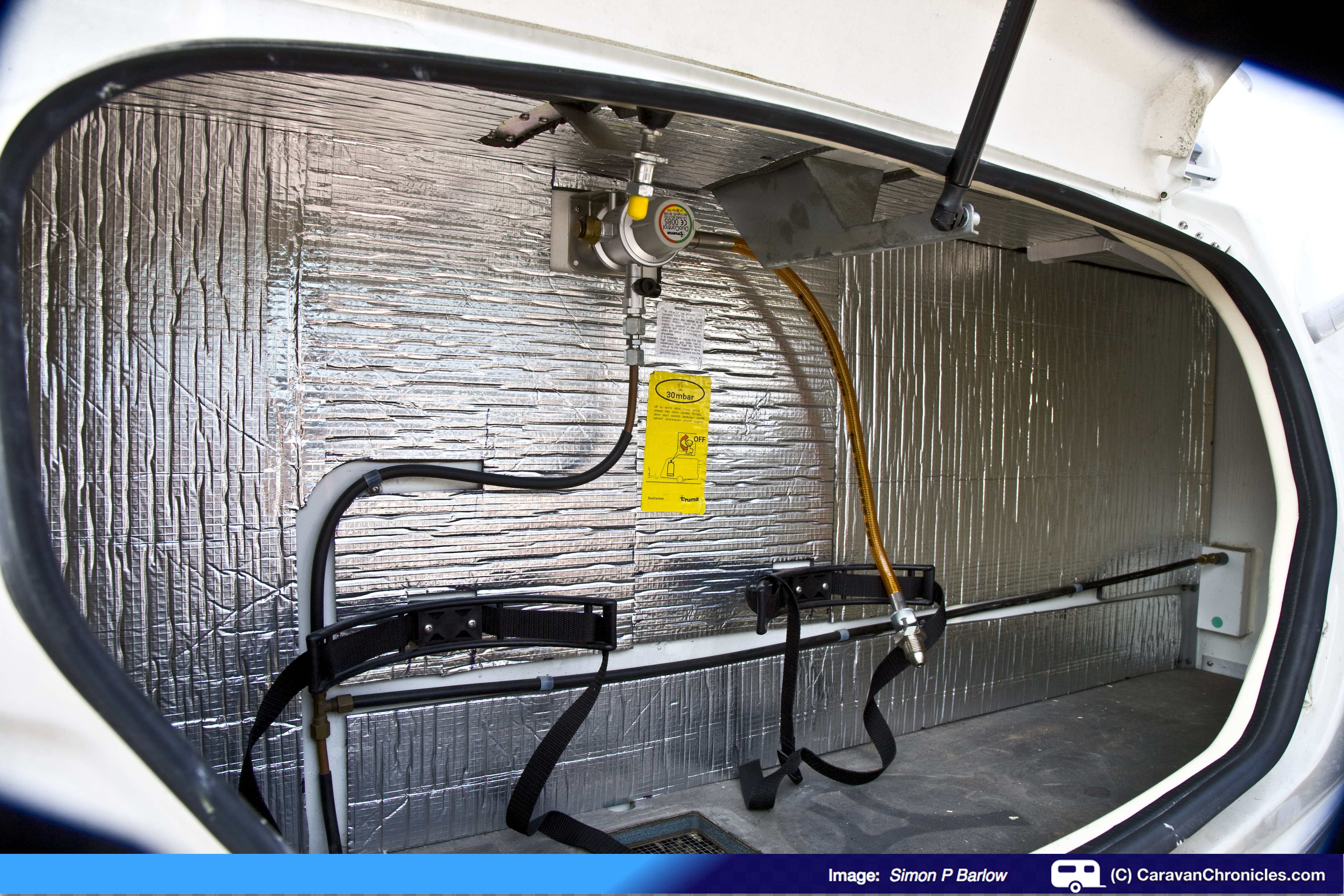
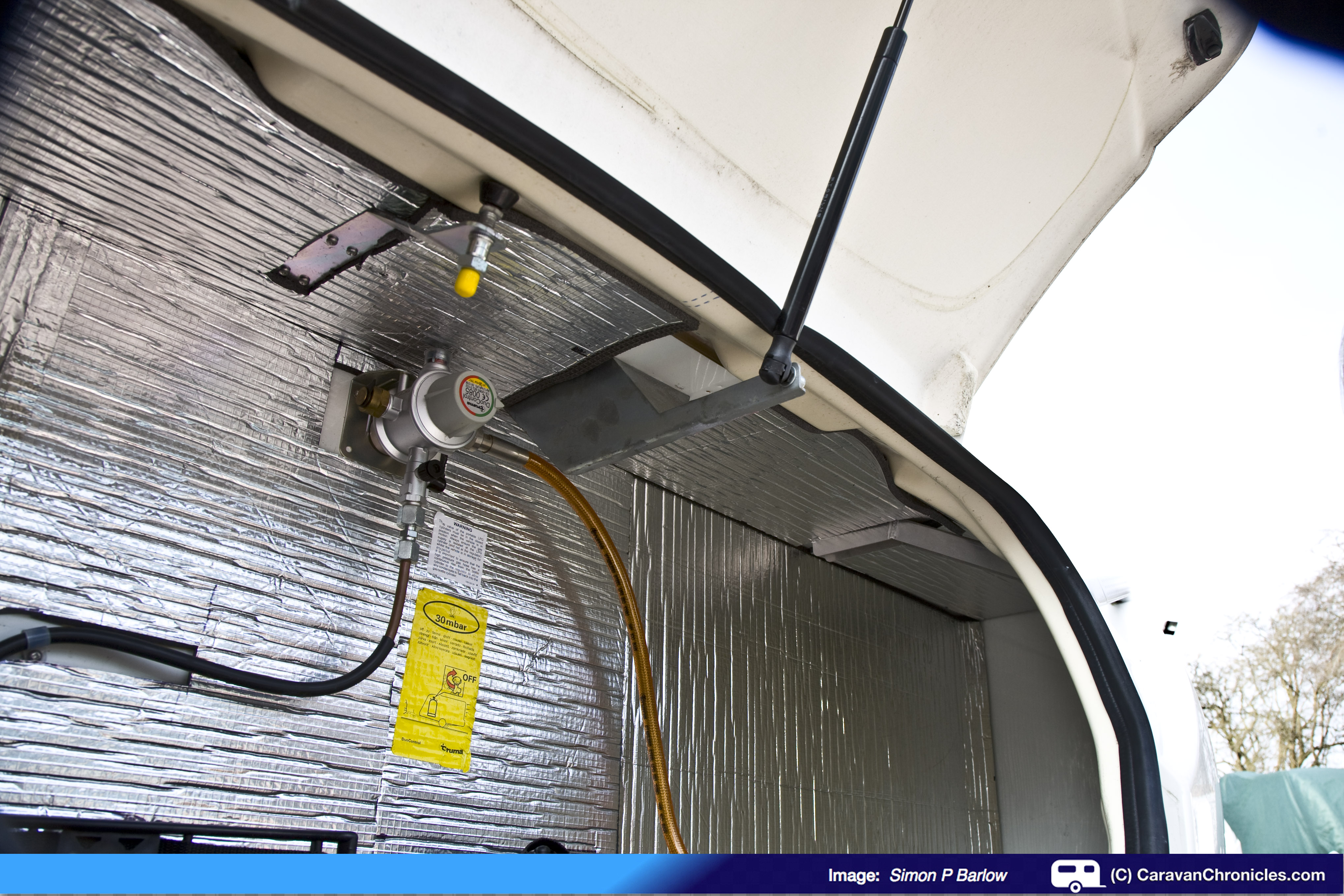
One thing we had noticed using the caravan all year round was the front wall between the caravan interior and gas locker and the window shelf above it always seemed noticeably cooler than the rest of the walls of the caravan. The cupboard under the front draws also was a lot cooler even though it had a blown heating pipe running through it. I’m not sure if it’s just a perceived thing that we think its cooler or if it’s down to the fact that the insulation in the front dividing wall my be a little thinner.
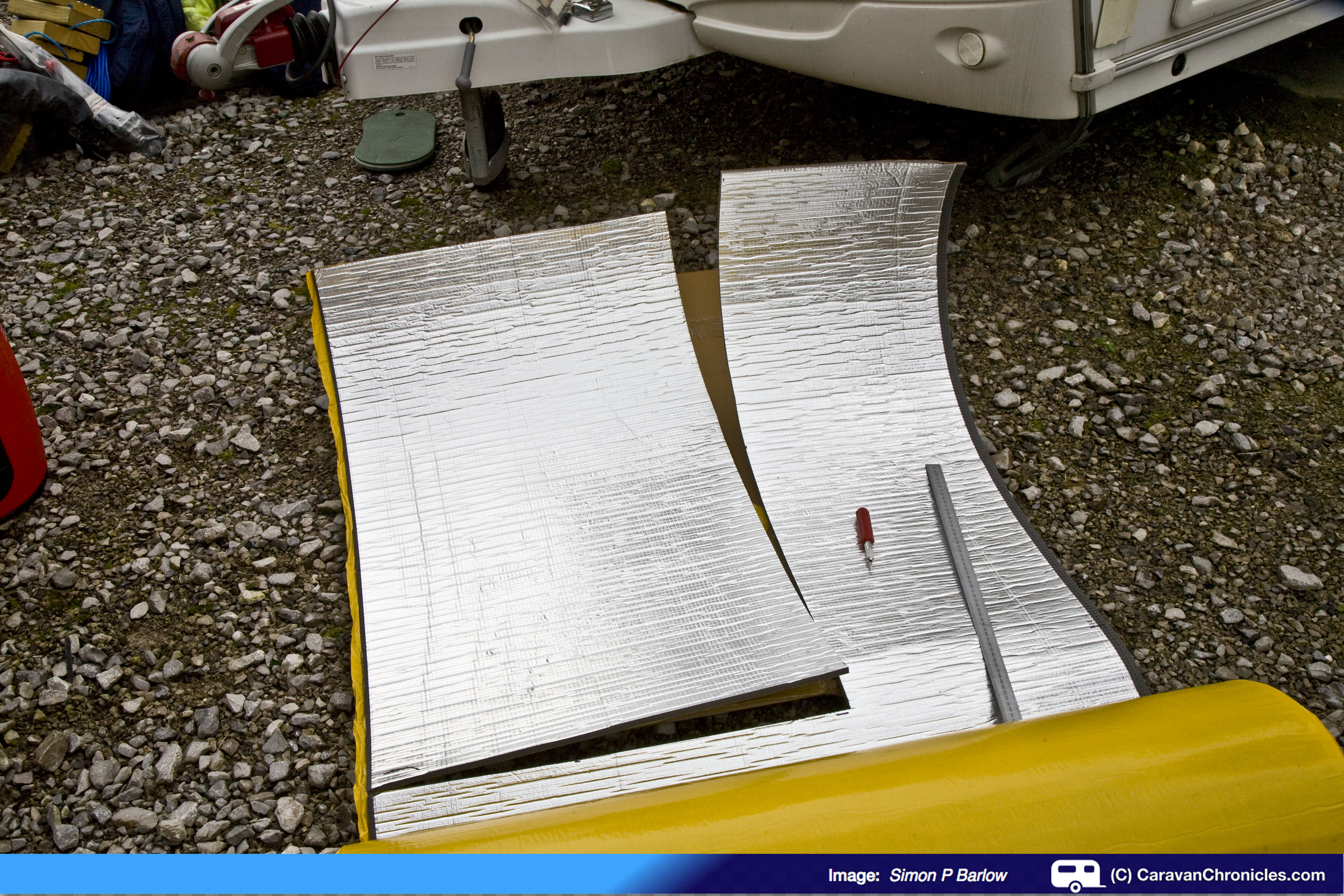
In an effort to try to cure this, I had been on the look out for some sticky backed foam insulation. Searching round the web gave a few results, but it was mainly for sound insulation rather than thermal insulation. However I did eventually discover Foam Solutions UK in Nantwich, Cheshire that offered a whole range of foam for various uses. When I started looking I wanted something that was anti-static and fire-retardant as it was being installed in the gas locker. Foam Solutions UK had just the product, a fire-retardant foam sheet that was designed for use under engine bonnets. I emailed Carole at Foam Solutions UK and she kindly sent out some samples, including a piece of the under bonnet material. A quick measure up and I ordered enough for the front gas locker and to cover the wheel arches inside the wardrobe and under the fixed bed.
First task was to empty the gas locker and give it a bit of a dust out…..
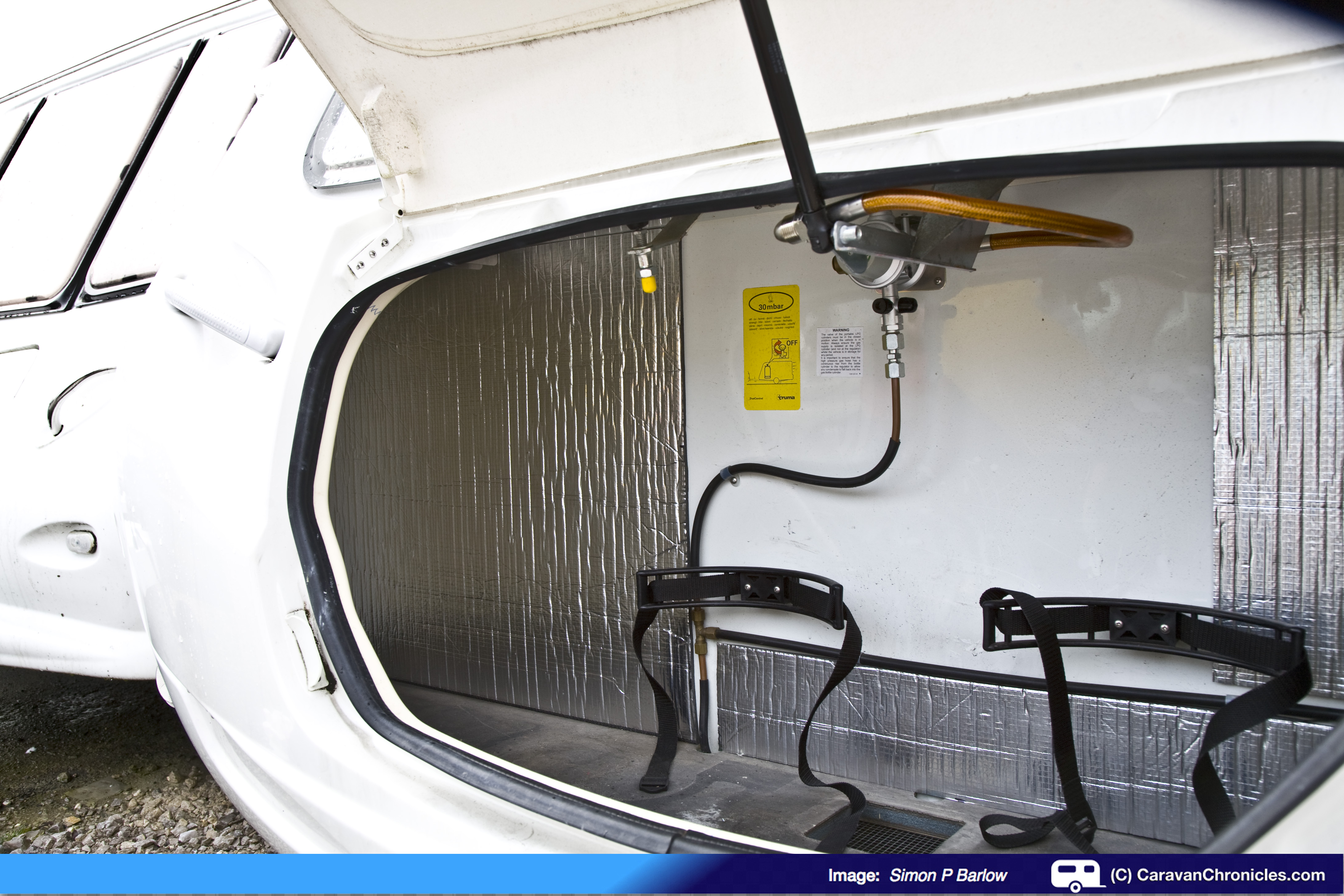
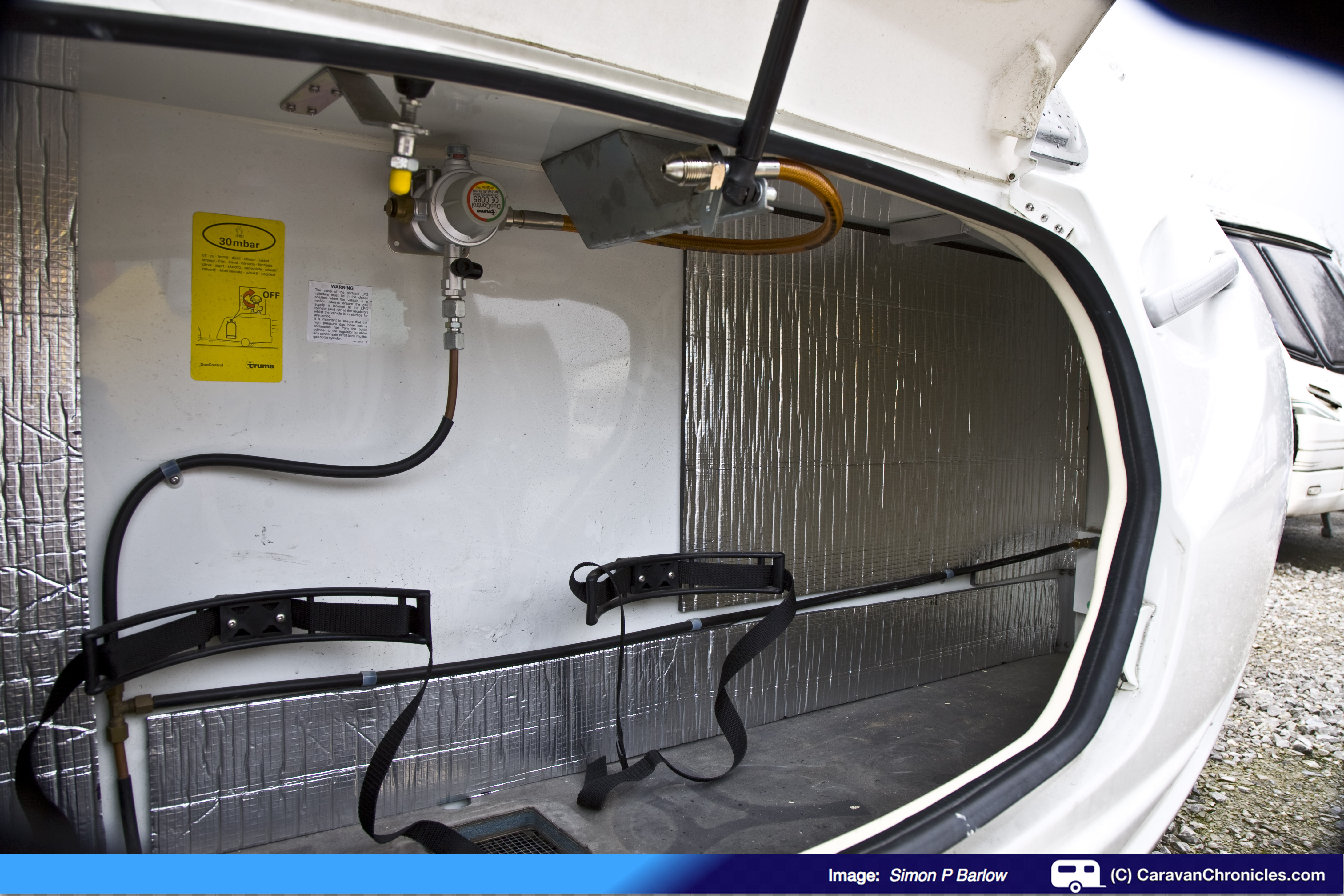
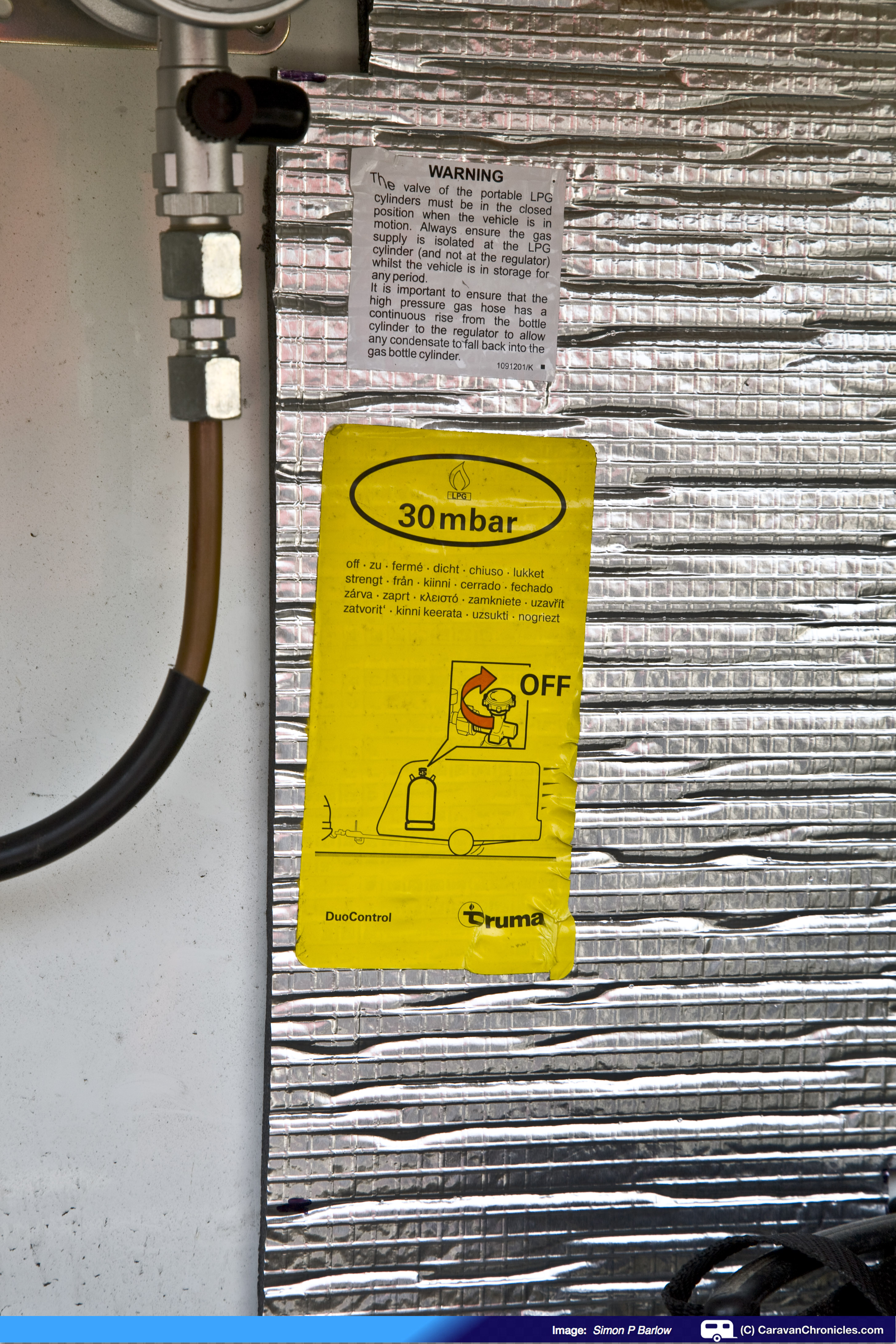
I thought I’d work from both sides into the middle where most cutting would be required. I’d have to make sure non of the gas pipes would be covered so that they could be inspected when it came to the annual service. I also had to make sure that the safety labels and notices were visible, so a bit of careful peeling would be required.
Measuring the first section, the foam was cut with a straight edge and a scalpel in an Exacto knife. I’d taken a couple of large pieces of cardboard to cut on to make it easier.
It didn’t take long to get the first few straight cut pieces installed. One thing though, the sticky back is really sticky and it took a bit of manoeuvring to get the pieces into the locker without sticking them to anything they touched.
I made sure that I left enough gap to inspect the gas pipe or to get to any screw heads that might require checking for tightness in the future. Peeling the labels off in one piece was a bit of a chore… I will probably try to get new ones at some point in the future.
The completed locker….
… and the underside of the window shelf….
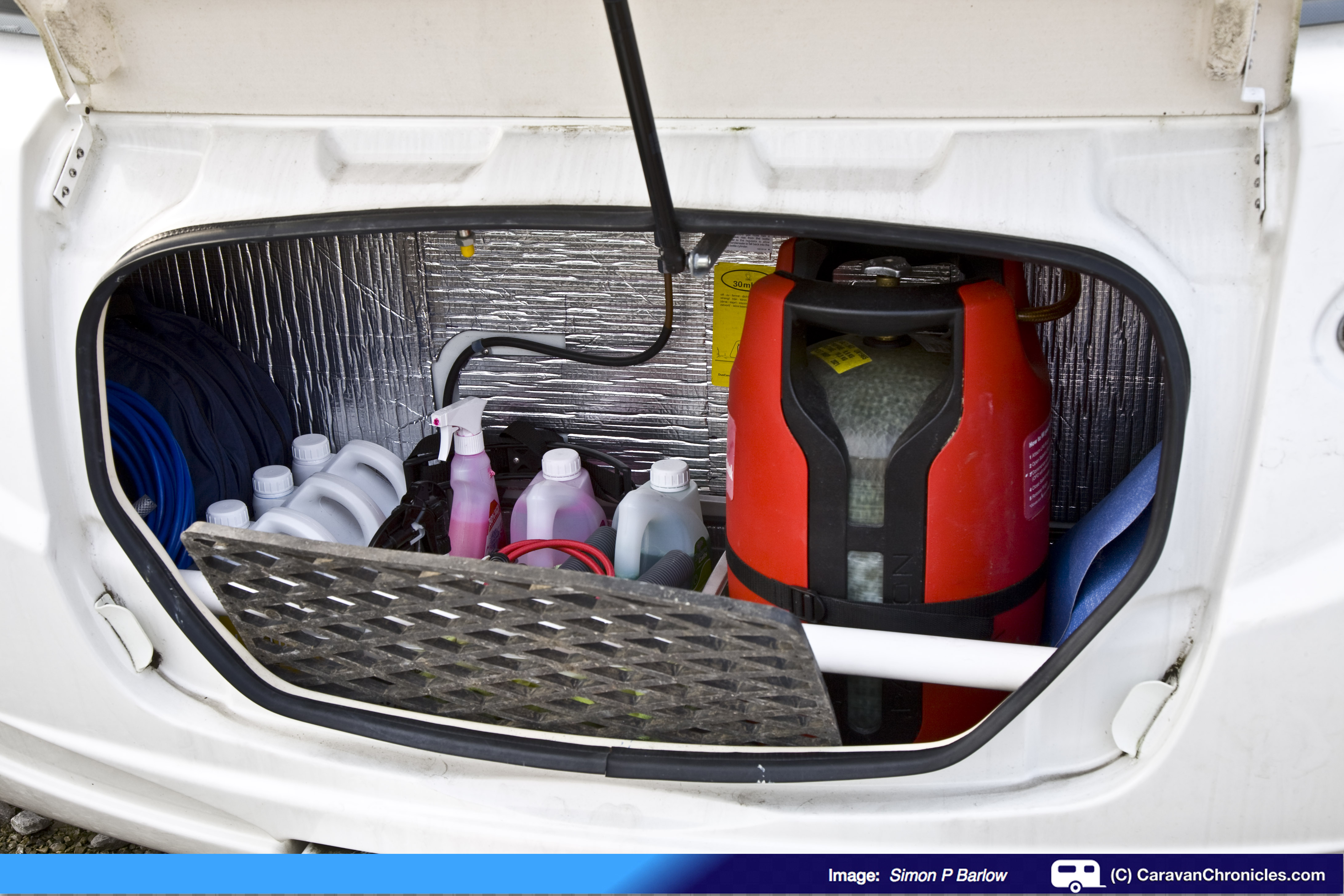
After a bit of a sort out and removing some stuff we haven’t used for a while (saving a couple of kilo’s in weight!), everything was replaced back in to the locker.
The next job will be to do the wheel arches inside the caravan.
Lucky or what!
When I was feeding in the second piece on the right hand side I had to take it out to curve it to get it in position. When I removed it I spotted something stuck to the bottom edge ( I did say it was really sticky!)….. it was my Wedding ring! I thought I’d lost it somewhere between our last stop in France – Camping Risle Seine and reaching home back in October 2012. It could have so easily dropped through one of the various vents in the floor in the couple of thousand miles of towing since then, but there it was, stuck to my piece of insulation.
So another little job crossed off the list. I’m not sure how effective it will be, only time and a bit of cold weather will tell. It might very well be a placebo thing…. but as the supermarket slogan say’s “Every Little Helps”.
Contact Info: Foam Solutions UK, Haymoor Hall, Wybunbury Lane, Nantwich. CW5 7HD or http://www.foamsolutionsuk.co.uk or telephone 01270 842 228 or email Carole: carole_395@fsmail.net
Don’t forget you can follow Caravan Chronicles on Twitter and Facebook… the link do-hickey things are on the left hand side.
Do you get dazzled by the reflection of you vehicles fog lights on the front of your caravan at night?
Someone emailed me about this problem. As he had a 4 x 4 and the fog lights were higher than some cars, when he turned the fog lights on, the front of the caravan was lit up bright red and a distraction. He asked me if I could come up with a simple way of turning the vehicle fog lights off, but leaving the caravan fog lights on…. but making sure it complied with the law.

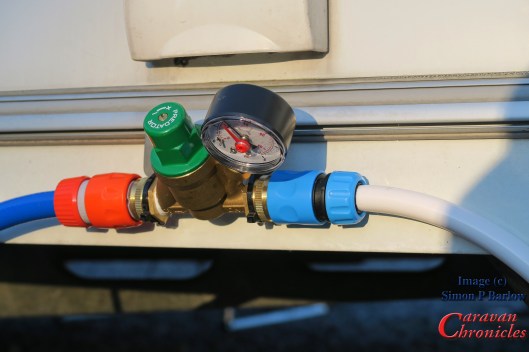 As a temporary mount I used a couple of the small plastic hangars that Fiamma sell that slide into awning rails allowing you to hang things from. In this case a couple of cable ties held it in position. I’m currently in the bat cave folding a small aluminium plate to mount the regulator on that slides into the rail and has a foam padded back to protect the caravan. I opted to use brass fittings for the hose connections rather than plastic just for durability.
 This ‘Y’ fitting has two small ball valves, one of each outlet. So when we go out, I simply turn off the appropriate ball valve. Having a ‘Y’ adaptor also allowed us to fill up our Brita filter jug or draw water off without having to turn the tap off and disconnect the caravan hose. All in all everything worked out perfect. (note I have since changed the blue hose adaptors shown for brass ones for durability).










 Just finding time to catch up on a few things that I haven’t had time to write about over the past few months.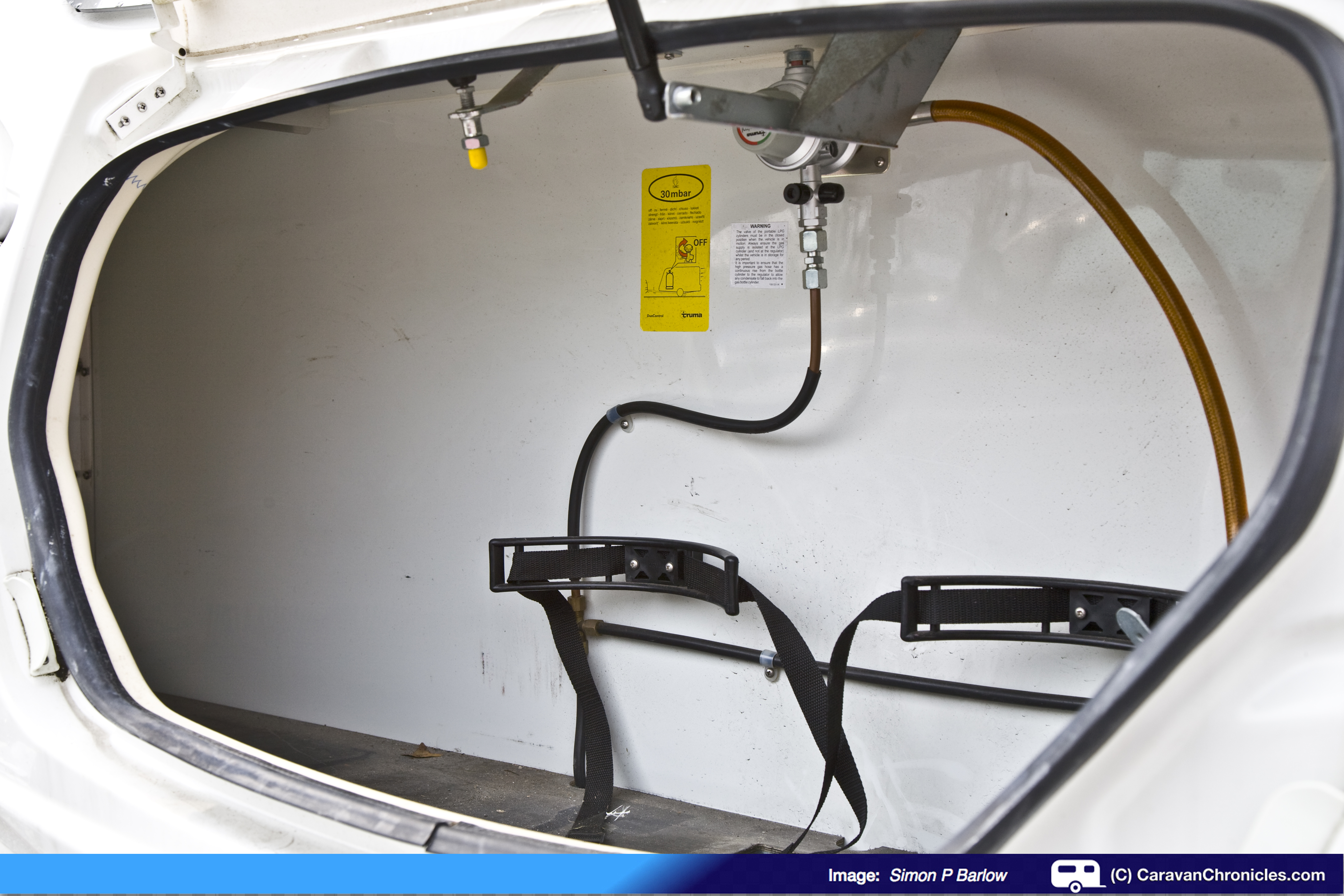
 Caravan Chronicles