• Home
  • Help Guides
    • Storage Sites
    • Equipment Reviews
  • Document Library
    • Electrical Drawings
  • Photo Gallery
    • Caravan Log
    • MPG
  • Trip Map
  • Shop
  • About Caravan Chronicles…
  • Contact
  • Links

Caravan Chronicles

~ not just another caravan blog

Caravan Chronicles

Category Archives: Electrical

Getting All Charged Up – Part 1…

25 Tuesday Apr 2017

Posted by Simon Barlow in Boondocking, Caravan Electrics, Caravan Servicing, Electrical, Gadgets, General, Maintenance, Modifications, Off Grid, Product Review, Reviews, Technical, Tow Vehicle, Uncategorized, VW Amarok

≈ 6 Comments

Tags

Euro6 Engines, Leisure Battery Charging, Maintenance, Project, Regen Braking, Sterling Power Wildside

If you are a regular reader you may remember a couple of posts I wrote about leisure battery charging in caravans and motorhomes (Smart Alternators: how they affect Caravans and Motorhomes…. and NEC Show Roundup – it’s all technical…) and I linked to a few videos that Charles Sterling from Sterling Power has produced covering charging topics and Euro6 engines. At the recent NEC show Sterling Power were featuring a new product that would soon be available that would solve all the issues for caravan owners that were experiancing towing with vehicles that had “smart alternators” which were are standard on Euro5 and Euro6 engines and the issues around regenerative braking on Euro6 engines. Charles promised to send me one of the first pre-production “Wildside” Battery to Battery chargers specifically designed for caravans.
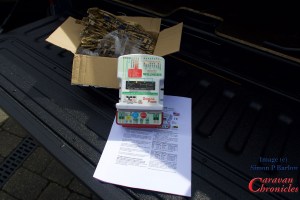
IMG_1127A couple of days ago I was excited to receive   a package from Sterling Power containing one of the pre-production new “Wildside” units. The unit itself is robustly constructed and weighs in at about the same as a bag of sugar – 1Kg.

It comes with a comprehensive 11 page instruction/installation manual that goes through all the steps that you need to install the units and what all the various lights and connections are on the unit itself. For anyone that is familiar with my electrical drawings, Sterling have based their installation drawings on my format so are easy to understand (in my opinion!).

I’ll state now for the record, Sterling Power have sent me this free of charge to install and evaluate and that is what I’m going to do, but I will be honest and tell you if I think there are any issues with the installation or the unit in the way that it operates.

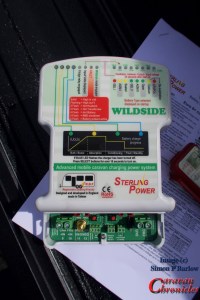
IMG_1131

Looking at the connections for the unit it all looks straight forward. The circuit board is labelled  exactly as the drawings in the installation manual which is reassuring and the manual goes into the various functions of each connection and the programming of the unit.

Why this unit?

Since we had changed from using our 2006 Land Rover Freelander HSE as our primary tow vehicle to our 2016 VW Amarok Atacama I had noticed that our leisure battery was not getting close to a full charge even after towing for a couple of hours. We don’t have a solar charging system installed and relied on the tow vehicle and EHU when on site to keep our leisure battery topped up. I knew about the limitations of smart alternators and have written about them before and answered lots of emails about problems readers were now experiancing. Up to this point I really didn’t have an answer to most of the problems and I was considering going down the same route as our Australian cousins and installing some hefty cables between the tow vehicle and caravan, connected together with Anderson connectors. Works fine down under and would do here, especially coupled with one of Sterling Power’s B2B units which I had been looking at.

Now this would be ideal for us, but anyone who tows using a company car, a lease vehicle or a vehicle on a LP scheme can’t just go ahead and install stuff willy nilly. Unless it is done right, it has the potential to be a bit of a ticking bomb as well and  if I was going to recommend it as a solution there are very few people with experience to do an installation of this type. I have seen some right botch jobs on heavy-duty cabling by so-called “professionals” when installing simple winches and dual battery systems on 4 x 4 off road vehicles. Using a lump hammer, cold chisel and block of metal is NOT the professional way to crimp battery cables!

I was looking round to see if there were other options and talking to the chaps on the Sterling Power stand at the show told me they had a product in development that might just be the solution…. and here we are!

How does it work?

I’m not going to give you chapter and verse on the internals (some of that would be guessing on my part and some is propriety information anyway) so I’ll simplify it as much as I can.

In current tow vehicles you have two connections that supply power to the caravan – one for the fridge which is only live when the engine runs and one for charging the leisure battery which is usually live all the time.  Now the problem is that as it’s quite a distance from the front of the vehicle where the battery and alternator are to where  the leisure battery and fridge are located in the caravan. The size of the cables providing the connections are key to how efficient it all works.

Nearly all good quality tow bar wiring uses 2.5 mm square (2.5mm²) cable for these circuits and they connect between the tow vehicle and caravan through a 13 pin plug and socket (or 12N & 12S in older vehicles). The problem with all this is down to good electrical ‘laws’. In essence the more current you draw through a length of cable the greater the voltage drop ( I go into a bit of techie detail about it here… Understanding Cable and Cable Sizes ) Some people go to the lengths of re-wiring the circuits in 4mm² or even 6mm² cable, which was OK up to a point… usually the point which is the connection between the vehicle and caravan. With the traditional installation what you end up with is two circuits that the voltage is usually too low to provide a good charging capability for the leisure battery and the fridge circuit that might or might not, depending on voltage drop, have some spare capacity but you can’t use it to charge the leisure battery.

Back to the Wildside unit…

What the Wildside unit does and this is really clever, is it takes over the two power circuits, aggregates them and manages the output. It draws the maximum current available through each of the two circuits and provides an output for the fridge always at the correct voltage to maximise the efficiency of your fridge and protect it from the voltage fluctuations inherent with Euro6 and Regen engines and any spare capacity on this circuit it added to the leisure battery charging circuit, steps up the voltage and provides a separate output via a four stage intelligent battery charger to maximise the charging capability to your leisure battery.

This is a very very simple one paragraph explanation, it does have a few other tricks up its sleeve though.

One feature is the “Remote Mode Select” switch option. This allows you to install a switch that will allow you to turn the unit to “Wildside”, “Boondocking” or “Off Grid” mode and run the fridge as though it was being powered from the vehicle. It is actually being powered from the leisure battery.

Take note though… Most caravans and motorhomes are fitted with absorption fridges which use a heated element that is constantly on to make the fridge work. However some motorhomes ( I don’t know of any caravans) are fitted with the more expensive and vastly more efficient compressor fridges which work exactly like your fridge at home but can’t run on gas. If you are camping off grid for a few days with an absorption fridge, then run it on gas. However if you are worried about your fridge not maintaining temperature on an hours ferry crossing or on a euro tunnel crossing then you can use the switch to keep the fridge running. The period you can power it will depend on the capacity of your battery(s)… I would not advise using it with and absorption fridge on a battery bank with anything less than 110Ah capacity.

If you do use this feature on the Wildside unit, it will protect your battery bank from discharging past the safe point by turning off the fridge when the voltage reduces and reaches a critical point that would damage your battries.

You also have the ability to specifically select the type of leisure battries you have installed – GEL I, GEL II, AGM I, AGM II, Sealed, Open, Calcium, LiFePO4 to get the correct tailored charging and maintenance program for your battery bank.

If you are fortunate to have lithium leisure batteries there are a couple of other connections you will need to check out too.

Installation Considerations…

We know what it does so how do we connect it. Well this is where it could get messy unless we have a plan.

IMG_1132

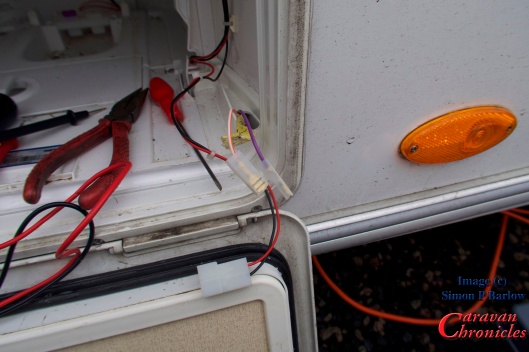
In essence, what do we need to do? Well we have to cut and divert the incoming pin 9 and pin 10 into the Wildside unit and connect one output to the leisure battery. We also need to disconnect the fridge from the caravan’s original control box and reconnect it to the Wildside unit. As the habitation relay is usually buried inside the original control box we need to be able to control this from the Wildside unit. There is a terminal for this (“CVan Dis Output”) but what do we connect to this to make the habitation relay operate correctly?

The original Pin 10 lead that we cut and diverted into the Wildside unit, the other end of this still goes into the installed control box and this will operate the habitation relay. Remember we disconnected the fridge power lead from the installed control box and reconnected it directly to the FRG+ output on the Wildside unit so all it does now is operate the habitation relay.

So summing up, we have to cut 3 cables and re-terminate 5 ends into the Wildside unit. This of course does not include the neutral connections which will be easy and straight forward.

Other Considerations…

The installation of the Wildside unit must be easily reversible so it can be moved to another caravan at some point in the future.

We must also use the correct size cables to connect to the leisure battery as we will now be charging at higher currents than was possible before, the original cable that was installed in the caravan to connect to the leisure battery may not be of a sufficient rating.

We must document the changes properly so that at some point in the future someone can follow what we have done incase they have to fault find.

We must make sure all the connections and general installation are done to a high standard to ensure the installation is safe.

Finally we must be able to do the install without invalidating any warranty on the original installed control unit (i.e. not opening it up) and retain functionality of all the elements of the caravans electrical system. It’s no use installing the Wildside unit if half the electrical features of you caravan don’t work afterwards!
IMG_1130In Part 2…

In the next part I’ll go through the manufacturers electrical schematics of the caravan and show how to find and trace  which cables we are going to look for when we do the install and how we produce a simple drawing showing the changes.

I’ll also come up with a quick check list for all the additional bits (cable, terminals etc) that we will need for the install.

Share this:

  • Share on X (Opens in new window) X
  • Share on Facebook (Opens in new window) Facebook
  • Share on Tumblr (Opens in new window) Tumblr
  • Share on Pocket (Opens in new window) Pocket
  • Share on Pinterest (Opens in new window) Pinterest
  • Share on Reddit (Opens in new window) Reddit
Like Loading...

NEC Show Roundup – it’s all technical…

28 Tuesday Feb 2017

Posted by Simon Barlow in Caravan Electrics, Electrical, General, Maintenance, Modifications, Technical, Tow Vehicle, VW Amarok

≈ 9 Comments

Tags

13 Pin Plug, Caravan Electrics, Caravanning, Caravans, Maintenance, Modifications, Sterling Power, Travel Trailer, Travel Trailers

This is really a follow-up to my previous post – Smart Alternators: how they affect Caravans and Motorhomes….

While at the NEC show one of my big tasks was to get a number of technical questions answered by the industry players. One of my first stops was to Westfalia and to meet up with Rick Sykes and his colleague on the Westfalia stand. Rick is the national training manager for Westfalia and I was able to get answers to a number of questions that you have asked me and I’d not been able to answer fully. Continue reading →

Share this:

  • Share on X (Opens in new window) X
  • Share on Facebook (Opens in new window) Facebook
  • Share on Tumblr (Opens in new window) Tumblr
  • Share on Pocket (Opens in new window) Pocket
  • Share on Pinterest (Opens in new window) Pinterest
  • Share on Reddit (Opens in new window) Reddit
Like Loading...

Smart Alternators: how they affect Caravans and Motorhomes….

15 Wednesday Feb 2017

Posted by Simon Barlow in Accessories, Caravan Electrics, Electrical, Maintenance, Motor Home, Technical

≈ 43 Comments

Tags

Battery Charging, Caravanning, Caravans, Leisure Battery, Maintenance, Towing

I have been receiving a lot of emails over the last two or three months from people reporting issues around charging their leisure batteries after changing tow vehicles and a similar number from people who are having problems with performance of the installation of the electrical harness on their new vehicle tow bar.

I’ve spent quite a bit of time answering emails and thought I’d try to sum up what is happening. A lot of this is also going to apply to Motor Homes, especially if they have a new Euro 6 engine. Continue reading →

Share this:

  • Share on X (Opens in new window) X
  • Share on Facebook (Opens in new window) Facebook
  • Share on Tumblr (Opens in new window) Tumblr
  • Share on Pocket (Opens in new window) Pocket
  • Share on Pinterest (Opens in new window) Pinterest
  • Share on Reddit (Opens in new window) Reddit
Like Loading...

Flushed With Success….. Eventually!

13 Tuesday Dec 2016

Posted by Simon Barlow in Blog updates, Caravan Electrics, Caravan Fault Finding, Caravan Servicing, General

≈ 9 Comments

Tags

Caravan, Thetford Toilet, Touring

You know there are times when I think the service industry is going down the pan.

Right… the prologue

We had driven down to Chapel Lane caravan site to do a bit of partaking of the Christmas Markets in Birmingham and to do a bit of filming with the Venerable Andy Harris of motorhome fame (more about that in the next post though!). We had set up and I was pottering round outside sorting the guy ropes for the awning or the Christmas lights, I can’t remember which, when Sue popped her head out of the door and announced with some consternation… “The toilet won’t flush”

I went in and pushed the button… yep it wouldn’t flush, no pump noise, nothing. I emerged from the bathroom and announced “The toilet won’t flush” at which point Sue gave me the “did you think I was pushing the button wrong or something” look.

Right… check the fuses first, all OK. Out came the tool bag and the multimeter. Voltage going to the loo OK… check the fuse in the bottom of the loo behind the cassette. That was OK too.

Now I don’t believe in coincidences and it just so happened a couple of weeks before the caravan had been in to Glossop Caravans to have a spot of damp sorted and they had replaced the wall board that the loo backs onto. It’s got to be that I thought and said to Sue “I’ll bet it’s when they did the damp and took the loo out”

“Give them a ring now while they are still open”

I spoke to one of the service centre receptionists and they said they would get the workshop manager to ring me back and in due course he did. After a brief conversation he assured me it was nothing they had done and if the loo was getting voltage and the fuse in the loo was OK it must be the circuit board. While he was on the phone I managed one handed to peel back the Thetford sticker on the top of the loo and extract the circuit board. A quick voltage check of the pins that connect to the motor revealed that it was zero volts when the button was pushed.

“It defiantly the circuit board then” he said.

The old circuit board top, with the new one below.

The old circuit board top, with the new one below.

I thanked him and started thinking about our next move while answering an email from the afore mentioned Andy Harris. I just happened to say “loos not working need a new circuit board” and Andy emailed back “Try Jonathan at CAK Tanks” A quick phone call and they did have one in stock… just one. I asked them to reserve it and would pop over mid morning. CAK Tanks was only about 18 miles away and took us 30 minutes to get there. After some double checking to make sure it was the right board… Thetford had very usefully changed the part number and not told many people about it. Handily the new part number was a lot cheaper and it cost £19.36 including the non voluntary contribution to the Chancellor of the Exchequer.

Now, you remember when I said I don’t believe in coincidences.  For some reason I thought I’d just check the connections that Glossop Caravans service people would have disconnected.

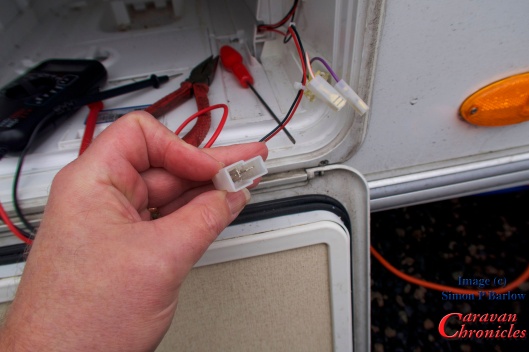
Its easy to extract the connector through the hole in the floor of the cassette compartment and check the connections….

img_0924

On checking the connections it was apparent that they had been connected the wrong way…. i.e reverse polarity!

img_0925

The plug that was fitted by Thetford is designed to be connected one way, but the wiring harness in the caravan used two spade connectors that could be connected in any orientation and this time the person re-fitting the loo had a 50/50 chance of being right or wrong and in this case got it wrong. I re-connected the two space connectors the right way and went and fitted our old circuit board. It worked!

So the morel of this story is there are no such thing as coincidences and before setting out on a round trip of 36 miles and spending £19.36 on a new circuit board… check the polarity!

I think I’ll go a flush the loo again…. just because I can.

Share this:

  • Share on X (Opens in new window) X
  • Share on Facebook (Opens in new window) Facebook
  • Share on Tumblr (Opens in new window) Tumblr
  • Share on Pocket (Opens in new window) Pocket
  • Share on Pinterest (Opens in new window) Pinterest
  • Share on Reddit (Opens in new window) Reddit
Like Loading...

Little Things….

04 Sunday Dec 2016

Posted by Simon Barlow in Accessories, Caravan Electrics, Electrical, Maintenance, Modifications, Technical

≈ Leave a comment

Tags

Caravan, Caravan Electrics, Maintenance, Modifications

One of the little things that has been on my “must do something about that” list for a while is to address the problem we have with not enough places to plug things in and charge them. When we are in the caravan in the evening the front looks like a tech gadget table top sale… Macbook Pro, WiFi router/MiFi device, two iPhones, camera battery chargers, Fitbit charger and all these needed plugging in. The 4 way surge protected power strip I put there just wasn’t cutting it any more.

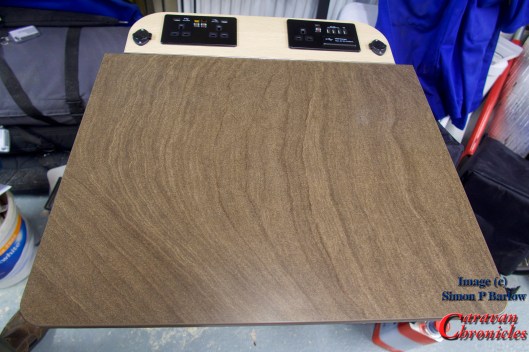
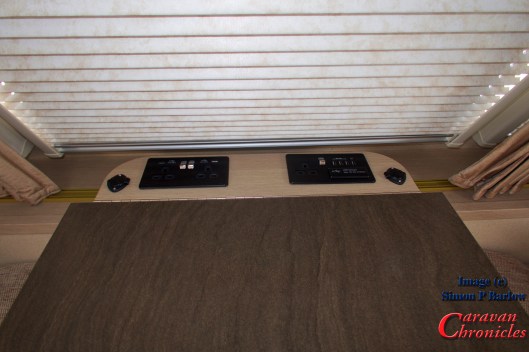
It was time to do something about it. A couple of years ago Swift supplied a kit to modify the drop down TV system that was installed in a range of their caravans. Our caravan already had the upgrade, however they did supply a new piece of wood to replace the installed piece as some of the holes had moved when they upgraded the latches. Always wanting to repurpose things I thought that this could be the basis of an upgrade… not to the TV drop down but to the rear of the draw unit. I wanted to install USB charging ports but still required a couple of 240 volt sockets and a brief search on Amazon I came across what I needed. The other thing I wanted was a couple of 12 volt sockets so that I could use our 12 volt plug-in USB chargers if we were pitched off grid.

To The Bat Cave…

The build was fairly simple. I had already converted the draw top from a slide and swing open operation to a pull out so the addition was straight forward.

The top being assembles in the workshop

The top being assembled in the workshop

It was a simple matter of cutting out the two rectangular holes for the 240 volt face plates and opening up the two existing holes intended for the new latches to the right size for the 12 volt sockets. I did intend to use the same electrical fittings as are already installed in the caravan but pricing everything up it came out at nearly four times the cost of what I eventually used here.

The two 240 volt sockets are wired with 2.5mm multi-strand cable and have slim line back boxes to protect them and the 12 volt cabling is all done with crimp connections and protected with heat shrink tubing.

The whole project including installation only took me a couple of hours and made me wonder why I’d been putting it off for so long!

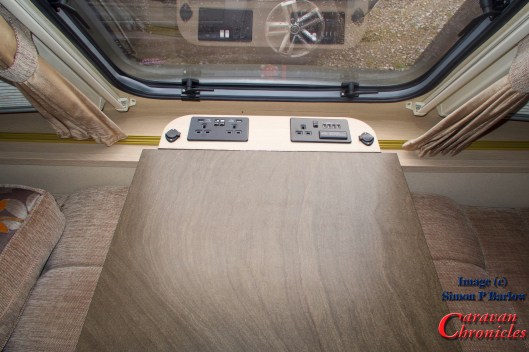
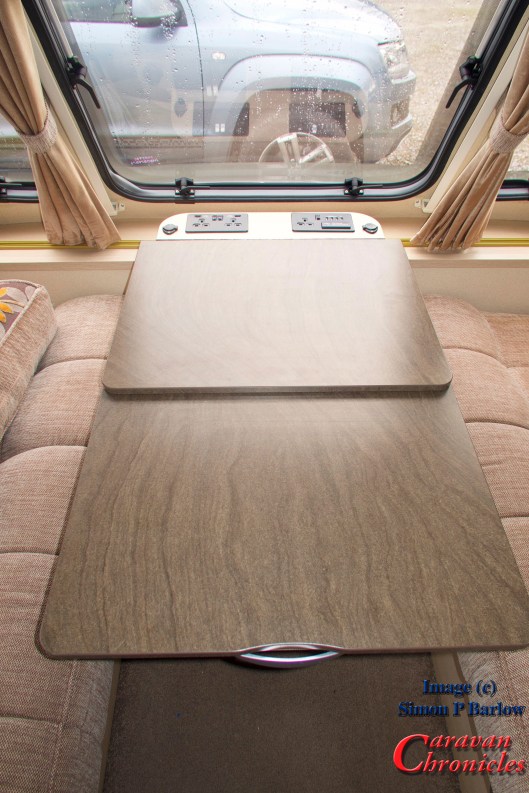
I didn’t want to fasten anything to the structure of the caravan so the piece seems to ‘float’ above the front sill. The wiring was all pre done in the workshop and was easy to connect up to the caravan services as we had a 240 volt and 12 volt outlets nearby in the base of the draw unit.
img_0916

img_0918

img_0921

Plenty of room even with the blind down.

The upgrade now gives me 3 x 240 volt sockets and 6 x USB charging points plus 2 x 12 volt sockets. The space under the sockets can be used to tidy any excess charging cable away while in use.

Shopping...

Use the following bits from Amazon…

Knightsbridge SFAV7USB4MB 13 A 1G Screwless Switched Socket with 5 V DC 5.1 A Quad USB Charger with Chrome Rocker – Matt Black

Knightsbridge SF9902MB 13 A 2-Gang Screwless Switch Socket with Dual USB Charger – Matt Black with Chrome Rocker

The back boxes came from B & Q and the 12 volt sockets came from Go Outdoors caravanning section.

Share this:

  • Share on X (Opens in new window) X
  • Share on Facebook (Opens in new window) Facebook
  • Share on Tumblr (Opens in new window) Tumblr
  • Share on Pocket (Opens in new window) Pocket
  • Share on Pinterest (Opens in new window) Pinterest
  • Share on Reddit (Opens in new window) Reddit
Like Loading...

Caravan Chronicles Shopping…

21 Thursday Jan 2016

Posted by Simon Barlow in Accessories, Blog updates, Caravan Chronicles Shopping, Caravan Electrics, Help Guides, Projects, Technical

≈ 1 Comment

Tags

Caravan, Caravan Electrics, Caravanning, Maintenance, Modifications

I receive a lot of emails asking where people can buy some of the tools – especially some of the crimp tools and terminations I use in my posts and articles. In the past I have just emailed people back with the details and maybe links. However my last post about cable termination brought on a rather large amount of requests. So I have decided that I will include links to the products on Amazon. So from now on you will see a section at the bottom of any posts called….

Caravan Chronicles Shopping...

Any specific items used will be listed, and by clicking on the link to the item you will be taken to the Amazon store page. If you do decide to purchase anything, it will be from Amazon (or their associates) and delivered by them. It’s just like buying from Amazon directly.

The price you pay is exactly the same as it would be by going directly to Amazon. All I receive is a few pennies from each sale that will help towards keeping the wheels of Caravan Chronicles turning.

I have also created a shopping page that lists the products under a link to the original article. There aren’t any photos, just descriptions to keep the page neat and quick to load. If you want to go back to the article, just click on its title.

I hope you don’t mind me doing this, but it will save you having to email me asking where to get things from and save me a bit of time in replying to everyone.

Cheers

Simon

Share this:

  • Share on X (Opens in new window) X
  • Share on Facebook (Opens in new window) Facebook
  • Share on Tumblr (Opens in new window) Tumblr
  • Share on Pocket (Opens in new window) Pocket
  • Share on Pinterest (Opens in new window) Pinterest
  • Share on Reddit (Opens in new window) Reddit
Like Loading...

Cable Termination 101…

03 Sunday Jan 2016

Posted by Simon Barlow in Caravan Electrical Fault Finding, Caravan Electrics, Electrical, Help Guides, Maintenance, Modifications, Technical, Tips

≈ 10 Comments

Tags

Cable Termination, Caravan Electrics, Caravanning, Maintenance

As it’s now the ‘off season’ for a lot of caravaners and thoughts turn to sorting out those problems that we put up with on the last couple off trips, I thought I’d look at cable terminations. One of the problems that I’m asked about revolves around cable termination in trailer sockets and plugs. Like most things there is a right way and a wrong way of doing it and there is also the compromise.

So what’s the problem?

Well the problem is terminating a cable to a solid metal part. You will most likely see cables that are striped down to the copper conductors and the individual strands twisted together then inserted in a hole with a screw tightened down to hold the conductors. So whats the problem with this? When you tighten the screw it’s turning obviously and the end of the screw twists down on to the strands of cable, often breaking a few off and pushing quite a few out-of-the-way, usually in an average termination about a quarter of the strands are not held under the screw tip. The 2.5mm square cable you thought would reduce volt drop for the battery charging circuit is now reduced to something less and its current carrying capacity is reduced. Is there a solution?

The obvious one would be to solder the ends of the cable to stop this happening and it’s a great solution, but is does have drawbacks. When you solder the end of a flexible cable the point where the solder stops becomes a weak point and is susceptible to vibration and flexing stress and the thin copper strands transition from being flexible to a solid mass. This is why in aviation, marine and military applications soldering is not usually permitted.

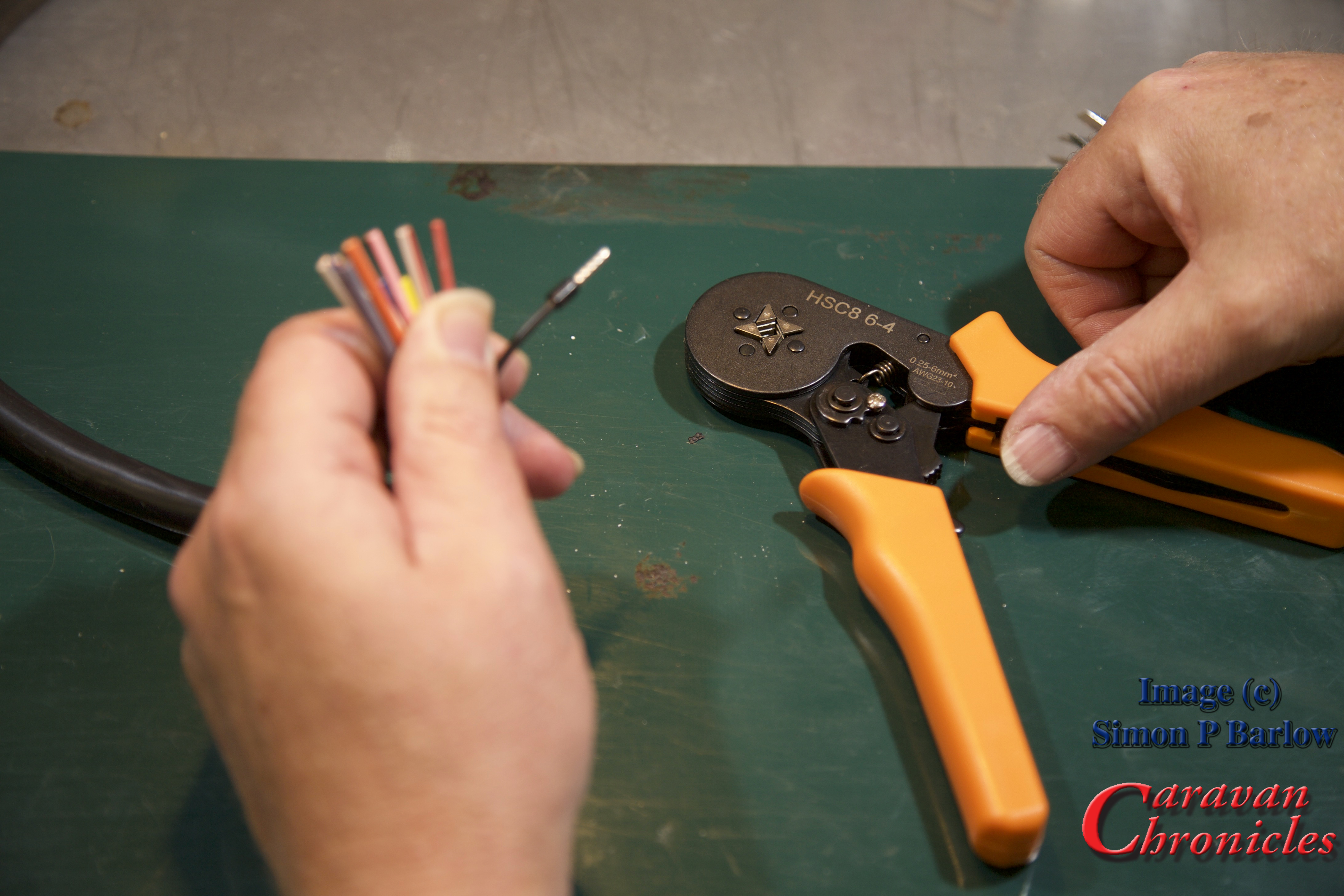
The correct way that flexible conductors should be terminated is by crimping on a “boot lace ferrule”. These are simple brass tubes, sometimes nickel-plated that are slid over the untwisted strands of the conductor and crimped tightly. Some ferrules are just small tubes or ‘U’ shaped section machine crimped and some have a plastic insulator to help isolate the conductor when several are installed in close proximity.

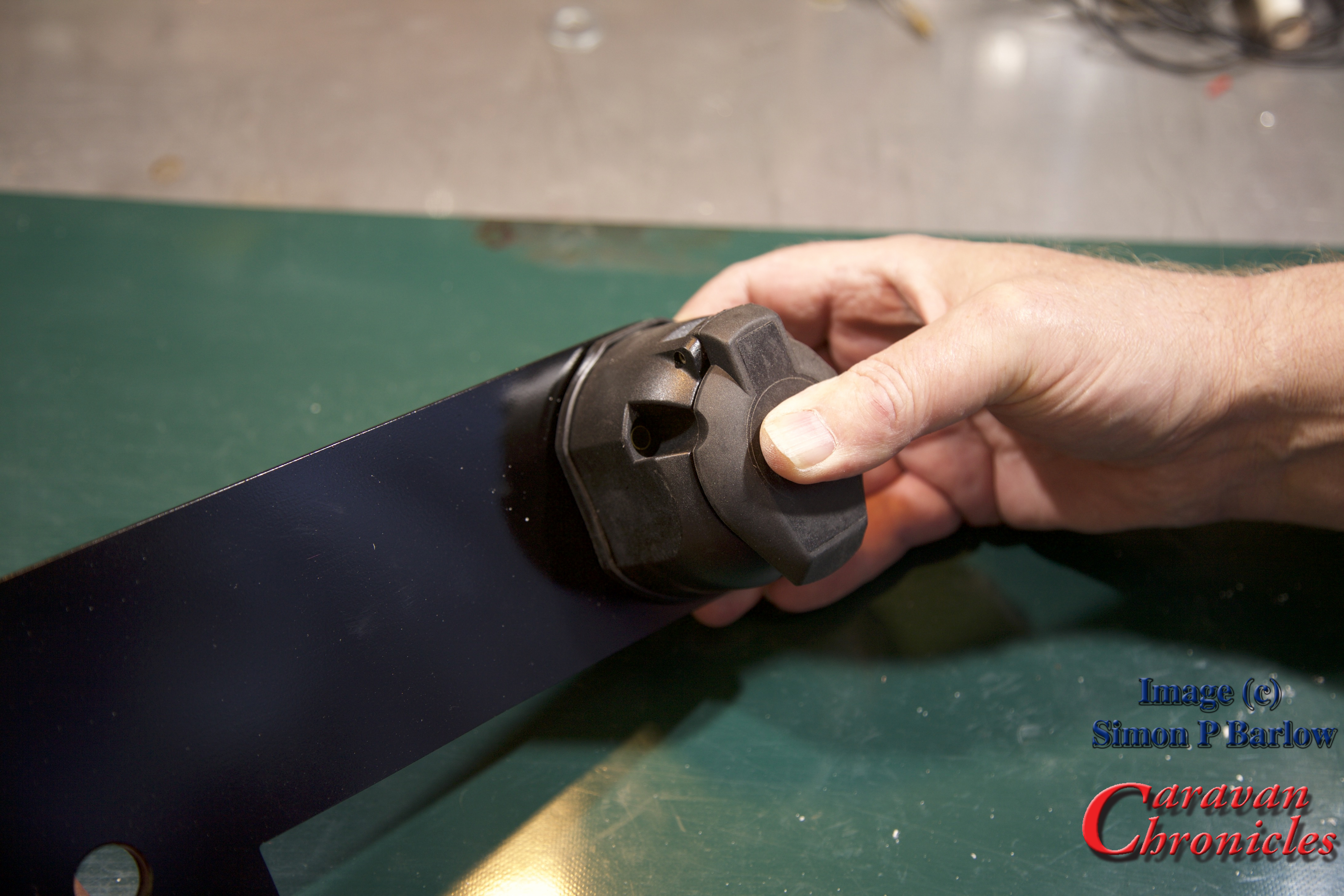
Here’s a simple step by step guide to crimping and terminating a 13 pin trailer socket. It could equally apply to a trailer plug.

For the photos I used a spare socket and short length of standard multi core cable. I have links to all the items, including tools used in the article in “Caravan Chronicles Shopping” at the end.

SPB_5D_098392

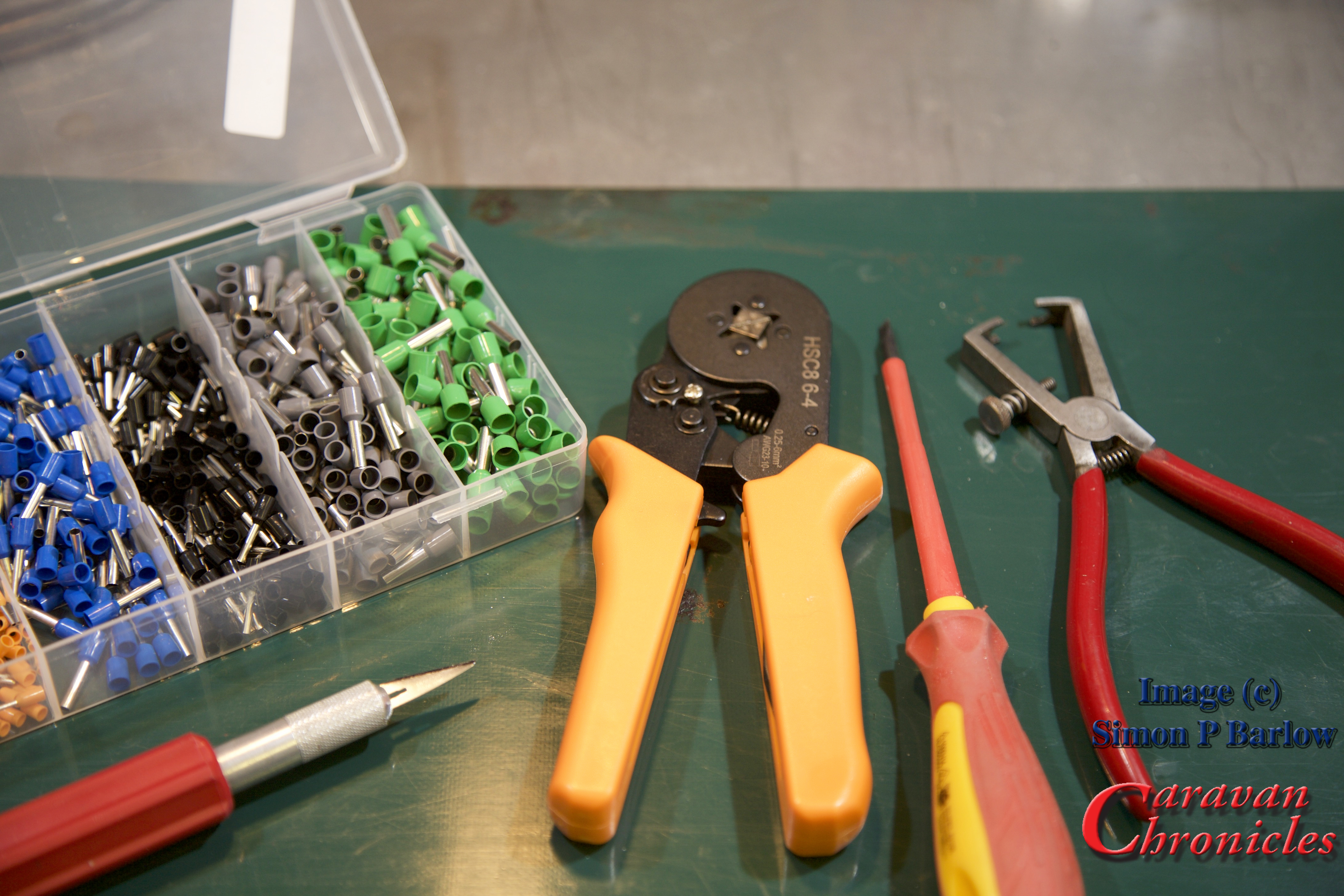
The tools required are a sharp knife, cable strippers, screw driver, ferrule crimps and the ferrules. (tip: make sure your screw driver is a ‘terminal driver’ with flat parallel faces and if fits snugly into the screw head. As the screws are brass, it’s easy to damage the head using the wrong screwdriver)

SPB_5D_098398

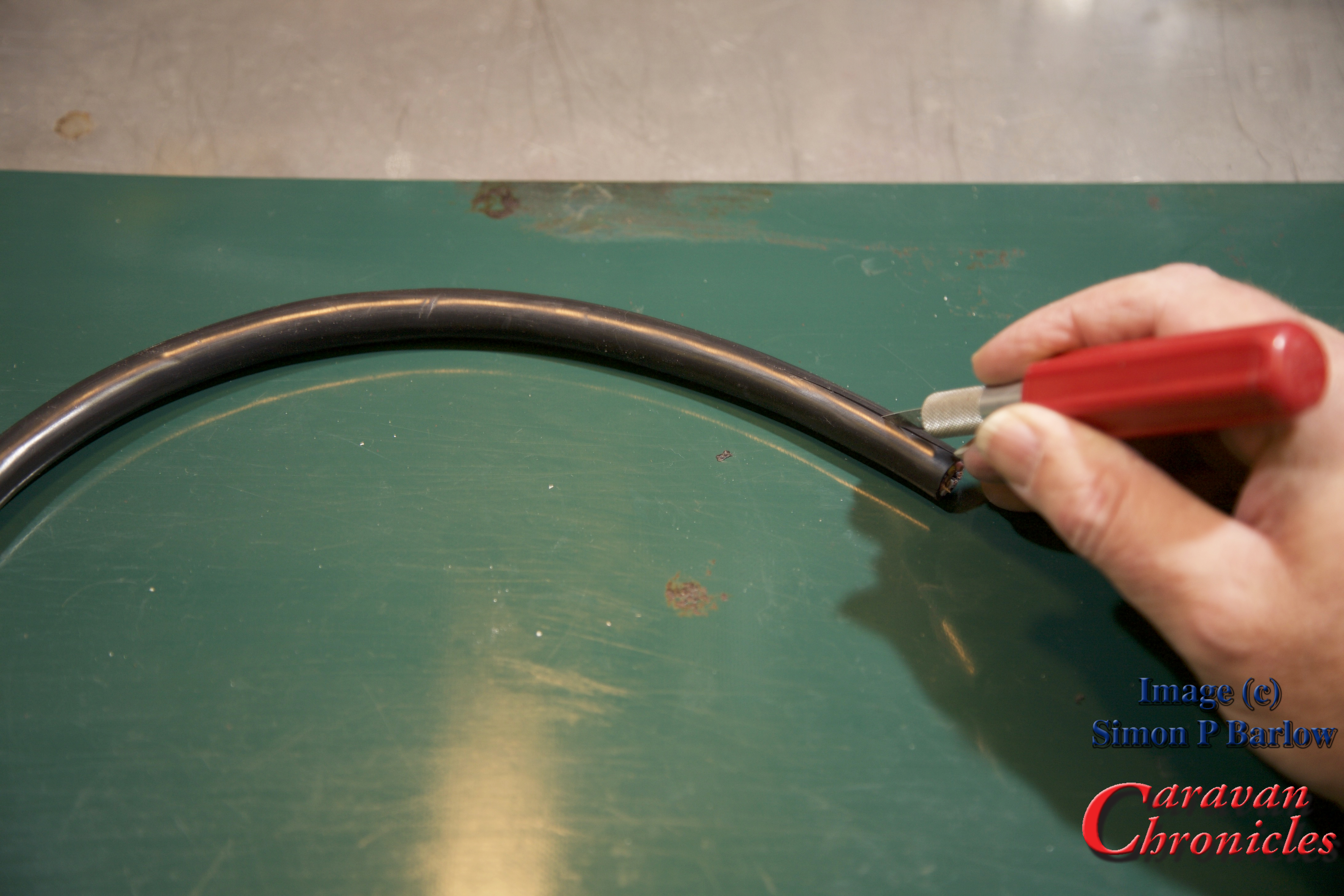
The first step is to trip back the outer cover for the cable. Strip back enough so that the individual cables are long enough to trim to length:

SPB_5D_098399

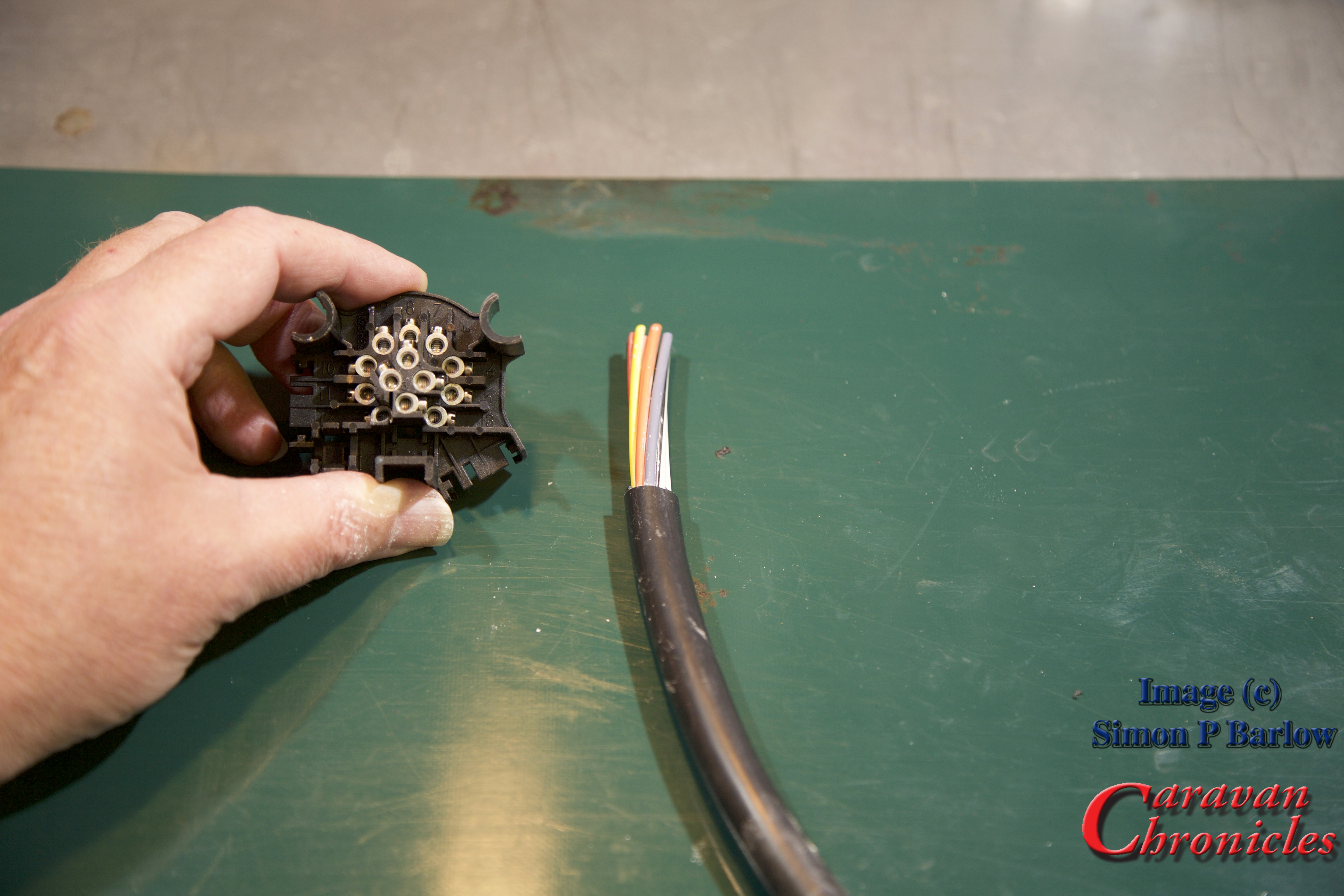
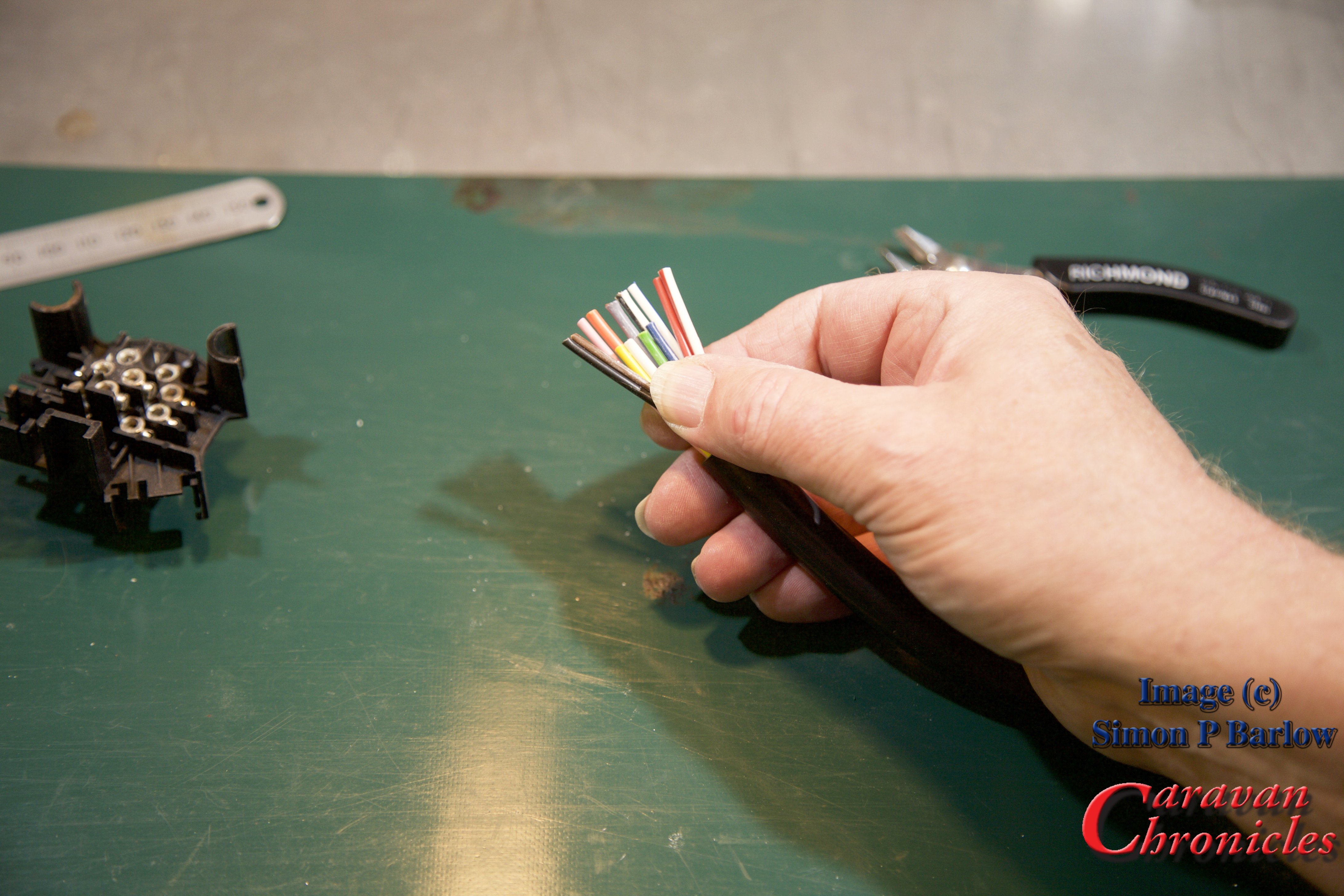
The next thing to check is have you got the right end of the cable? The cable manufacturers lay the individual conductors in a specific pattern so that when stripped, the pattern of colours is in the right order for the end you are terminating. If you have the incorrect end of the cable you will have to cross all the colours over each other to install them correctly in the plug (or socket) As you can see, this is the wrong end for a socket:

SPB_5D_098401

Ok, I’ve stripped the other end and you can see the colours are in the right ‘order’ for terminating a socket:

SPB_5D_098402

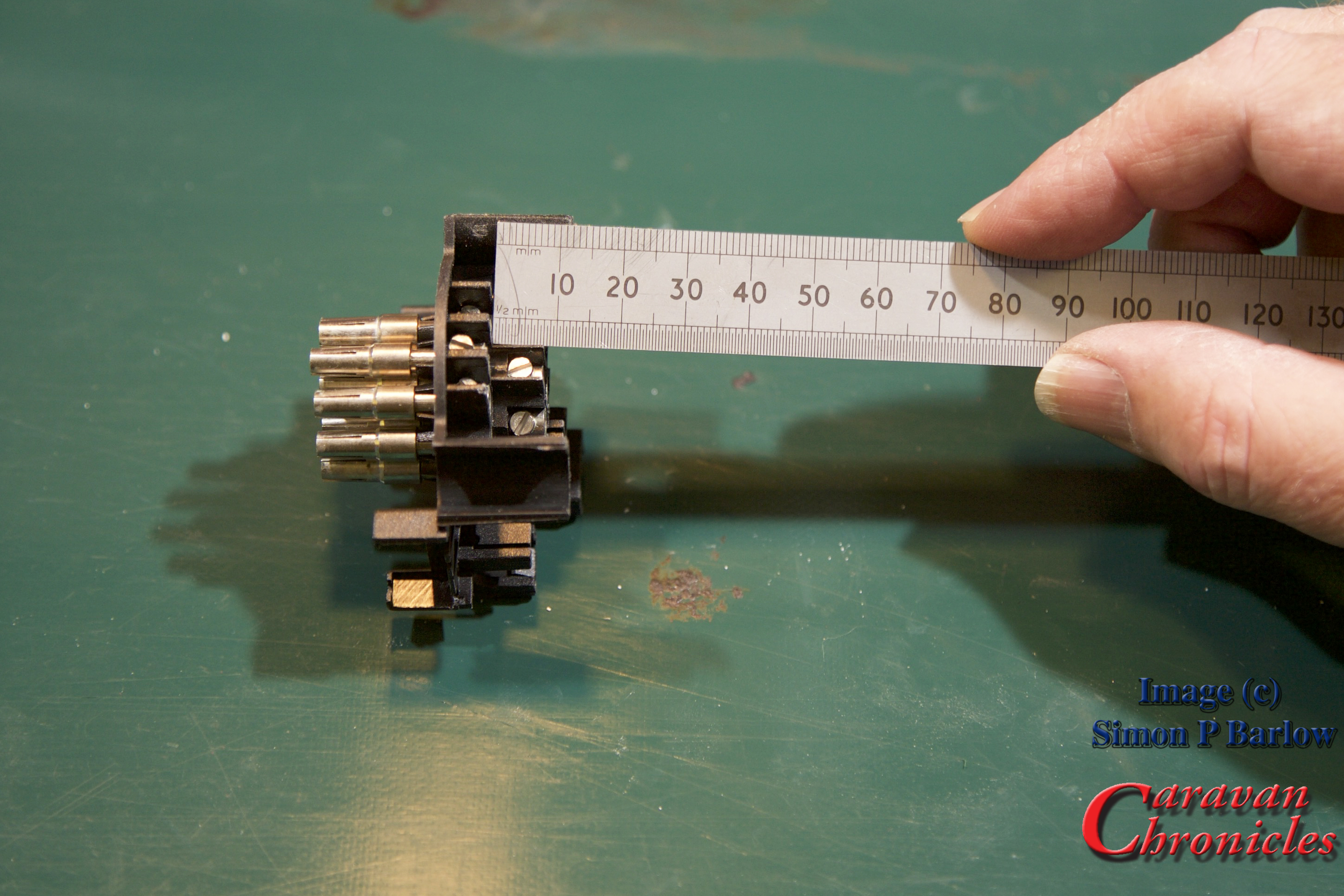
Next we need to measure the difference in termination length between the four centre line and the 9 outer pins… here it’s about 8 mm:

SPB_5D_098404

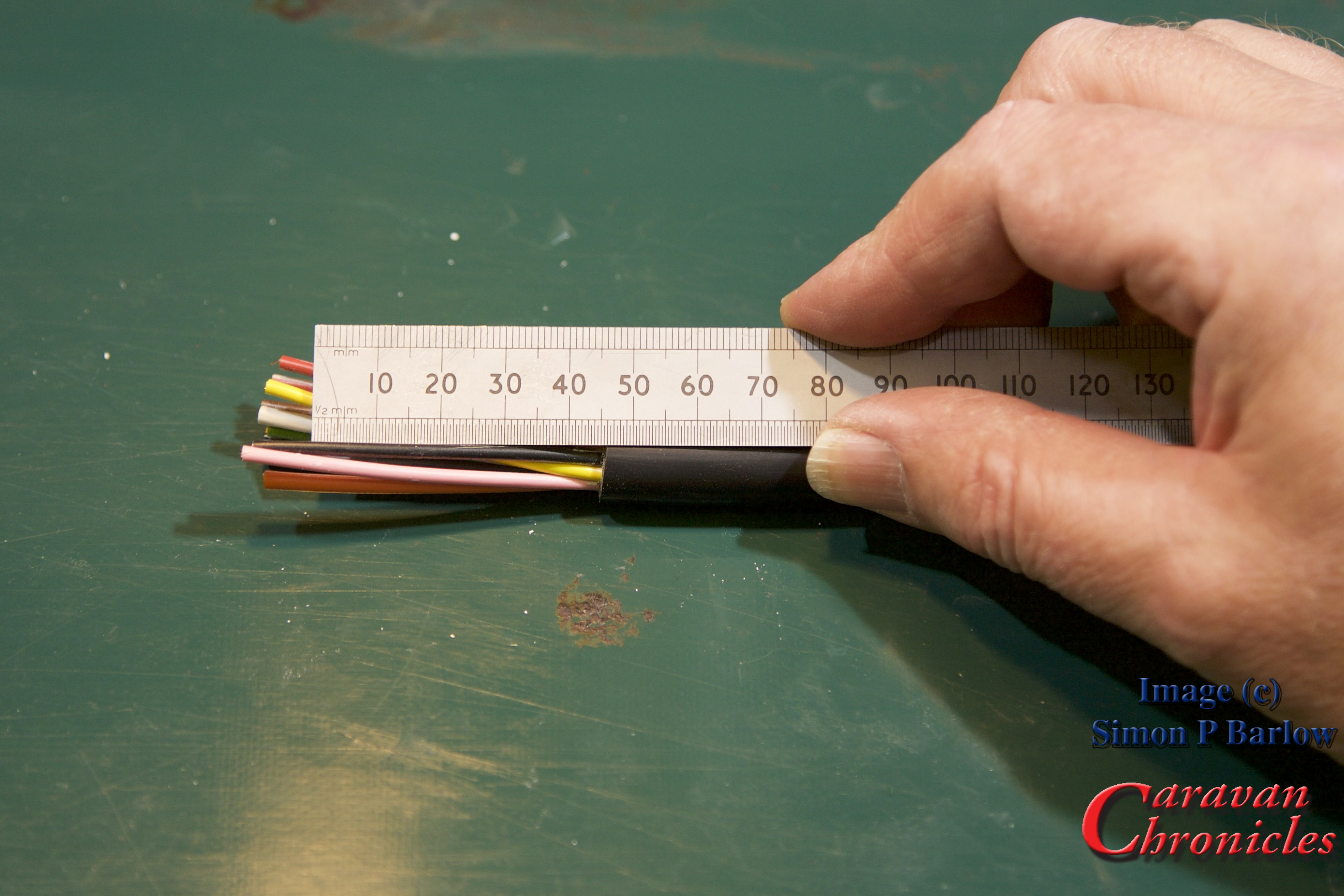
Measuring the back waterproofing cover I know the outer jacket needs to be a maximum of 45 mm from the 9 outer pins and the 4 inner pins need to be trimmed back to 37mm:

SPB_5D_098405

Now the cable is cut to the right length so there should be no short or long cables causing problems when assembling the socket:

SPB_5D_098406

Strip back the individual cables so the exposed conductors are the same length as the ferrules:

SPB_5D_098408

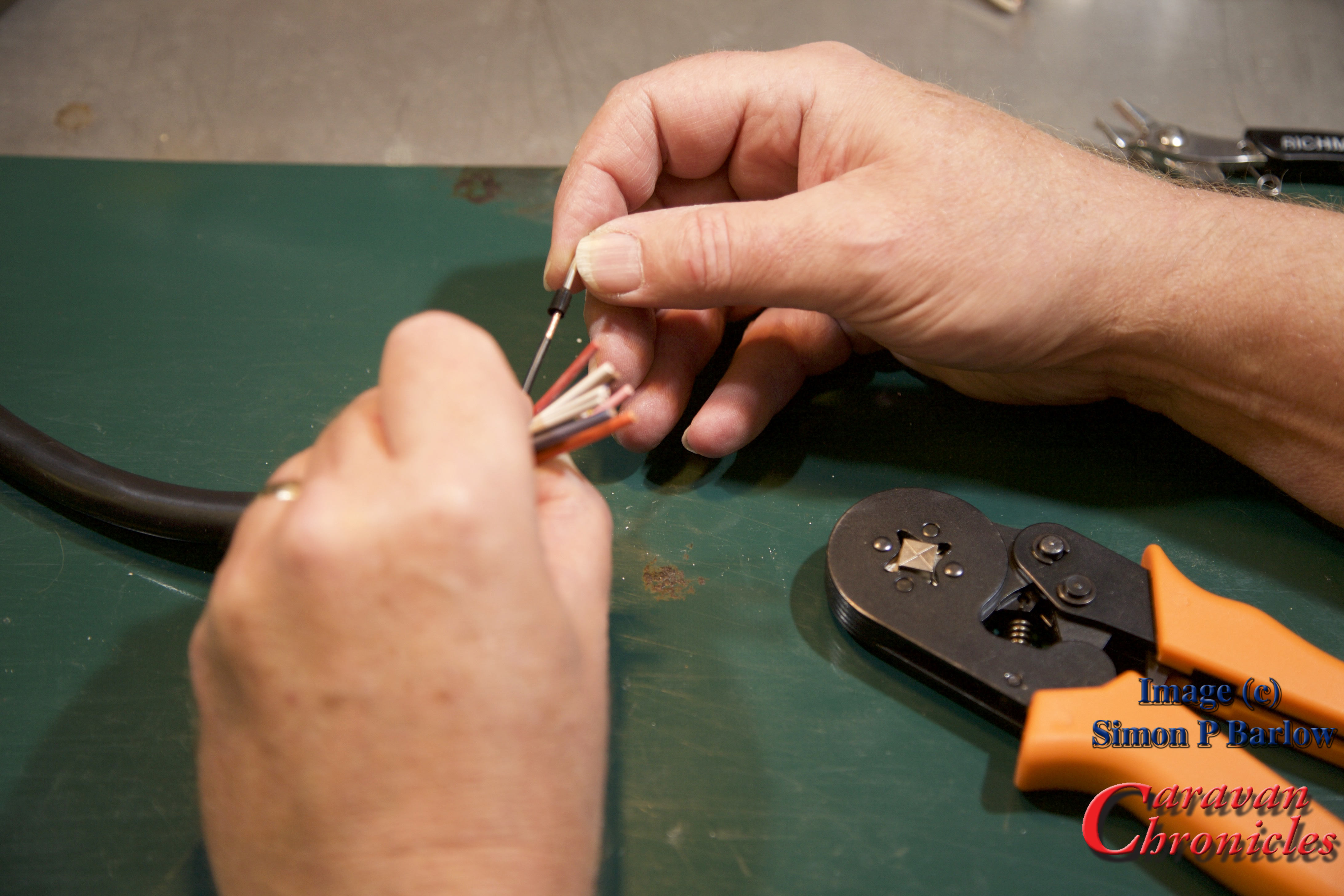
Slide the correct diameter ferrule on to the exposed conductors:

SPB_5D_098410
SPB_5D_098413

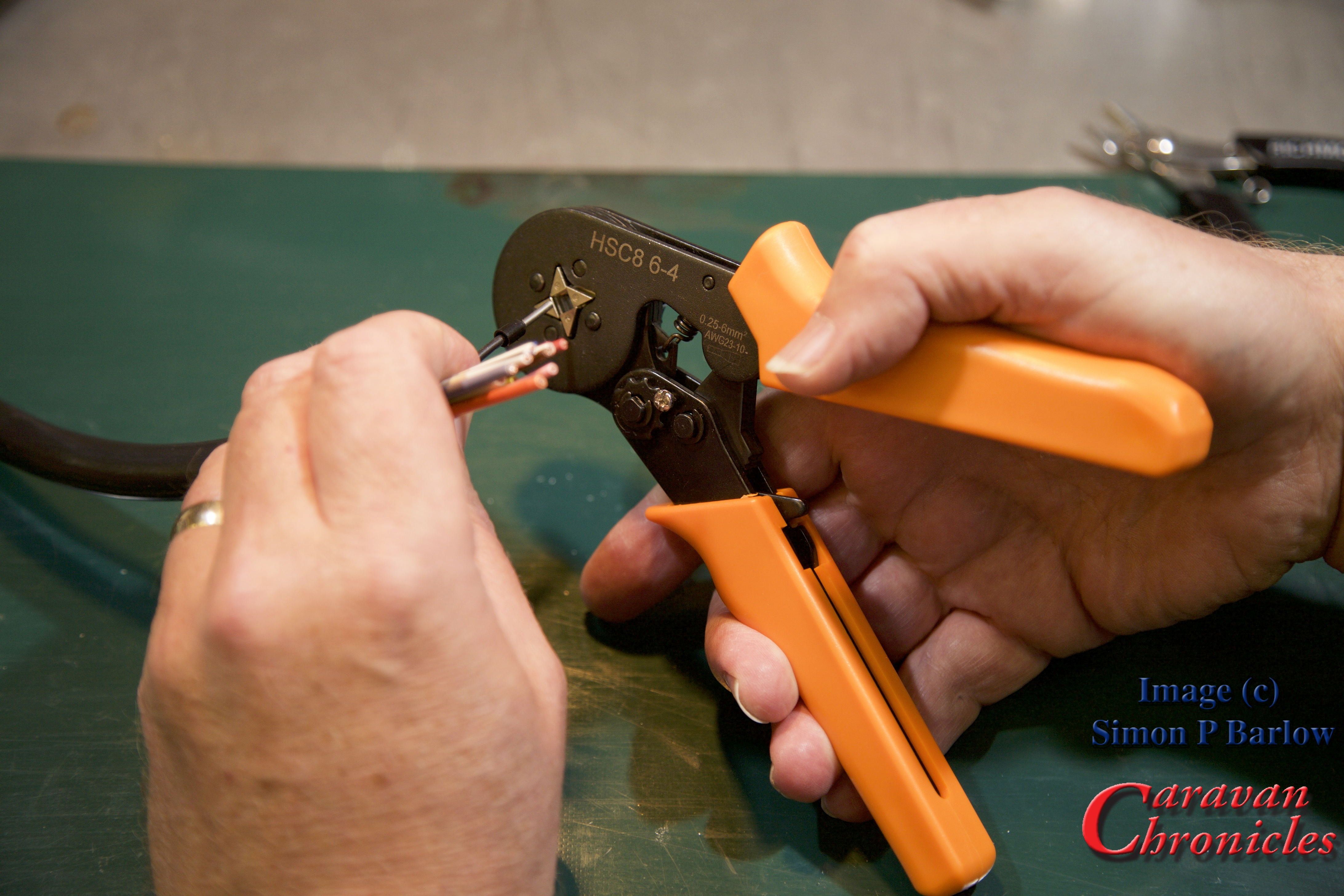
Crimp into place:

SPB_5D_098411

The crimp tool is set so that it will only apply the correct pressure to compress the exposed conductors the required amount. Squeeze the handles and the four jaws close on the ferrule and compress it, continue squeezing and once the jaws have attained the right pressure the ratchet mechanism in the handle releases.

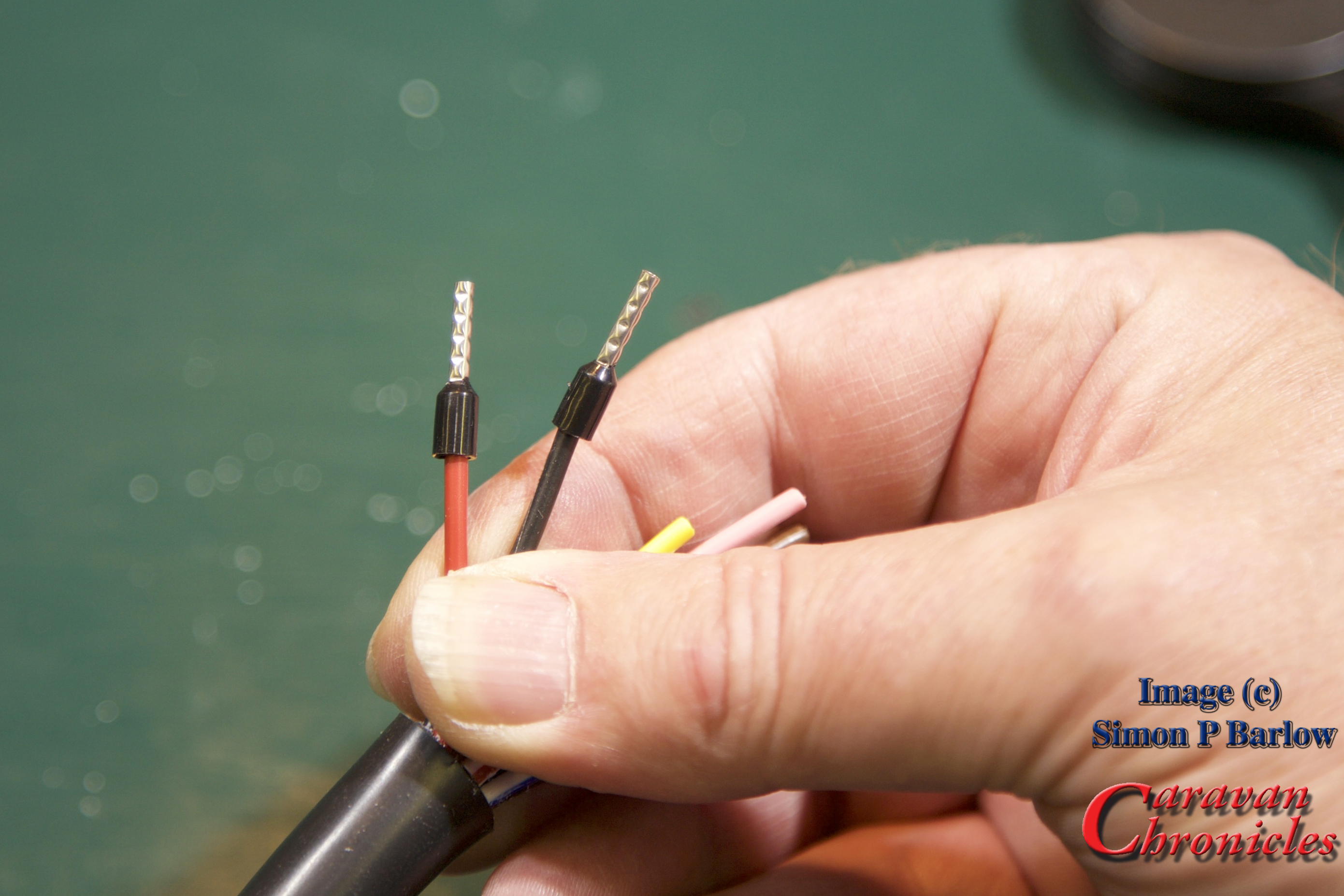
If you look at the picture below you will also see that the crimp tool also presses several ridges into the tube, this is to increase the mechanical grip on the conductors and help stop the tube distorting under the pressure of the terminal screw tip:

SPB_5D_098416

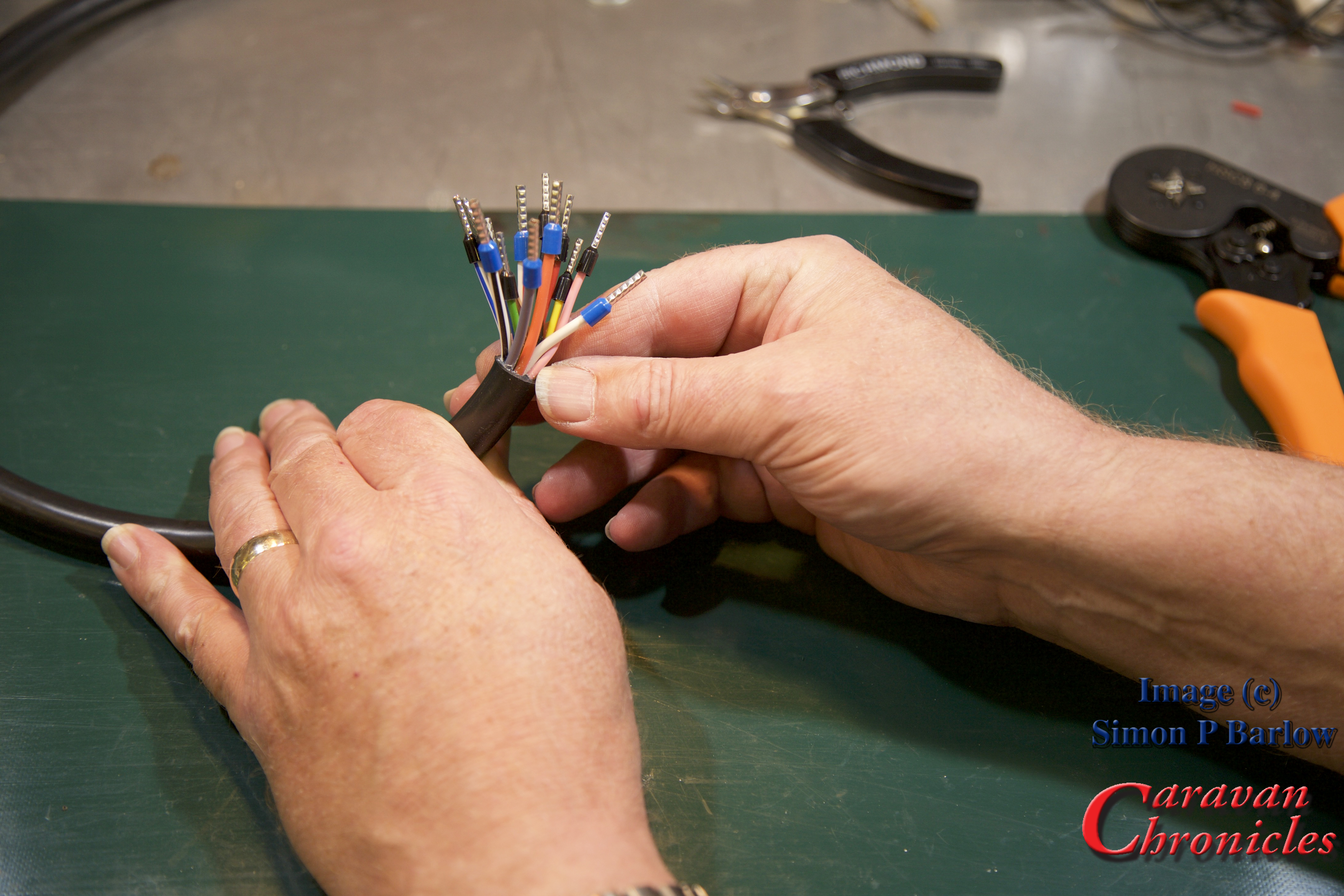
Continue until you have all the cables completed:

SPB_5D_098418

One last check… look for stray strands and anything that doesn’t look as though its crimped correctly… give them the ‘tug’ test if in doubt.

SPB_5D_098423

I always like to back off the screws so the ends are just visible in the holes:

SPB_5D_098424

The next thing you might need to do is correct the length of the ferrule. I have used standard length ferrules and as the holes in the socket terminals are not as deep, I had to trim off the excess. The ridges pressed into the ferrule body help gauge how much to trim off. In this case I only had to snip off to the first indent:

SPB_5D_098431

Once trimmed to length, it’s a simple matter of following the colour coding and inserting each cable and tightening the screw. I always start with the four pins in the middle:

SPB_5D_098429
SPB_5D_098425

Once all the cables are terminated, have a good look to see if all the screws are tight, and of course check the colours are in the right place!

SPB_5D_098435

Because the cable was trimmed to the right length before we started there are no loops, so the cover can slide on neatly:

SPB_5D_098436

There we go, a finished socket all ready to mount onto the bracket:

SPB_5D_098437
SPB_5D_098438

To terminate the socket  from start to finish and while Sue (thanks `Sue) took all the photos took no more than 25 minutes. Ok it was on a bench and doing outside at the back of a vehicle will take a bit longer, but it’s not that difficult to get a professional result.

The ‘Compromise’

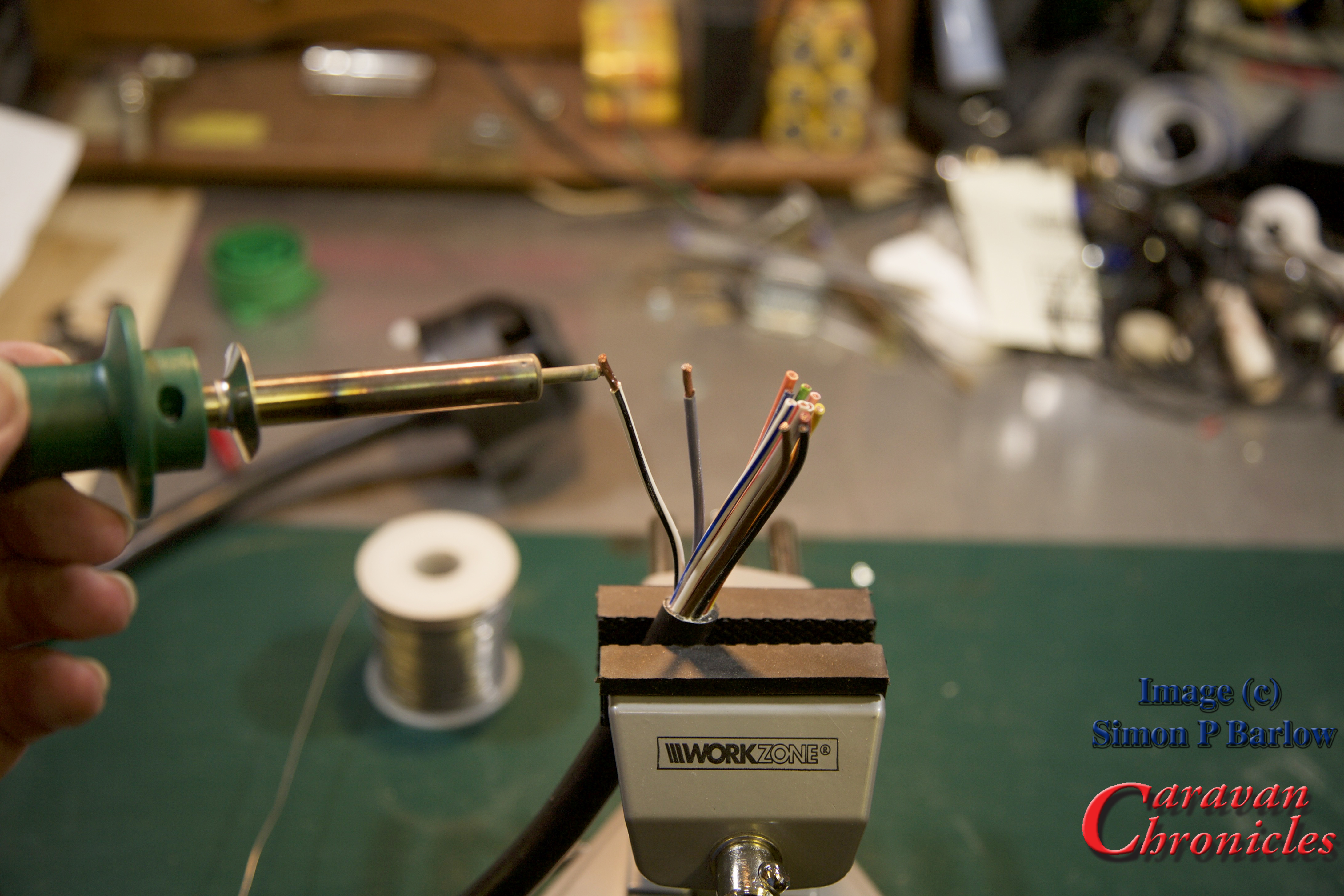
Right back at the start I said there was a compromise – soldering. It’s not difficult to do and achieve and end up with a professional result.

Practice makes perfect and its worth having a go on a scrap length of cable first.

Here’s a few of my tips for successful soldering:

Don’t apply too much heat to cause the insulation to melt (turning down the temperature of the soldering iron or reducing the contact time between the soldering iron and cable helps)

SPB_5D_098440

Don’t try to melt solder onto the tip of the iron and run it in to the cable you will burn off the flux too fast… instead touch the solder onto the hot strands of the conductor. Capillary action will pull solder into the strand bundle.

Don’t allow too much solder to be drawn in. You are looking for just enough to still be able to make the outlines of the strands of cable, not a big ‘blob’ of solder on the end.

SPB_5D_098443

The solder should look shiny not dull. If it’s dull, the solder cooled too soon as the conductors were not hot enough, this is commonly known as a ‘dry joint’ the solder sits on the surface of the copper.
SPB_5D_098442

Avoid breathing in the fumes given off from the flux and the solder. Solder is an alloy of tin and lead… and the flux is pretty nasty too. ( I have an old computer cooling fan that I use to blow the fumes away if I’m doing a lot of soldering).

If you have made the soldered cables too long, you can always trim them back to the correct length. Soldering all the conductors in a caravan cable like this usually takes me no more than five minutes from start to finish.

A few practice runs will soon get you producing good results.

Finally to finish off, I usually give the finished connections a spray of ‘liquid plastic’. It comes in an aerosol can and when sprayed on form a thin plastic coating over everything. You can usually find it in motorbike and automotive shops for waterproofing electrics and HT leads.

It easy to get a good professional result, and I still can’t understand why some tow bar fitting companies don’t either crimp or solder their connections. They usually do when it comes to connecting the other end of the cable to the vehicle. The cynic in me wonders if they are hoping for repeat custom when sockets or plugs start to have problems in the future.

Caravan Chronicles Shopping...

I have been asked where you can purchase some of the products featured above. Here are the links to the products in the Amazon store. If you click on the links and purchase the items, a few pennies will go to helping the cost of running CaravanChronicles.com

Crimp Tool : Hsc8 6-4 Self-adjustable Ratcheting Square Ferrule Crimping Plier for 0.25-6.0mm² Wire Terminal

Wire Ferrules : 750x AWG18 AWG16 Wire Crimp Insulated Ferrule Pin Cord End Terminal

Soldering Iron : 50w Variable Temperature Adjustable Controlled Solder Station Iron Gun Soldering Kit Set

Solder : Solder with Cored Flux 100g 60/40 Tin Lead Resin 0.7mm

13 Pin Milenco Socket : MILENCO 13 Pin Socket Black Caravan / Motorhome / Trailer

13 Pin Milenco Plug : Milenco 13 Pin Plug

13 Core Cable (8 x 1.5mm + 5 x 2.5mm) ISO Approved : 13 Core Caravan Cable Sold per metre

Share this:

  • Share on X (Opens in new window) X
  • Share on Facebook (Opens in new window) Facebook
  • Share on Tumblr (Opens in new window) Tumblr
  • Share on Pocket (Opens in new window) Pocket
  • Share on Pinterest (Opens in new window) Pinterest
  • Share on Reddit (Opens in new window) Reddit
Like Loading...

Upgrading pre September 1998 Caravans to 13 Pin

06 Saturday Jun 2015

Posted by Simon Barlow in Caravan Electrics, Electrical, Help Guides, Maintenance, Modifications, Technical

≈ 2 Comments

Tags

13 Pin Plug, Caravan Electrics, Maintenance, Modifications, Towing

One of Caravan Chronicles long time readers and supporters, Colin “Snowy” Snowden, has sent me an excellent article he has written covering all aspects of upgrading pre September 1998 UK caravans to the 13 pin Euro Plug.

It’s very comprehensive article and goes into detail about the various problems and colour codes that were used and cover some of the changes that are required, habitation relays and details the steps required to actually do the upgrade with steps on fault finding.

If you have a pre September 1998 caravan and are thinking of replacing the original 12N/12S wiring with a 13 Pin plug, it’s an essential read.

The document can be downloaded and viewed here: Upgrading to 13 Pin

Colin has included contact details in the article, but if you have any questions that the answers might be helpful to others as well, you could also post them in the comments section below and Colin will be able to answer them.

Share this:

  • Share on X (Opens in new window) X
  • Share on Facebook (Opens in new window) Facebook
  • Share on Tumblr (Opens in new window) Tumblr
  • Share on Pocket (Opens in new window) Pocket
  • Share on Pinterest (Opens in new window) Pinterest
  • Share on Reddit (Opens in new window) Reddit
Like Loading...

A Readers Puzzle Answered…

04 Wednesday Feb 2015

Posted by Simon Barlow in Caravan Electrical Fault Finding, Caravan Electrics, Caravan Fault Finding, Electrical, Technical

≈ 21 Comments

Tags

Bailey Caravan Electrics, Bailey Senator, Caravan, Caravan Electrical, Maintenance

No, I’m not starting an Agony Aunt post..!

A couple of days ago one of Caravan Chronicles readers, Vic, posted in the comments section of “Understanding Caravan and Tow Car Electrics” that he recently flattened his car battery by leaving his caravan connected to his car. Here’s what he posted:

Hi Simon, while travelling across Spain I made an overnight stop and left the caravan connected to the car electrics I also hooked up to mains. The next morning the car battery was flat, I’m sure I’ve done this before with no consequence. All I can think is that european site wiring can be suspect.
brilliant article.

OK, that got me thinking…
Was it the car-off-van switch faulty? Was there another fault of some sort? I asked Vic for the details of his caravan and he replied it was a 2009 Bailey Senator California. I don’t know the exact details for Bailey electrical schematics, but it should not be too difficult to work out what might be happening. I started to think of various failure scenarios that ‘could’ account for Vic’s problem. At this point I have to say I’m indebted to David Rose for sending me information about the electrical services in Bailey Caravans.

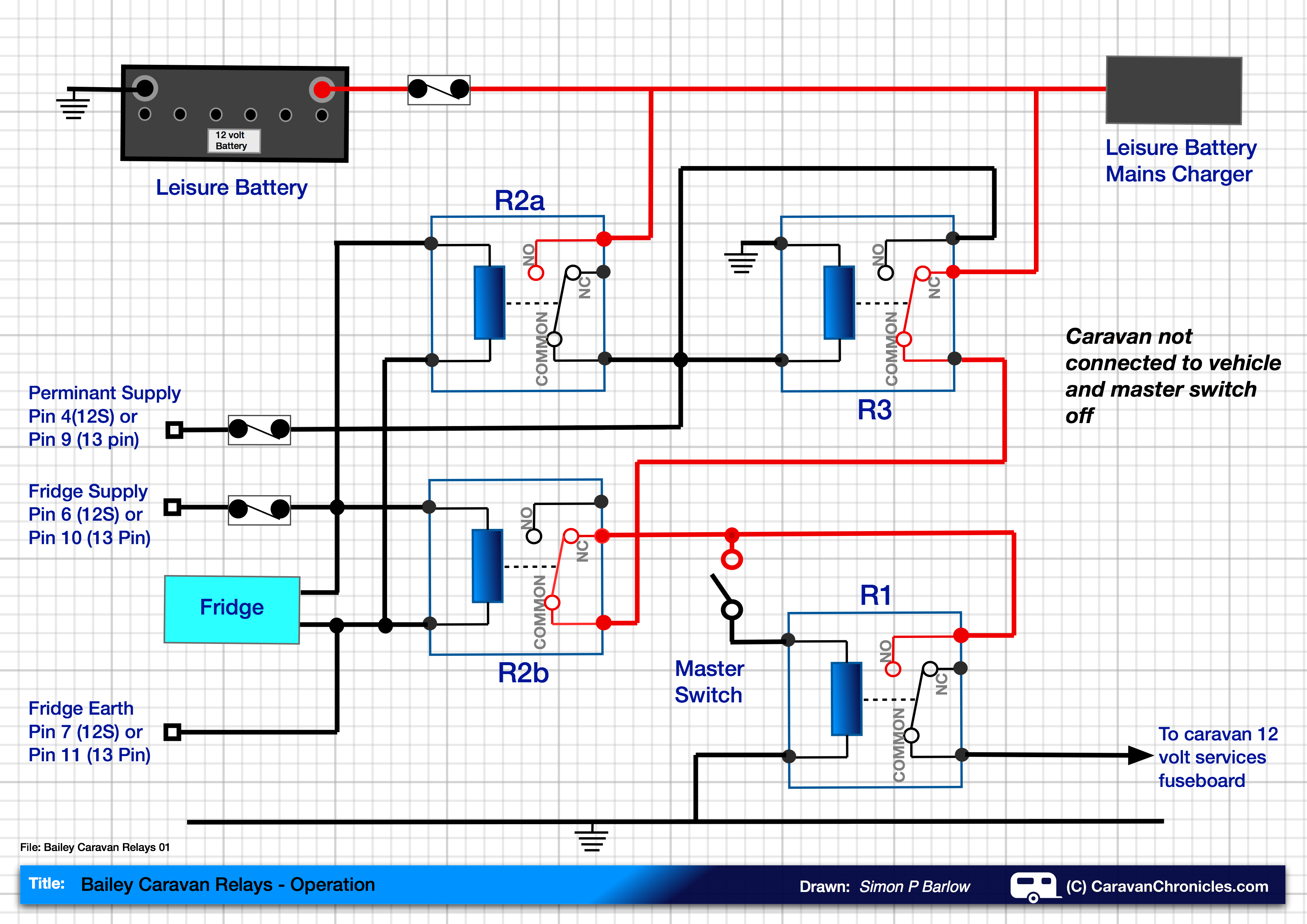
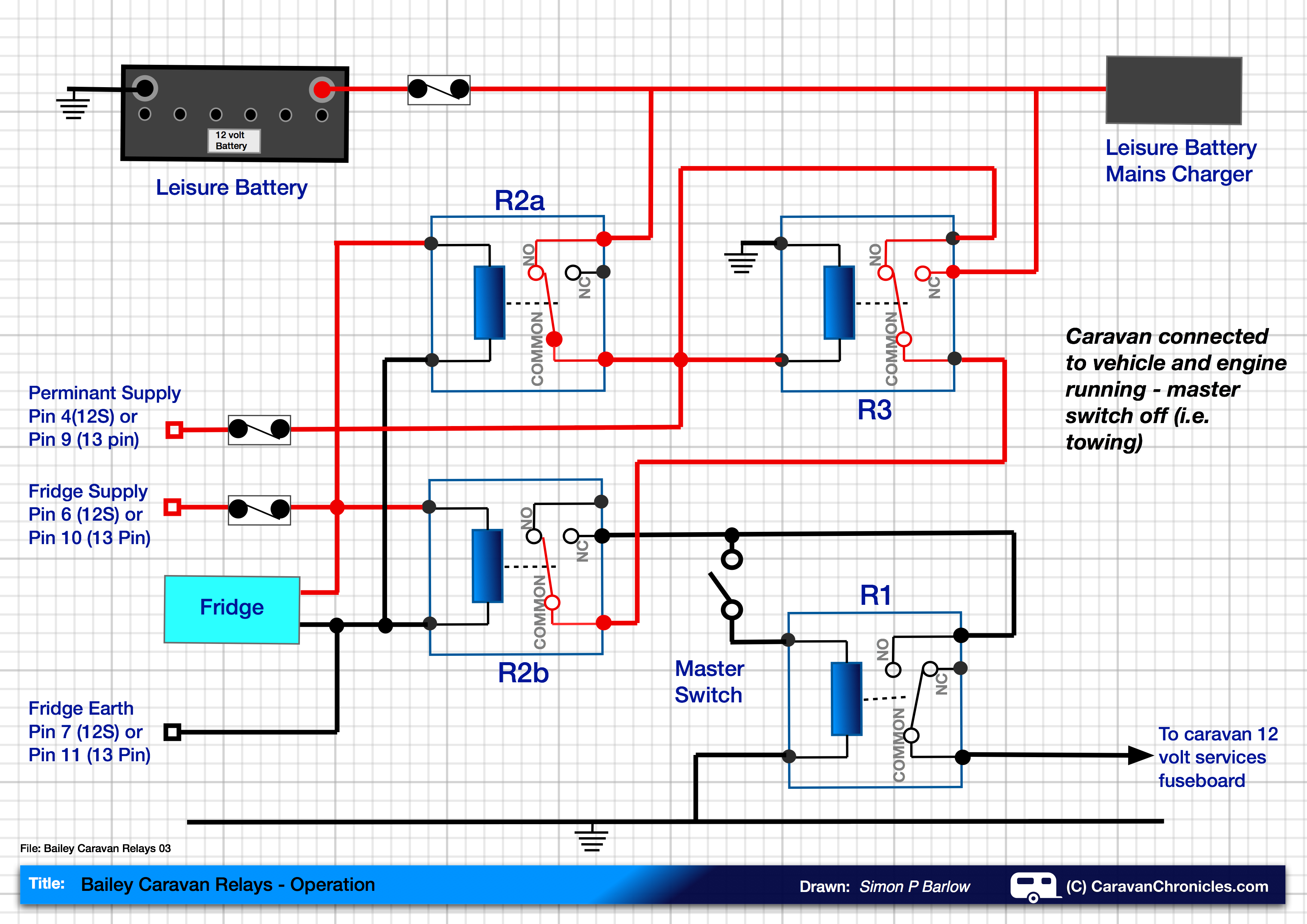
Looking closely at the schematic of the control unit, it all hinged around the correct operation of four relays. Here is the schematic I have drawn out in a simplified form:

Bailey Caravan Relays 01

The drawing (above) shows the four relays – R1, R2a & R2b, R3 as they are set when the caravan is not connected to the vehicle and the master switch is off. The red lines show what part of the circuits are live. The master switch controls relay R1 and when energised by turning the Master Switch on allows current to flow to the caravans 12 volt electrical system via the 12 volt fuse board.

Bailey Caravan Relays 02

Above: We have now turned the Master Switch on and can see that relay R1 has energised and is allowing current to flow to the caravans 12 volt services. The caravan is not connected to the tow vehicle.

Bailey Caravan Relays 03Above: The caravan is now connected to the tow vehicle and the engine is running. The caravan master switch is off. With the fridge circuit powered from the running engine, it energises R3, R2a and R2b. Relay R2b disconnects the master switch circuit so that it cannot operate R1. Relay R2a connects the leisure battery to the 12 volt permanent feed from the tow vehicle. R3 energises, but only switches the feed for the master switch from the leisure battery to the permanent 12 volt supply from the tow vehicle. As this stage it cannot be used to supply the master switch due to R2b being energised.

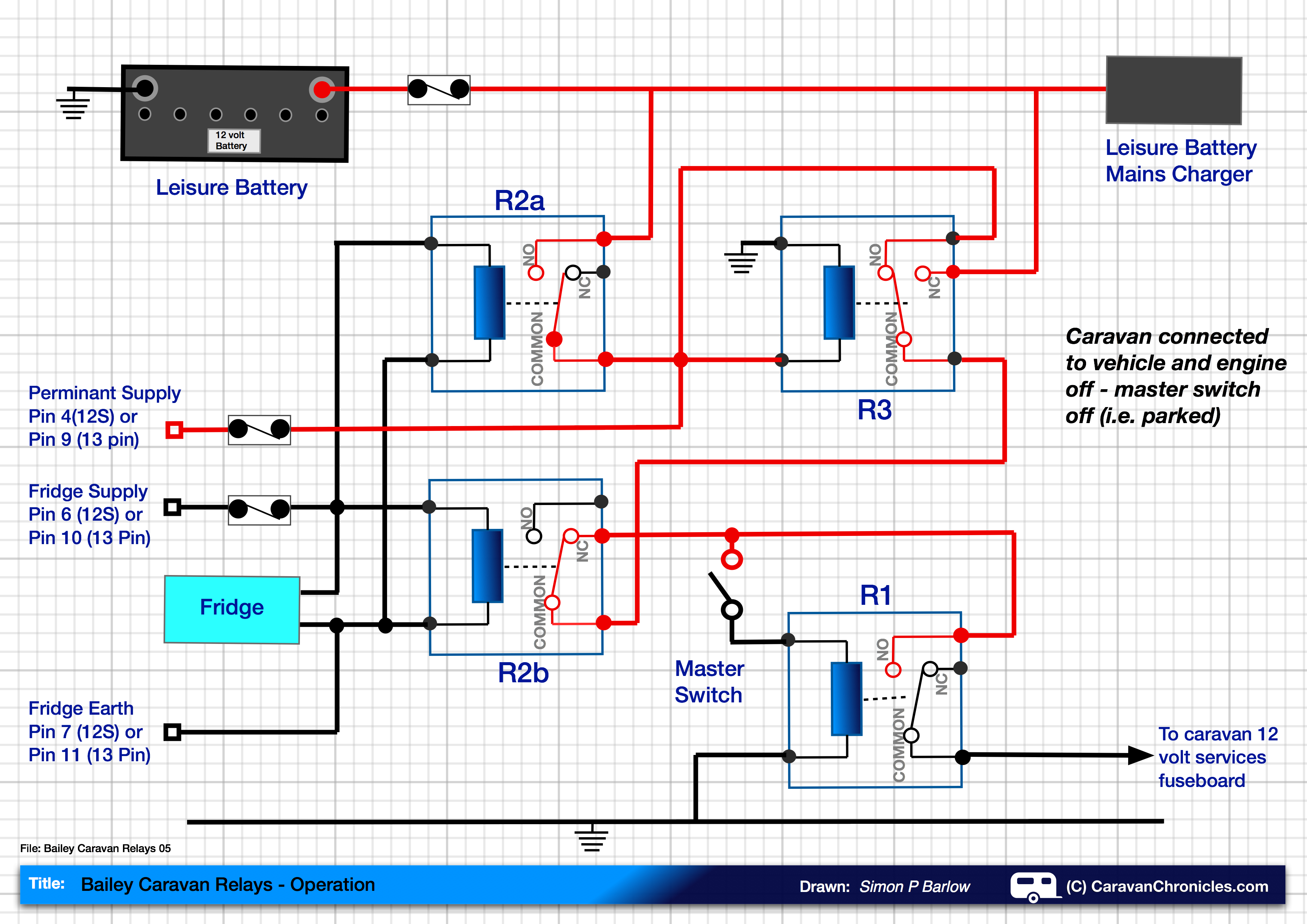
Bailey Caravan Relays 05

Above: The caravan is still connected to the tow vehicle, but the engine is off. Relay R2a and R2b that are controlled by the fridge circuit are now not energised and revert to the default position. However as the caravan is still connected to the tow vehicle, the 12 volt permanent feed keeps relay R3 energised, therefore supplying the Master Switch – not from the leisure battery but from the permanent 12 volt feed from the vehicle.

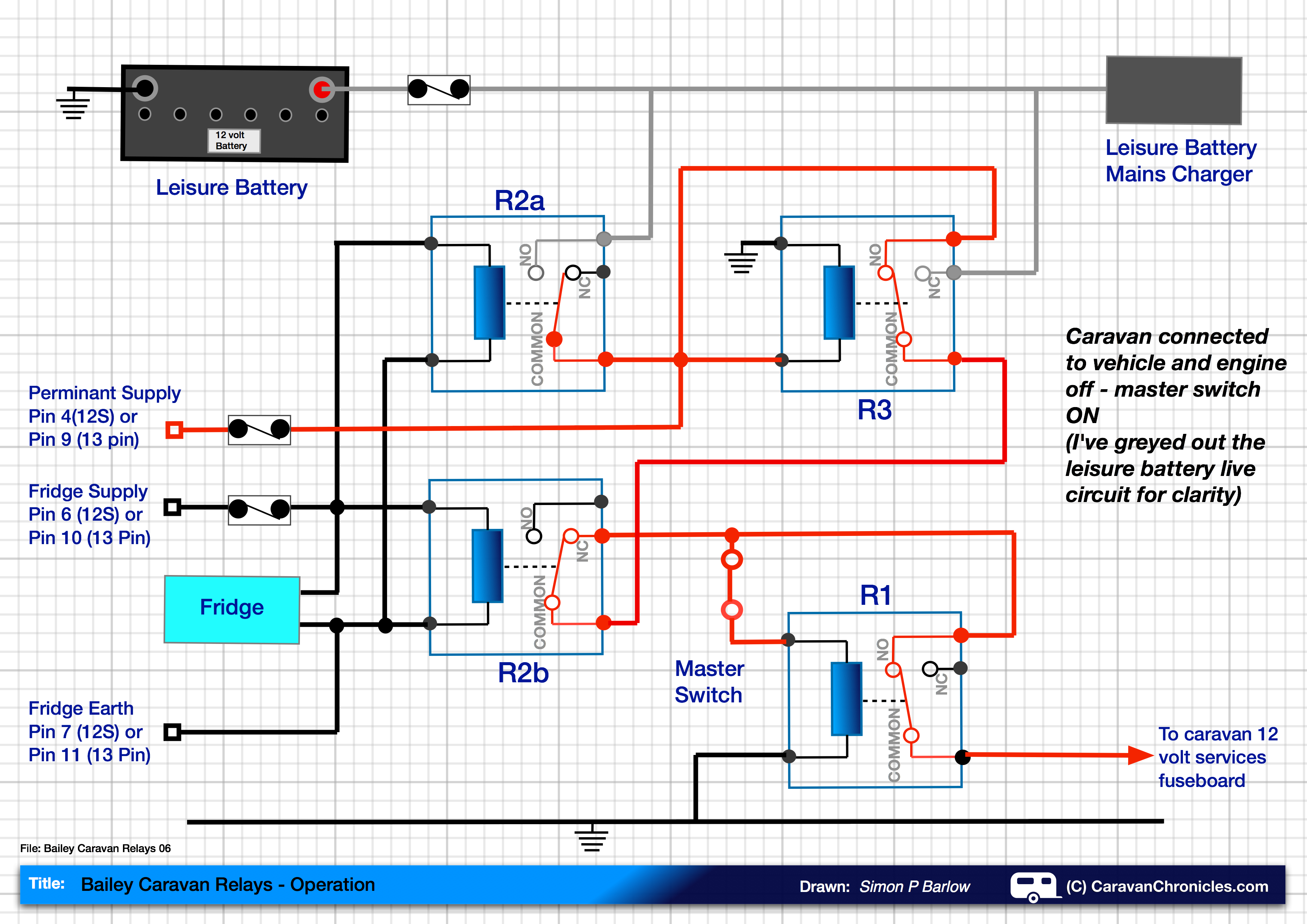
This now leaves us in the following position:

Bailey Caravan Relays 06Above: The caravan is connected to the tow vehicle but the engine isn’t running. The master switch is on. The caravan now receives it’s 12 volt feed from the tow vehicle to power all the 12 volt services. I have greyed out the live circuits from the leisure battery. Even though the caravan is plugged into a EHU bollard, the 12 volt services will be run from the vehicle battery and not the mains charger/ leisure battery circuit. The fridge will continue to work on 240 volts as will any mains powered equipment.

So, it’s not a ‘fault’… it’s a ‘feature’ ! Leaving the caravan plugged into the car and turning the Master Switch on allows you to power the caravan’s 12 volt services from the car. Disconnect the lead from the car and the caravan will be powered from the leisure battery.

I hope this solves Vic’s puzzle.

.

Copyright © 2011 – 2020 Simon P Barlow – All rights reserved

Share this:

  • Share on X (Opens in new window) X
  • Share on Facebook (Opens in new window) Facebook
  • Share on Tumblr (Opens in new window) Tumblr
  • Share on Pocket (Opens in new window) Pocket
  • Share on Pinterest (Opens in new window) Pinterest
  • Share on Reddit (Opens in new window) Reddit
Like Loading...
← Older posts
Newer posts →
Buy Me A Coffee

Blog Stats

  • 45,906,785 hits
Follow Caravan Chronicles on WordPress.com

Follow Caravan Chronicles and receive notifications of new posts by email.

Some previous posts you may like...

My last post….

Many thanks to all my friends. As I write this I’m in the Christi hospital hoping to go home in a few days. I was told about a week ago that I had about 3 months to live and should start preparing my affairs. Which Sue and I are trying to do. I have some…

A Bit Of A Tour…

Well not really a tour, only two locations. The first leg was down from Manchester to Glastonbury and a stay at The Old Oaks. We first went there in 2012 and had five or six more visits in the next four years. So it had been quite a while really. We were located in the…

What’s The Question I Get Asked a Lot?

“What’s in your toolbox when travelling?” Tricky one… I don’t have a tool box anymore. I recently started mooching around the internet for a smaller tool box… or rather a tool bag. I used to use up until a few months ago a Stanley Tool Bag. It was lighter than a tool box, I could…

#Tourfest North West

Tourfest North west was our first time attending anything like a gathering of bloggers, vloggers and the generally like minded. It was organised by The Caravan Addys with a little help from others I’m sure as it must be a time consuming task and hard work to bring everything together. We opted to arrive at…

More Jobs Ticked Off…

OK we are still working on a few bits and pieces but the weather on Friday and Saturday was ideal for cleaning the outside of the 5th Wheel. So while Sue made a start on the cleaning of the nose cap, I finished the first stage of the water pump relocation project and upgraded the…

A Few More Jobs Ticked Off The List…

Like any project, ticking the small stuff off a list is the way to move forward even if it seems like sometimes you have ground to a halt. A bit lacking on photos…. I’m temporarily unsure of their location… pilot speak for I’ve lost them! I’ll correct that in due course. I built a new…

A Few Little Jobs Done…

It seems such a long time since I posted anything. Last time out with the Dreamseeker I noticed that the charging voltage when we were hooked up to the truck was only about 12.1 to 12.3 volts as measured in the Dreamseeker battery box. I know that the VW Amarok puts out 14.6 to 14.8…

Happy New Year…

Happy New Year to everyone, I hope you have a great touring year ahead. I’d like to take this opportunity to give you a bit of an update on my personal circumstances and a look forward to a couple of projects I’m planning to kick off our year. First… … A HUGE thank-you yo everyone…

Sutton-on-Sea In September

Just like to say a huge thank you to so many people that have commented or emailed me over my last post. It has cheered me up no end…. it really has. Enough to rattle this post off! We recently went back to Cherry Tree Springs at Sutton on Sea for an 7 day break.…

This Might Be My Last Post…

Not clickbait…. Three weeks ago Sue and I were cycling between 8 and 10 miles each morning to get a morning coffee. Arrived back home and…. well time stopped. I had received notice that my test sample for Bowel Cancer screening had come back positive. Two days later I underwent a colonoscopy procedure which didn’t…

Something went wrong. Please refresh the page and/or try again.

  1. Dave Hart's avatar
    Dave Hart on How to: Connect two batteries in parallelAugust 27, 2024

    brilliant and so well explained! Thank you, love your work!!

  2. Simon Barlow's avatar
    Simon Barlow on Caravan Road Lights – Basic Fault FindingAugust 25, 2024

    Please look at my very last post on the blog

  3. Martin's avatar
    Martin on Caravan Road Lights – Basic Fault FindingAugust 25, 2024

    martin here caravan lights worked fine for two stop overs I had then hooking up again for my third trip…

  4. Emmy’s Camper Travels's avatar
    Emmy’s Camper Travels on My last post….August 25, 2024

    I’m so sorry. My sincerest sympathies go to you and your wife Sue. Your ideas and advice have been so…

  5. Steve Walsh-Jones's avatar
    Steve Walsh-Jones on My last post….August 22, 2024

    very sorry to hear this. Your posts have been very informative and enlightening providing an in depth view on different…

  6. thetwinaxletouringscouser's avatar
    thetwinaxletouringscouser on My last post….August 22, 2024

    Good heavens above Simon I am ever sorry to hear of such devastating news for both you yourself and Sue.…

  7. Eileen's avatar
    Eileen on My last post….August 22, 2024

    Simon and Sue, thank you both for sharing your passion for caravans with us. The news is extremely sad, our…

  8. Philip Parkes's avatar
    Philip Parkes on My last post….August 22, 2024

    Simon. So sad to read you last post today. Our thoughts are with you and Sue at this time. Whilst…

  9. Philip Parkes's avatar
    Philip Parkes on My last post….August 22, 2024

    Simon. So sad reading your post today. Our thoughts are with you and Sue at this time.

  10. Philip Parkes's avatar
    Philip Parkes on My last post….August 22, 2024

    Simon our thoughts are with you and Sue.

  11. Luke Tarrant's avatar
    Luke Tarrant on My last post….August 22, 2024

    Very sorry to read this and my thoughts are with you both at this time.

  12. Alan Smith's avatar
    Alan Smith on My last post….August 22, 2024

    Dearest Simon. I have never met you, but I feel as though I have some (limited) knowledge of you and…

CaravanChronicles.com Tag’s…

5th Wheel Caravan 13 Pin Plug Accessories AL-KO Avtex Bear Extender Bike Rack Blackpool Blackpool Illuminations blogging Cadac Camping & Caravanning Club Canterbury Caravan Caravan Blog Caravan Club Caravan Electrical Caravan Electrics Caravanning Caravans Caravan Show Caravan Talk Cheltenham Chirk Christmas Market Christmas markets Cleaning design Event City Factory Visit Fiamma France Freelander Glastonbury Glossop Caravans Humor Insync Jonic Bedding Lady Heyes La Tournerie Ferme Leisure Battery Leisure Battery Charging LPG Refilling Maintenance Manchester Caravan & Motorhome Modifications NEC North Western Caravans Ltd OLPRO One Hairy Caravanner Oswestry Oxford Product Review Project Review Safefill Sat Nav Sterling Caravans Sterling Power Wildside Swift Factory Swift Group Swift Talk Technical The Old Oaks Touring Towing Tow Vehicle Trafford Centre travel Travel Trailer Travel Trailers vacation VW Amarok Warwick Racecourse WiFI

Website Powered by WordPress.com.

  • Subscribe Subscribed
    • Caravan Chronicles
    • Join 672 other subscribers
    • Already have a WordPress.com account? Log in now.
    • Caravan Chronicles
    • Subscribe Subscribed
    • Sign up
    • Log in
    • Report this content
    • View site in Reader
    • Manage subscriptions
    • Collapse this bar
 

Loading Comments...
 

    %d