• Home
  • Help Guides
    • Storage Sites
    • Equipment Reviews
  • Document Library
    • Electrical Drawings
  • Photo Gallery
    • Caravan Log
    • MPG
  • Trip Map
  • Shop
  • About Caravan Chronicles…
  • Contact
  • Links

Caravan Chronicles

~ not just another caravan blog

Caravan Chronicles

Category Archives: Electrical

Here’s Another Thing….

26 Saturday Jan 2019

Posted by Simon Barlow in Accessories, Blog updates, Caravan Designs, Caravan Electrics, General, Uncategorized

≈ 14 Comments

Tags

design, Humor, Tips, travel

Following on from my last post – Never Admit to Being a Caravan Designer (Well Not to Caravaners!) I was floored by the number of emails I received on the subject of design. So after our trip out to the Manchester Caravan & Motorhome show at Event City a few days ago, I thought I’d sit down and pen a few more thoughts on the subject.

I believe that if you store something where you use it, it will make your life easier. One of the big items that almost every caravan wrestles with is the Aquarol. its bulky, fairly lightweight when empty, often wet from the liquid sunshine we enjoy in the UK and  sometimes muddy. Where do you put it when travelling? OK, so you buy a bag to sort out the wet and muddy bit and maybe just put it in the doorway… or in the shower tray. That seems like a good place. Just carry it through your nice clean van and put it in the shower tray. Sorted…. unless you have a mid bathroom shower that has the shower ‘conveniently” located over a wheel so the floor has a step in it. The designers sell it as a feature… “You can rest your feet on it when showering” they say. However don’t stick your Aquarol in there if you have bi fold doors!

A fellow caravan enthusiast who shall be nameless – I’ll call him George… decided that this would be perfect for storing the Aquarol. He put it in the shower of his previous rear bathroom outfit for years without incident so no need to change anything. Upon arrival at site in with the first outing of the shiny new caravan all was going well until Mrs George popped her head out of the door and exclaimed to George that she could not get the Aquarol out. “It’s in the shower dear” exclaimed George. Irritatedly “I know that I can see it but I can get it out” came the rather louder reply. On examination of the problem George discovered that the carefully placed Aquarol had somehow shifted and was now preventing the bi-fold door from opening therefore stopping it’s extraction and subsequent deployment and use for brewing that much-needed cup of tea.

What’s the moral of this story? Well if you store something where you use it it will make your life easier. So as nearly all caravan users possess possibly one of the best inventions ever for transporting the splashy stuff about with ease why haven’t caravan designers thought about this? I was thinking of George when I was pondering the uses of this cupboard…..

img_1552

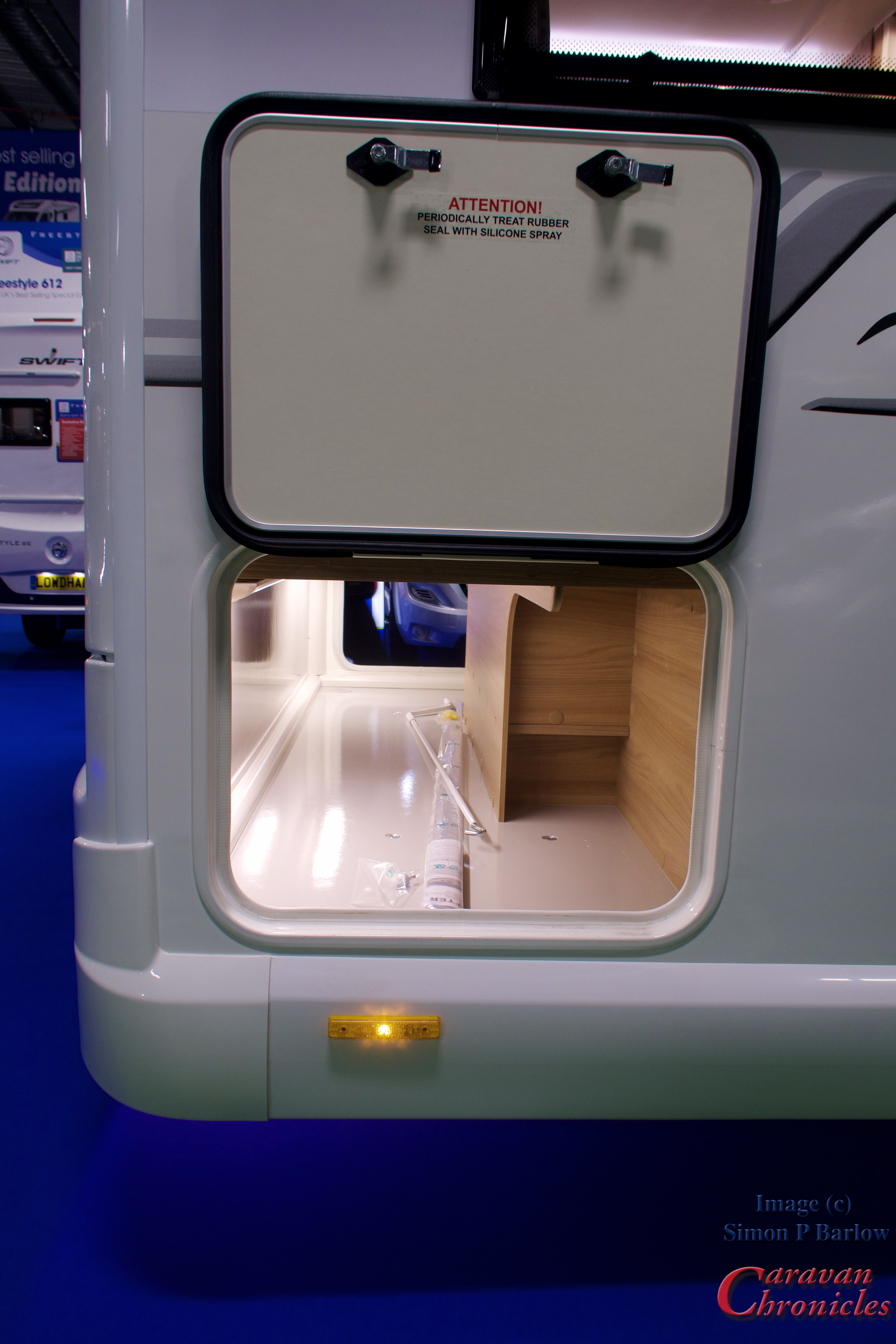
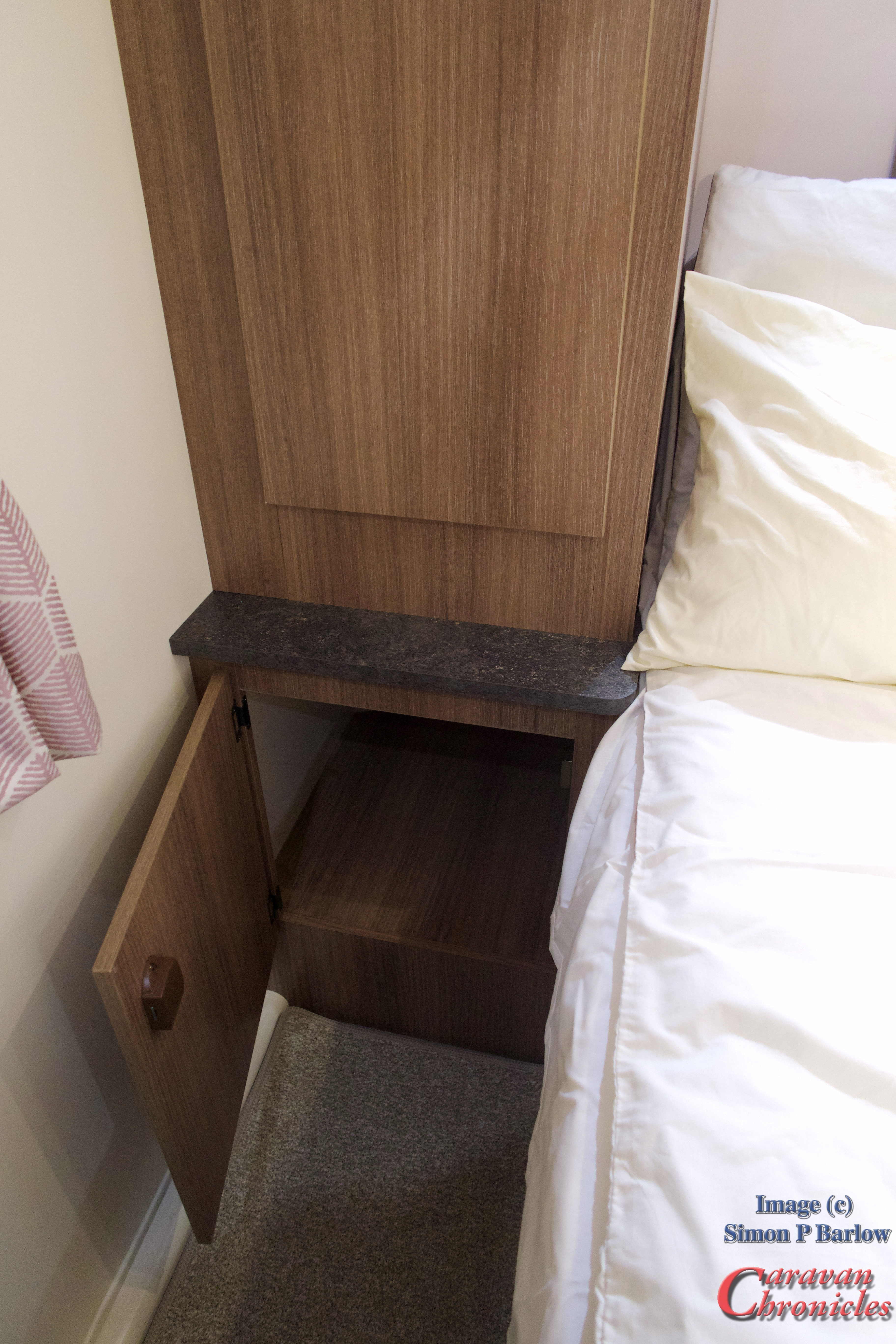
There is a matching one on the other side funnily enough… but what did the designer have in mind for these cupboards… shoes (who would want to put wet shoes away in there?) Handbags…. maybe but I prefer to hang mine on a hook. It looks great… on a computer mock-up but as for use, well maybe I have a better idea. As they are right at the back of the caravan you really would not want to store your collection of beach pebbles in them.

Instead of a cupboard, just block it off and instead create a wet locker across the back of the caravan and stick a door like this in it……

img_1550

… it may need a bit of adjusting size wise but imagine a wet locker accessed from the side that you use the Aquarol and wastehog on that you can simply throw these two bulky but relatively light items in… and there would be room for your wet and muddy mains cable too! All right where you need them.

Now here is an idea…. put the water inlet in there along with the mains inlet and a small hatch in the floor…. save on cutting holes in the side of the caravan and it means we all might just get away with using shorter mains cables!

Caution Vehicle Reversing

In a galaxy far far away… oops wrong blog…. I recently watched a chap valiantly trying to manoeuvre his caravan onto an awkward pitch using his motor mover. Stone walled raised bed one side, overhanging branches, awkward access angle all on a short pitch with a stone wall at the back of the pitch. Normally I’d postulate that the chap in question would have been able to perform this manoeuvre on a sunny afternoon with remote control in one hand, a mug of tea in the other while carrying on a conversation with the couple two pitches down. However at eight o’clock on a winters eve in near wartime blackout conditions required the use of a head torch (flashlight for my US readers) and a lantern held aloft by his partner and much wandering side to side and swivelling of the head to direct the head torch in the desired direction.

We don’t have a motor mover… for some reason Sue seems to take enjoyment from me sweating like a traction engine driver at a summer steam rally when reversing on to a pitch… but if we did, the question I’d have to ask is why don’t they have a 13 pin socket wired in so that you could simply plug-in the caravan’s road lights and turn on the reversing lights, hazard lights… heck even get the marker lights and brake lights to work. I’m sure there are people out there that have to detach their caravans on the road and reverse them into their drive and having simple flashing hazard lights and operational marker lights would be a good safety feature.

I have a small cunning device waiting to be fitted…. it consists of a remote key fob and a couple of solid state relays to be mounted in the caravan. On selecting reverse while seated in the vehicle I can simply push a button on the key fob and it will turn on the awning lights and can be made to turn on under floor LED flood lights to light up either side of the caravan. It stays on for a pre-determined time that can be adjusted so if you have to pull forward for a second attempt (highly likely) the lights stay on. Just waiting for a suitable time to mosey off down to the caravan storage site to do a test fit.

The Perfect Caravan

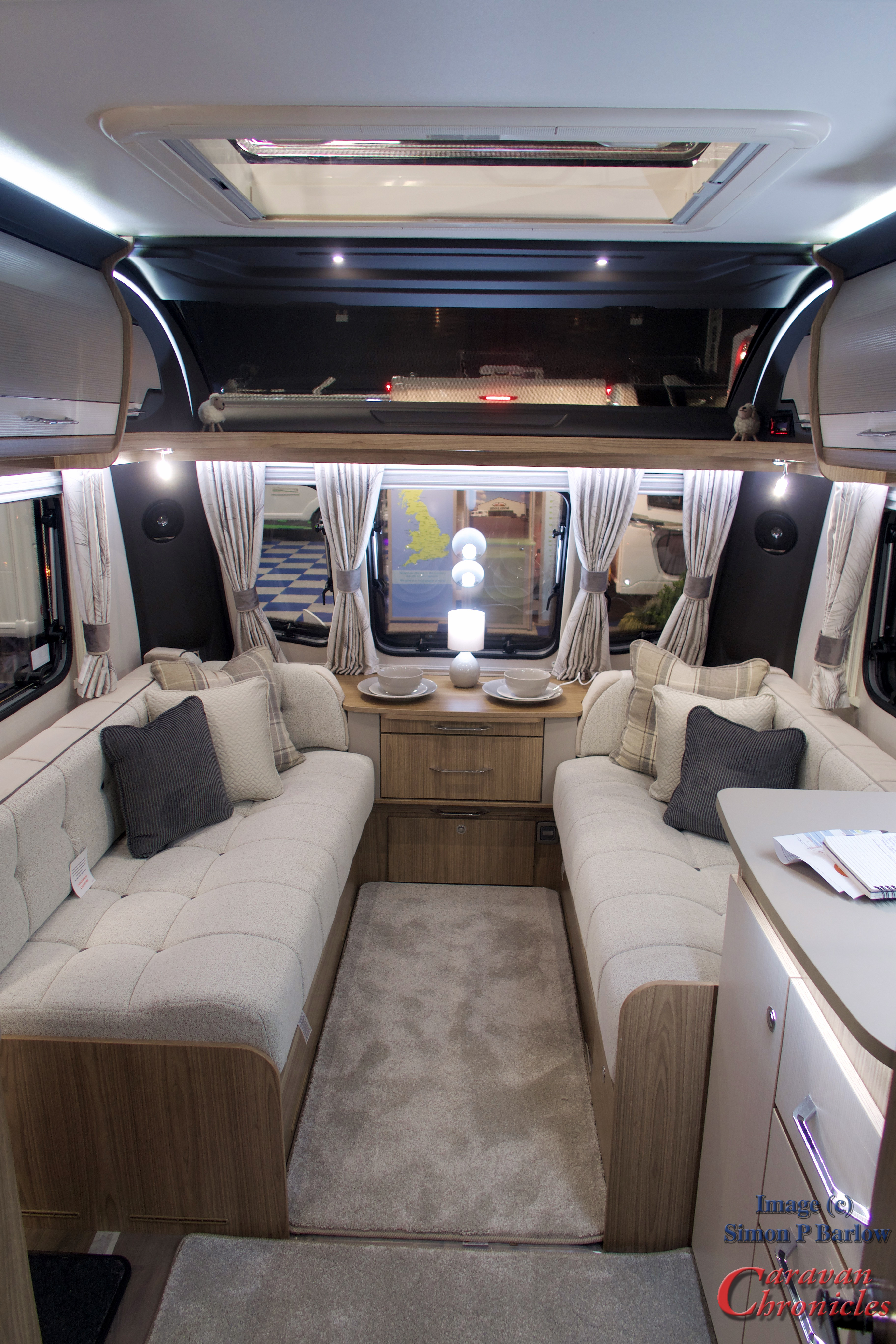
For those go you that have been following the blog for a while will know we have been flip-flopping like a stroppy teenager over getting a new caravan. Well we were…. then we weren’t than we were, then we changed our minds about what we wanted. Then we couldn’t find one and we changed our minds again… anyhoo we managed to tick more boxes off our list with one of these than any other…..

img_1543

So the question is….. will we or won’t we? Will there be a deal at the NEC in February to tempt us…. or will we wait until the August price slashing begins?

By the way if you wanted to know how George managed to retrieve the Aquarol…. it required a wire coat hanger and a length of paracord…. and about four hours of fishing to raise the Aquarol up above the step in the shower tray.

Share this:

  • Share on X (Opens in new window) X
  • Share on Facebook (Opens in new window) Facebook
  • Share on Tumblr (Opens in new window) Tumblr
  • Share on Pocket (Opens in new window) Pocket
  • Share on Pinterest (Opens in new window) Pinterest
  • Share on Reddit (Opens in new window) Reddit
Like Loading...

A Request…

09 Sunday Dec 2018

Posted by Simon Barlow in Blog updates, Caravan Electrical Fault Finding, Caravan Electrics, Caravan Fault Finding, Caravan Servicing, Electrical, General, Help Guides, Maintenance, Motor Home, Technical

≈ 11 Comments

Tags

Fuse Voltage Drop Table, Relay Wall Chart, Technical, Wire Size Chart

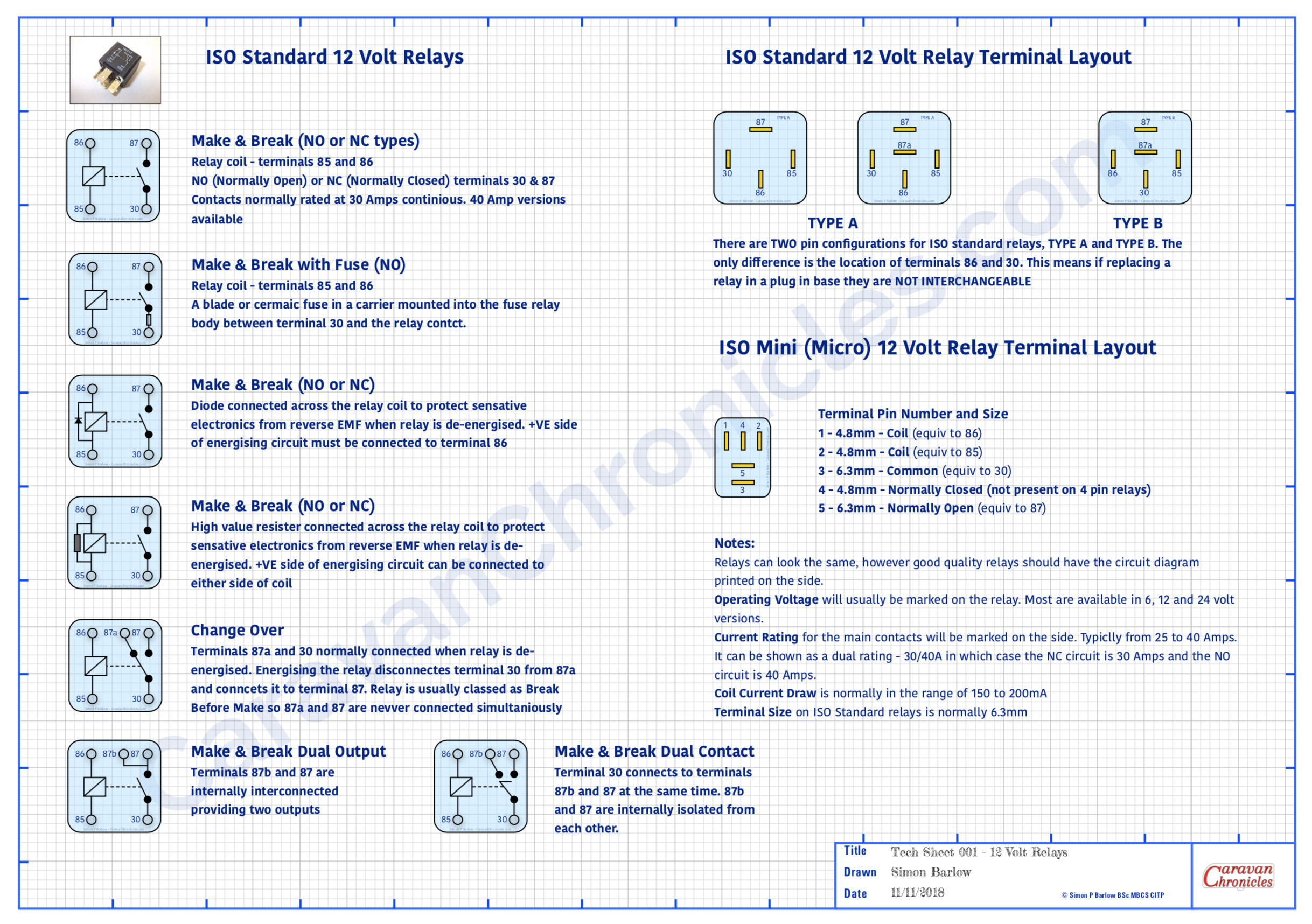
Ok, not one of my usual blog posts. I get a lot of email asking about various electrical items related to caravans and motorhomes and a few things seem to keep cropping up on a regular basis. One is to do with 12 volt relays… what types are there and what are the pin connections.

Another is to do with cable size relating to load and its relation to the length of cable…. “I have a 40 Amp load and its 3 metres from the battery… what size cable do I need?” type questions.

In the past I’ve emailed back with answers, but one caravan engineer asked me if I know of any information sheets that had this type of info that he could put above his workbench.

So I’ve produced a couple of A3 size PDF information sheets (they will print A4) that can be downloaded printed out and pinned up, shoved in your notebook, glued to the lid of your tool box or used to wrap that must have tool present for your beloved caravan or motorhome DIY enthusiast in your life (seasonal eh!)

(I have been told that Office World can print and laminate A3 PDF’s cheaply…. I never knew that!)

Screenshot 2018-12-09 at 10.23.41

Click here to download the  Relay Wall Chart

Screenshot 2018-12-09 at 10.24.11

Click here to download the   Wire Size Wall Chart

Screenshot 2018-10-11 at 16.52.54

Click here to download the Fuse Voltage Drop Table

I have stylised them as technical drawings and I’ve had to watermark them and some of the icons as I found a lot of my drawings were ending up “as is” or edited on various sites and forums without any credit or link back to Caravan Chronicles. You are free to print out and use them for your own personal use, but if you wish to use them (or any of my drawings) for commercial use, inclusion in blog posts or forums please include a credit line back to CaravanChronicles.com and drop me a line to let me know.

We are just back from Chester Fairoaks after doing the Chester Christmas market and a bit of shopping at Cheshire Oaks Designer Outlet Village and will be adding off to York for a bit more Christmas Market action.

I have a couple of more information ‘posters’ in development but if you have any ideas for future offerings, drop a line in the comments below. Of course my legal advisor – Henry has asked me to point out E & OE

(Everything on the internet is improved by a cat apparently… so here’s Henry)

IMG_2176
  • Related posts you may like…
  • A Request…
  • The problem with information from the internet…
  • Euro 6 Engines, Smart Alternators and Your Leisure Battery…
  • For Anyone Restoring A Vintage Caravan…
  • Overland Vehicle Electrics and Other Stuff…
  • A Quick Fault Finding Tip…
  • Something For Your Toolbox…
  • Getting All Charged Up – Update 2…
  • Is A Euro 6 Engine Killing Your Leisure Battery?…
  • Getting All Charged Up – Update
  • Getting All Charged Up – Part 3 “The Install”…
  • Getting All Charged Up – Part 2…
  • Getting All Charged Up – Part 1…
  • Smart Alternators: how they affect Caravans and Motorhomes….

Share this:

  • Share on X (Opens in new window) X
  • Share on Facebook (Opens in new window) Facebook
  • Share on Tumblr (Opens in new window) Tumblr
  • Share on Pocket (Opens in new window) Pocket
  • Share on Pinterest (Opens in new window) Pinterest
  • Share on Reddit (Opens in new window) Reddit
Like Loading...

A Quick Fault Finding Tip…

12 Friday Oct 2018

Posted by Simon Barlow in Caravan Electrical Fault Finding, Caravan Electrics, Caravan Fault Finding, Caravan Servicing, Electrical, Technical, Tips

≈ 18 Comments

Tags

Caravan Electrical, Fault Finding, Maintenance, Technical, Tips

Sometimes things you take for granted and have in your toolbox of fault-finding tricks are a dark art to others.

I was talking someone through a bit of fault-finding on their vehicle and asked if they had measured the current in the circuit. “No” came back the answer. I asked what type of fuse and rating it was and asked the person to just put their voltmeter across the fuse and tell me the voltage across the fuse. “Ah… that’s about 3.2 amps then” I said.

“How do you know that?”

Simple really – all fuses have a resistance and if you know that you can work out the current from the voltage drop. Even simpler really – there are tables for various fuses that have it all worked out for you. I have a selection collected over the years stuffed into the lid of my tool box, along with a lot of other junk paperwork!

I created a volt drop table based on PEC (Pacific Engineering Corporation) fuses that are supplied as OEM fuses in most Japanese, Korean and European vehicles however it is pretty accurate for almost all other makes of the same type of fuse. I printed mine out, laminated them and added them to the collection in the top of my toolbox.

Screenshot 2018-10-11 at 16.52.54

It’s quite easy to use. Just set your multimeter to read DC mV and read the voltage displayed. Now select the fuse type, in this case an ATO fuse – the most common used in vehicles, caravans and motorhomes and from the chart look down the left column until you see the voltage measurement that matches the one on your multimeter… lets say 0.011 volts (11mV)

The fuse is a red 10 Amp fuse so follow the 0.011 volt line across until you get to the 10 Amp fuse column and read the current figure… in this case 1.3547 or 1.3 Amps. It’s as easy as that, no need to break the circuit to put your multimeter in as an Ammeter.

fuse-buddy-specialty-meters-esi305m-64_1000
I have a couple of these cheap handy plug-in ammeter’s…  although they do have limitations and only work up to 20 Amps.

Although the table is based on PEC ATO/ATC and MINI fuses (download info below) it is pretty close with most manufacturers fuses and as a general reference for fault-finding will be good enough to 0.1 amp.

If you need to know the actual current through a circuit, you need to use an ammeter and not rely on tables but for general work they are close enough.

These tables also come in handy if you are trying to find out why a battery is draining. Without turning anything on it is easy to run through a fusebox checking to see if any circuits have a current drain on them without having to constantly pull fuses and insert an ammeter, which sometimes can upset or reset the circuit you are working on.

One thing to remember with this test if you’re tracing a fault, is you are only measuring the volt drop across the fuse to determine current. You really need to know how much current you should be drawing. For example, If I was testing the 12 volt fridge circuit fuse and I only got a voltage drop across the fuse that calculates to 6 Amps then I’d know there was an issue somewhere along the circuit as I’d be expecting around 10 Amps or more.

A word from our Safety Officer…

"Oscar" our senior safety cat.

Oscar would like to remind you that working on a live circuit has risks and never attempt to undertake volt drop measurements on mains circuits. Most cheap multimeters do not have the internal protection or fused test leads. Be safe. Be like Oscar.

You can down load the table in PDF format (4 pages) and either print them out or save them to your device from the following link: Fuse Voltage Drop Table

Unfortunately due to a lot of my drawings and text being used elsewhere without credit back to CaravanChronicles.com  I’ve had to start putting watermarks on a lot of things. I hope this doesn’t make the table too difficult to read.

P.S. Someone told me that everything on the internet can be improved by cats and my “likes” would go through the roof!

Share this:

  • Share on X (Opens in new window) X
  • Share on Facebook (Opens in new window) Facebook
  • Share on Tumblr (Opens in new window) Tumblr
  • Share on Pocket (Opens in new window) Pocket
  • Share on Pinterest (Opens in new window) Pinterest
  • Share on Reddit (Opens in new window) Reddit
Like Loading...

E-Trailer….Smart or what!

28 Monday May 2018

Posted by Simon Barlow in Accessories, Electrical, Gadgets, General, Maintenance, Modifications, Uncategorized

≈ 5 Comments

Tags

Accessories, App's, E-Trailer, Maintenance, Technical, travel

A few weeks ago Andy Harris (yes that Andy… him off the TV) and of Road Pro fame called me to tell me about a new gadget that Dutch caravanners were getting all excited about. Now not one to turn down the chance to test a gadget or two, when Andy asked if I’d like one of the units to test I of course said in true reserved fashion said “Well I suppose I can take a look at it”. Who wouldn’t pass the chance to check out the latest piece of tech gadgetry being made by those clever Dutch people at e-Trailer. A few days later a large brown box arrived.

On a recent trip to the C & M Club’s site at Blackshaw Moore I took the opportunity to not only put my feet up for a couple of days with Sue but install and play around… er… seriously test… one of the units..

Blackshaw Moor C & M Club

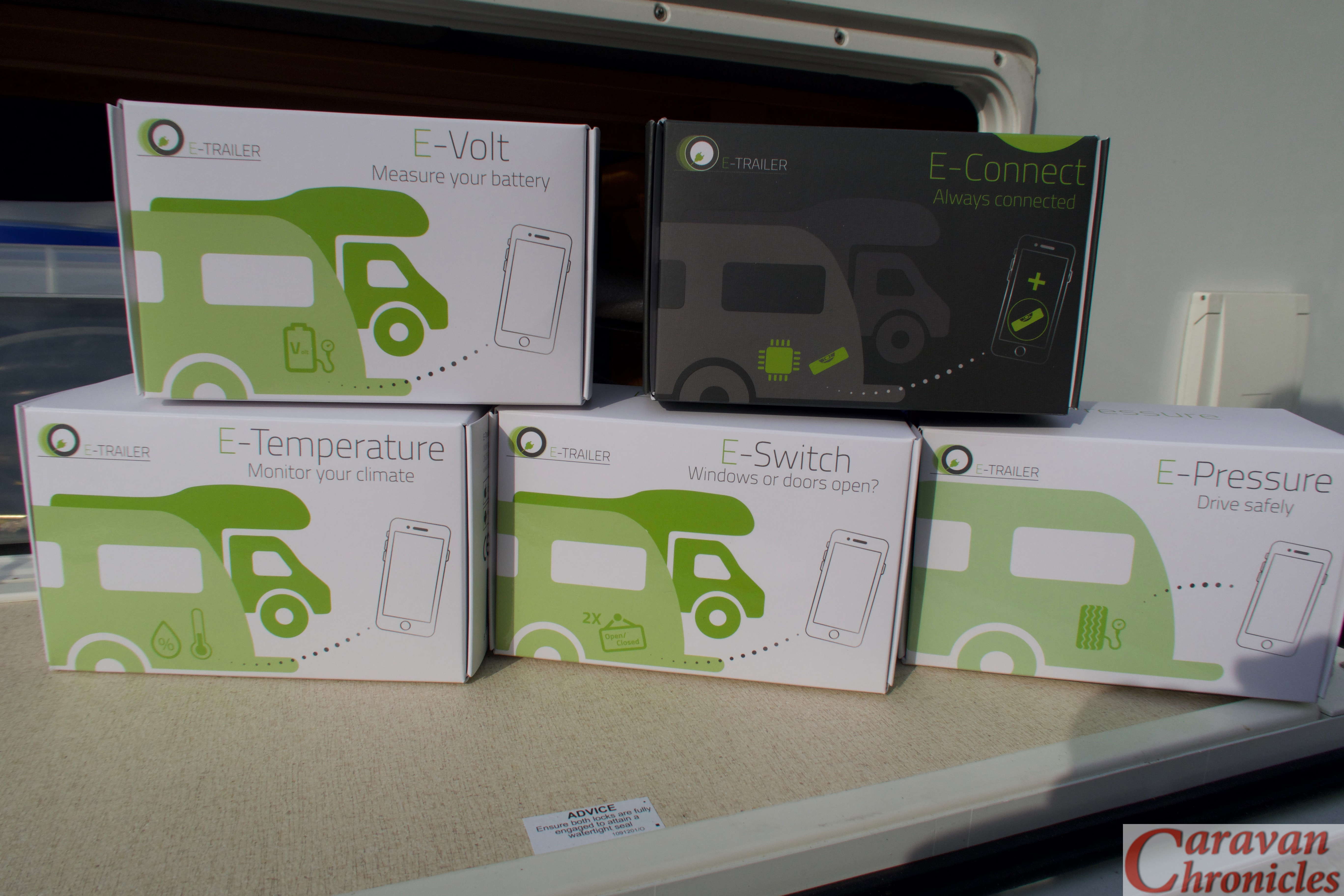
Opening up the box I found five smaller boxes, containing the main unit and four of the modules.

IMG_1400

Ok, so what is e-Trailer? The simple explanation is there is a black box that sends all kinds of information about your caravan to an app on your phone. It works with both Android and iPhones and there are various ‘modules’ you can add-on to get additional info.

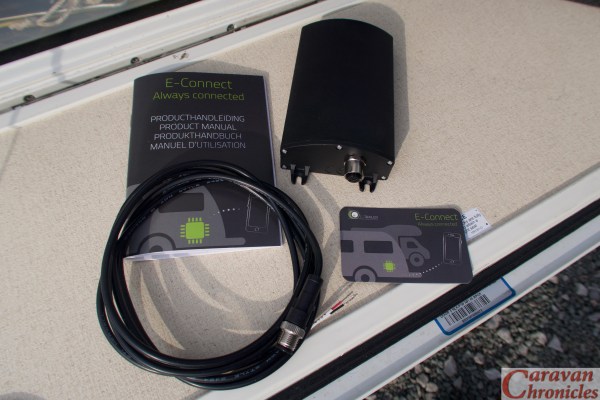
IMG_1403The actual unit is about 120mm long by 80mm wide and 40mm high with a good quality power connector at one end.

In the box is the main unit, 1.5 metre long power lead, instruction manual and a card with a QR Code on it.

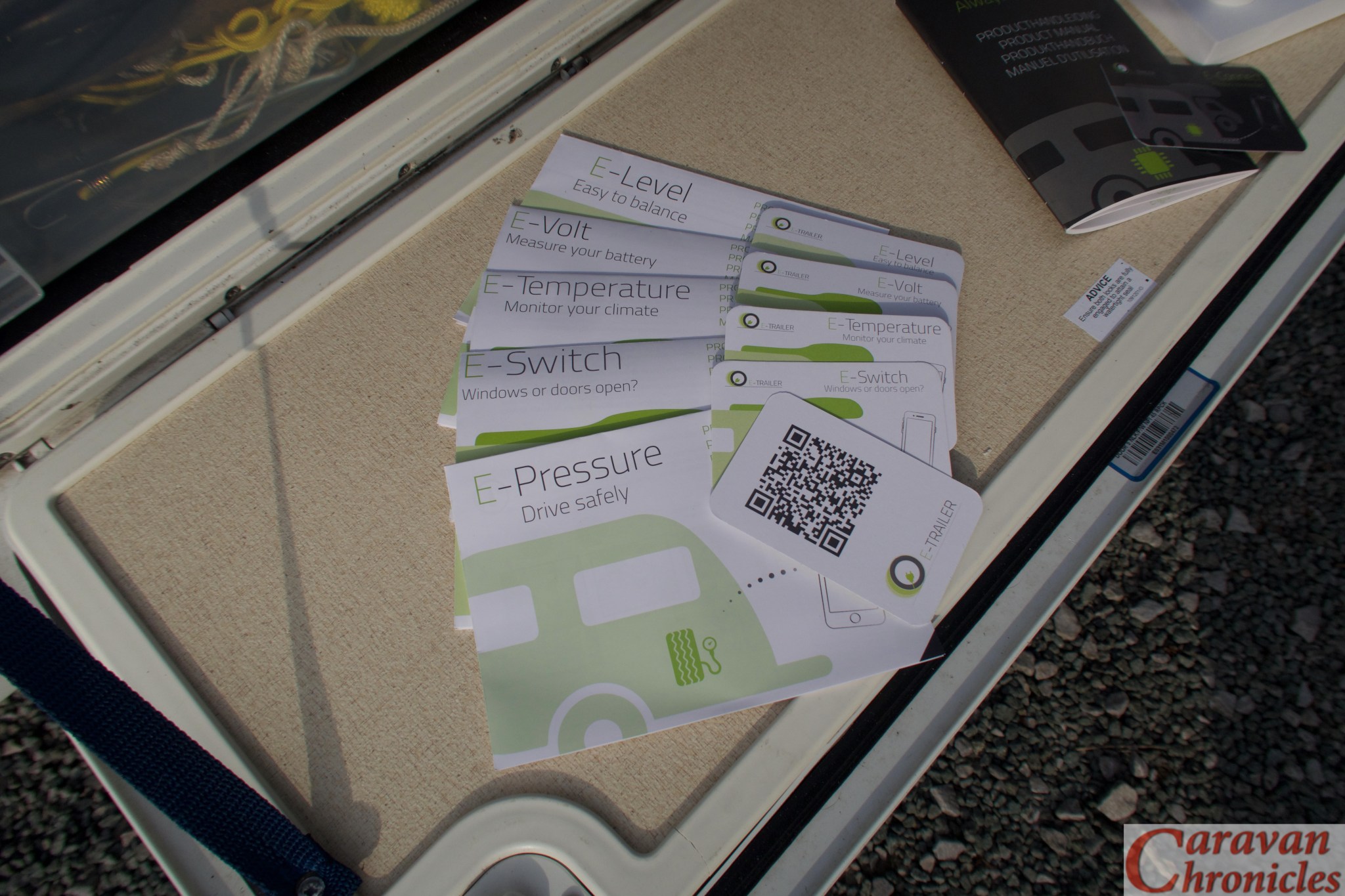
You get a QR code with each of the modules, and set of instructions, don’t lose the cars with the QR codes on them! (more about these later)

IMG_1401

Installing the unit is serious easy. You just hook up the power lead to a 12 volt supply. I opted to connected to a switched supply sort came on whenever the caravan master switch was on. This would mean it would be active when towing.

IMG_0855

Once you have powered up the main unit, go to the website e-trailer.nl/app and follow the link for your phone. In the case of my iPhone it took me to the App Store were I could download the app. Once downloaded launch the app and follow the on-screen instructions to register. I was a bit surprised it asked for my postcode and house number, but I guess this is how they register the unit to you for warranty etc.

Once you have created your account in the app and logged in… well remember that card with the QR code on it, simply scan the code and it pairs the app with the unit you have just installed.IMG_0861

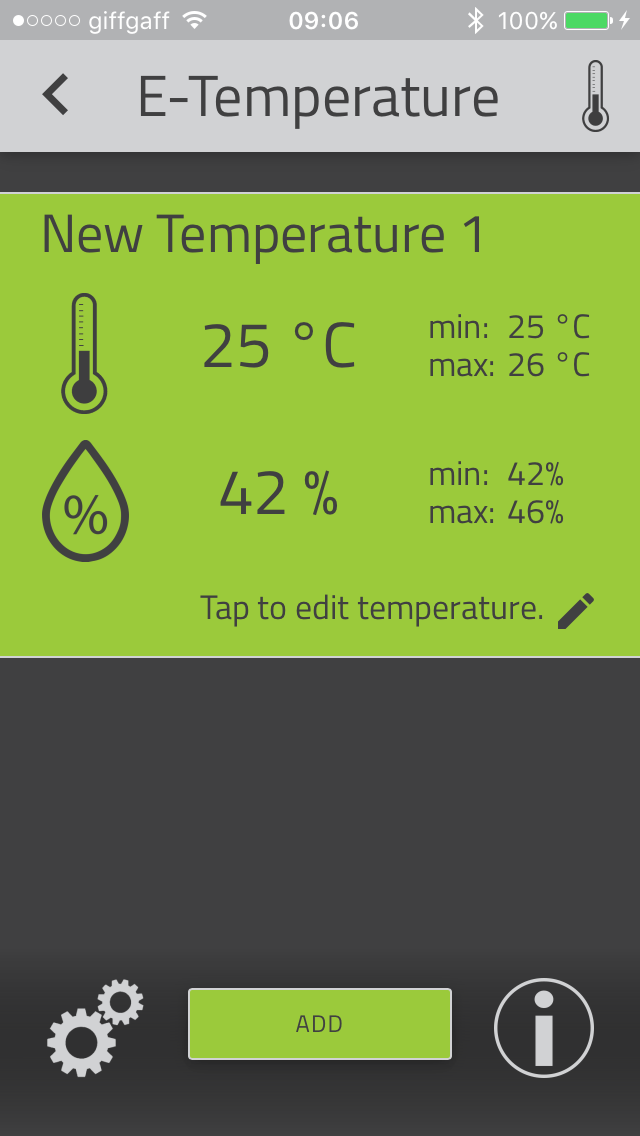
You are done! It’s that easy. Now to add the modules. The first one I added was the temperature module. You get a small puck shaped device and following the on-screen prompt, scanned the QR code.

IMG_1408

Done… a quick scan and now I have the temperature reading. For each module you can set lower and upper limits and the type of alarm… visual notification, vibrate, sound. From reading the instructions you could put this sensor in the fridge so when you are driving along you can keep an eye on the fridge temperature to make sure your wine or beer is perfectly chilled when you arrive. From what I understand you can add additional temperature sensors so you can check what the temperature is in the caravan at the same time.

IMG_0859

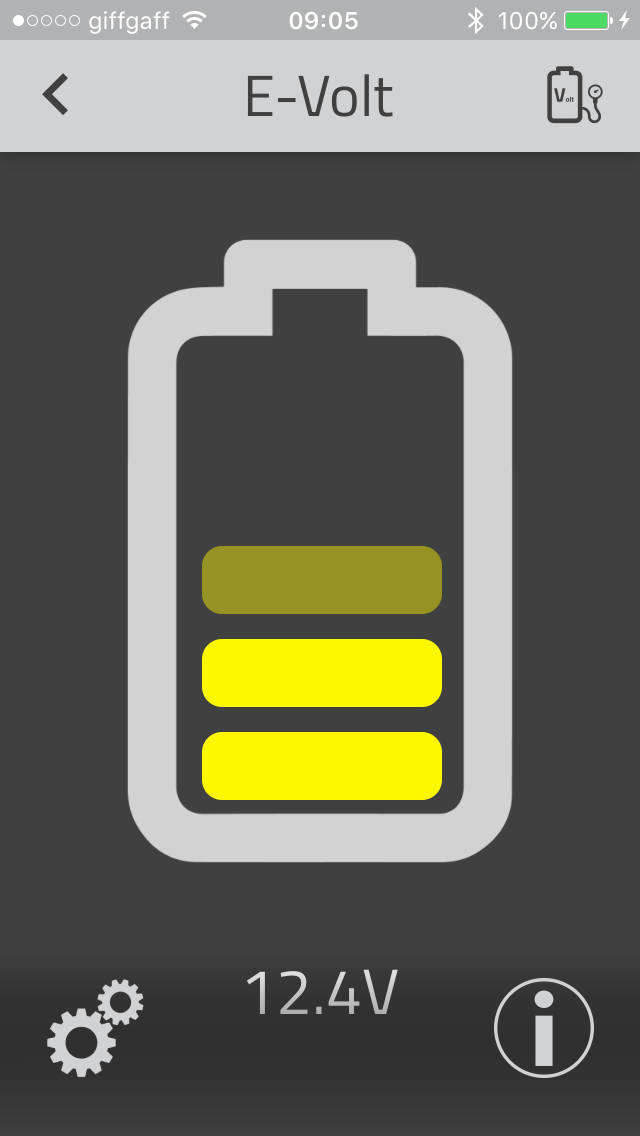
Next was the voltage sensor so you can keep an eye on the battery voltage. Again it was a quick scan of the QR code and I could see instantly what the battery voltage is and its relative state of charge. (I have yet to check how accurate this is).

IMG_0858

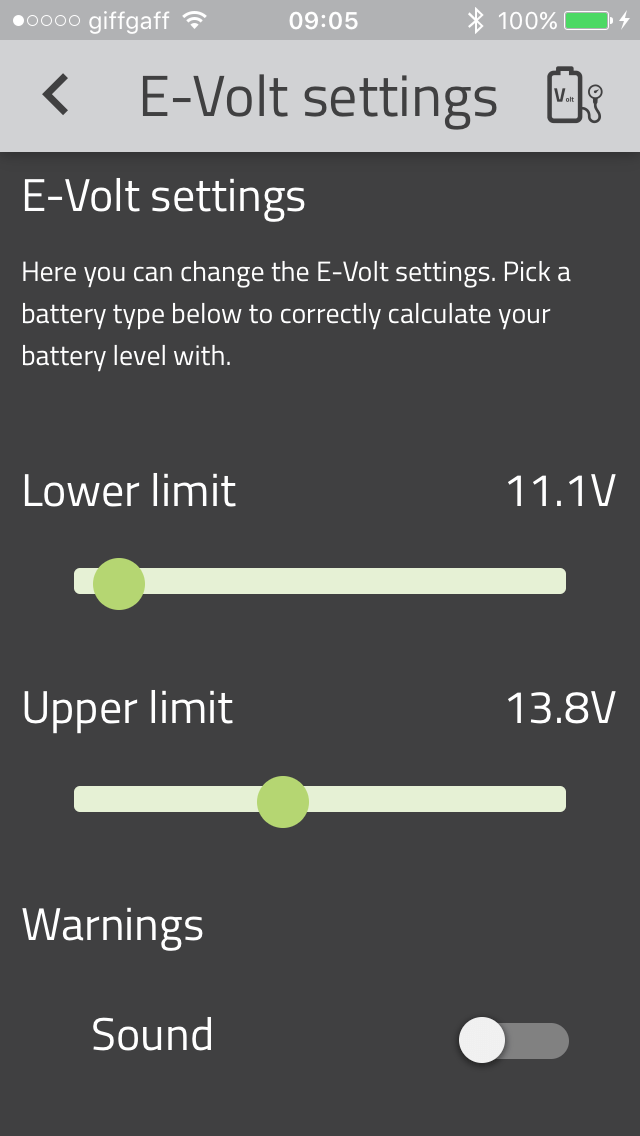
Again, it is easy to set the limits, just tap the two cogs in the bottom left corner….

IMG_0857

… And you can adjust the upper and lower alarm voltages. This is really useful as you can correctly set it for flooded call, AGM or lithium batteries.

Want to know if you have left your roof light open or TV aerial up… or even if your fridge door is open? There’s a module for that… The E Switch.

IMG_1409

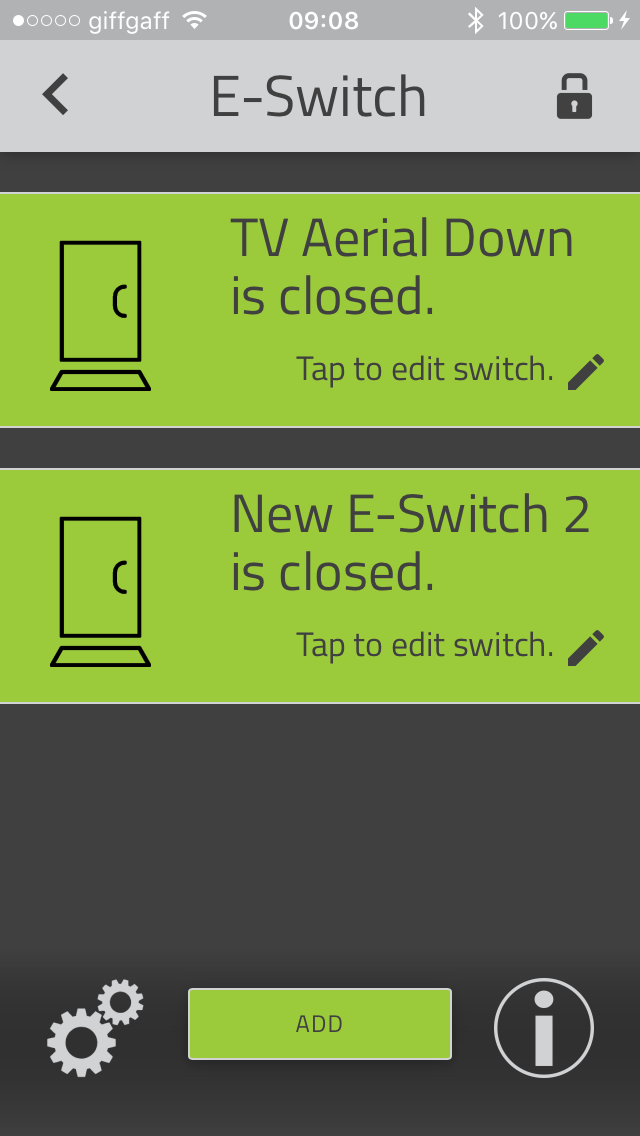
In the E-switch module you get two magnetic contact switches that come with 3M pads so you can stick them almost anywhere. Again adding them is a simple scan of the QR code and follow the instructions on-screen. I edited the text for the first switch so I know it is the TV Aerial.

IMG_0860

If one of the switches is open, on the home screen you see that the padlock is orange, close the switch and the padlock closes and the icon turns green.

IMG_0863
IMG_0862

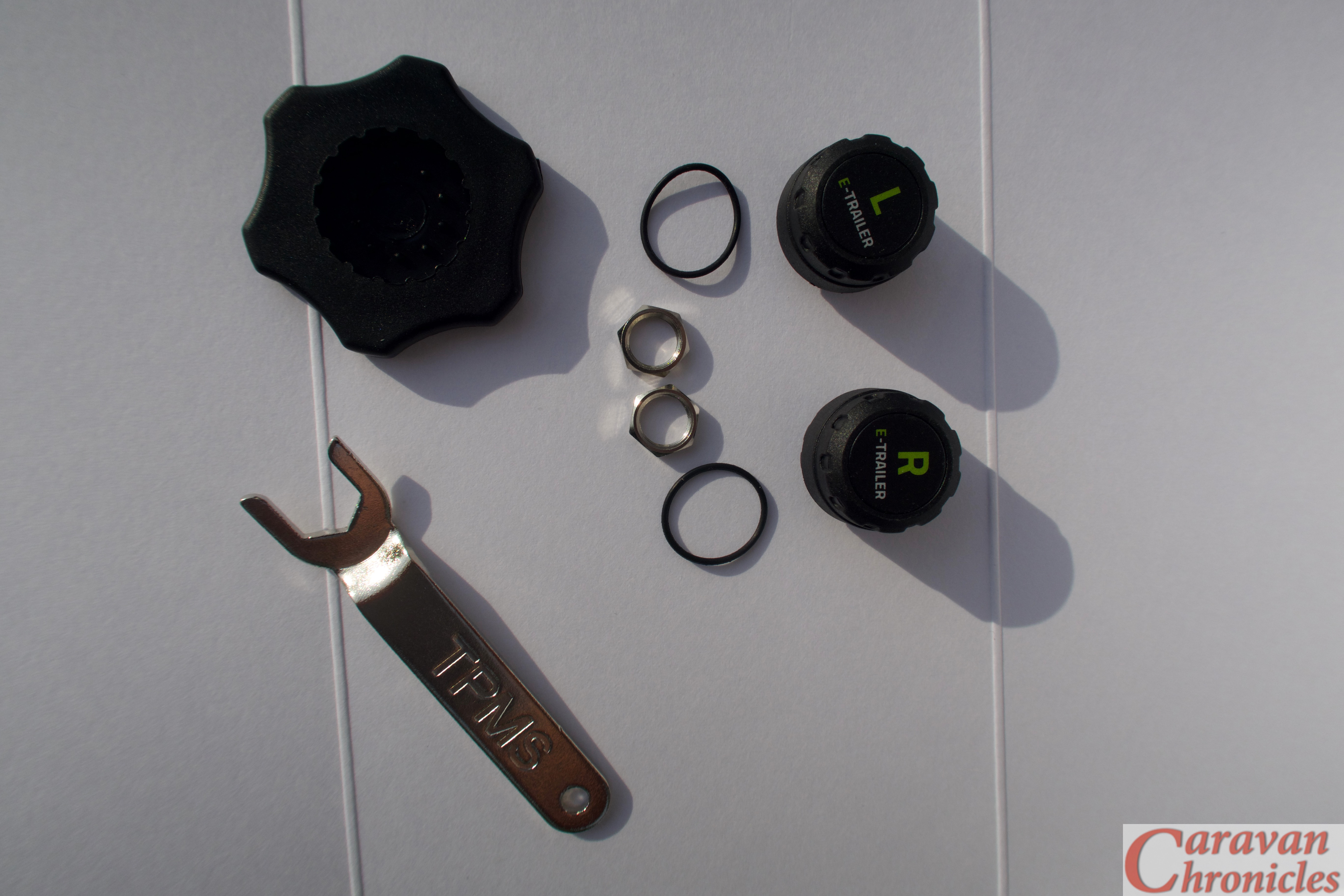
So what else can it do? Well I also have the tyre pressure monitor module. You get two pressure sensors to attach to the tyre valve stems. The sensors are the type that you can change the battery, which I much prefer, as opposed to the sealed type. I’ve not installed the TPMS module yet as I’m still testing out other TPMS systems on the Amarok and caravan but no doubt it will be an easy install… by just scanning the QR code!

IMG_1411

The last little trick that is has is it is an extreme accurate caravan levelling aid. Again a quick scan of the QR code gets this up and running and follow the on-screen instructions to determine your level point and it becomes easy to level next time you pitch.

OK so what did I think about it?

Well it was super easy to install. It was also super easy to add each module. I like the fact that when you hit up to set off you can check the battery voltage and see if it is charging. You can make sure what ever you have attached the magnetic contacts to you can see if they are in the correct position (i.e. closed, lowered etc.) and you can check the fridge or caravan temperature and tyre pressure.

While driving you can keep an eye on things like your caravan’s tyres, battery charge and fridge temperature. when you arrive on site, reversing into your pitch you can easily see if the caravan needs levelling side to side using ramps or blocks and when you un-hitch you can adjust the jockey wheel to get perfect levelling front to back.

“We have a problem Huston…..”

Now I do have a problem with it. Come what may I cannot get it to vibrate, notify me or play a sound when  anything goes out of the parameters (switch open, battery voltage low etc. I made sure I had the latest version of the app, I have double checked all the settings within my iPhone but I cannot get a single ‘vurrrrrr’ or ‘ding’ out of it. Admittedly my iPhone is now 2 versions behind the times but if the app installed I’d have expected it to work ok. I’ll continue to work on this one.

Finally…

I think the idea and technology is great behind the product and I really do like it and can see lots of additional applications could be added on in the future.

Why though is it an after market accessory? When you can be paying the best part of £30k for a top end caravan should not this sort of information system be standard? When I hitch up and set off, I’d love to be able to check the battery voltage (and charging current) check the fridge was working, tyre pressures, doors and hatches closed… and it is not beyond the engineering skills of man to be able to have a bulb out detection system for the road lights even…. all fed directly to your phone.

If a manufacturer decided to install such a unit the price point would drop dramatically.. and that’s one of my other niggles. The technology and ease of installation is great, however there is a bit of an ‘ouch’ in the wallet as currently the comfort pack is priced around £380. That’s a lot of nights on site. You can build up the unit by just buying the individual modules though.

Do I want one… “Yes”…. would I buy one…. I’ll just go and have a word with Sue.

The e-Trailer is currently available from Road Pro here.. www.roadpro.co.uk/catalogue/01m-smart-trailer

Share this:

  • Share on X (Opens in new window) X
  • Share on Facebook (Opens in new window) Facebook
  • Share on Tumblr (Opens in new window) Tumblr
  • Share on Pocket (Opens in new window) Pocket
  • Share on Pinterest (Opens in new window) Pinterest
  • Share on Reddit (Opens in new window) Reddit
Like Loading...

Getting All Charged Up – Update 2…

29 Monday Jan 2018

Posted by Simon Barlow in Accessories, Blog updates, Electrical, Gadgets, Maintenance, Modifications, Product Review

≈ 10 Comments

Tags

Accessories, Maintenance, RoadPro, Sterling Power Wildside, Technical

I guess this really is the update to an update (Getting All Charged Up – Update…). We have been living with the Sterling Wildside unit now for about 6 months and a LOT of people have been emailing me asking how we are getting on with it and is it worth it?

IMG_1194Well I have done quite a bit of testing with my leisure battery in various states of discharge. With it at about 50% I have recorded a charging current of 15.9 Amps which is far greater than I could manage before and due to the fact that the Wildside unit uses the correct charging profile for my battery I’m not concerned that I will be reducing or damaging my leisure batteries life expectancy.

Earlier this month I had an email from David Dent who had successfully installed a Wildside unit in his Bailey Unicorn 3 Cadiz and he seemed pleased with the results so far. Although installing it in a Bailey was a bit more of a challenge. I’m looking forward to checking back with David to see how he is getting on with his unit.

A couple of other people have also emailed me reporting that after installing a Wildside unit that it had solved their problem of having enough stored energy to operate their motor movers. I still wonder if people who have been experiencing problems with their motor movers caused by supposedly bad batteries and have had to replace them is possibly down to the fact their battery was never really receiving a correct or full charge before causing its early demise.

New Tool…

One of the things I want to get to add to my ‘tool box’ in the near future is one of the computerised digital battery testers. At the moment I’m basing a lot of my work on the voltage of the battery and chemistry type. I’d like to be able to improve on this.

Watch This Space…

The other thing I’d also like to be able to do is get a voltage and charge current reading for the leisure battery while we are actually driving. I have been looking at a few – mainly American options for bluetooth remote voltage and current sensors that you can connect up to with your phone. There are a couple of devices that offer a separate display to fit in your vehicle.

However, there is a rather exciting unit that will shortly be coming on the market in this area that might be a bit of a game changer. If you want to know what it is well go and see Andy Harris or one of the guys on the Road Pro stand at the NEC in a couple of weeks time as they, along with the manufacturer will be launching and demonstrating a new product that might just be bringing caravan technology bang up-to-date. I hope to be bringing you a bit more about this soon and maybe an install too!

Final Thoughts….

Is the Wildside unit worth it?  Before I answer this let me just say I am not being paid by anyone for any endorsements of this unit. I was supplied one of the first (pre production?) units as a test and to provide feedback to Sterling Power on how easy it was to install and it’s performance in the real world, which I did. As a result a couple of things were ‘tweaked’ hence mine had to be returned, reprogrammed and reinstalled.

Well I’d say if you have a Euro 6 or even a 5 engine and you want to make sure your battery is looked after then yes. If you want to upgrade to a more advanced battery chemistry, again yes.  If I had to return mine would I go out and buy one? Yes I would.

Is there anything I’d like to see changed? Well if they ever did a Wildside 2.0 I’d like to be able to move the caravan’s own charging system so it was routed through the Wildside unit when on mains hook up to take advantage of the Wildside’s smart charging facility and to allow you to move to more advanced battery chemistry. I guess also adding a solar panel input with built-in MPPT would be a big hit too.

In The Future…

I’m starting to wonder if the way we charge and power caravans needs to take a leap forward. I have had an idea that you could basically split an inverter. One half in the vehicle and the other in the caravan. Imagine a small unit that takes the 12 volt DC from the vehicle and inverts it to 48 volts AC. You then have a lead that connects this across to the caravan and there it is converted back into 12 volts DC.

So whats the difference… all you are doing is what’s already happening? Well using a 2.5 mm cable rated for 25 amps at 48 volts gives you 1200 watts of power. To transfer that much power at 12 volts you would need 100 Amps. Keeping it at 48 volts will mean the system is still in the ELV range for safety. (Use 4mm cable and this could be 1680 watts of power which would be equivalent to 140 Amps at 12 volts)

Being able to transfer that sort of energy would allow you to forget LPG cylinders and put 1000 Ah of lithium cells in the caravan with a 240 volt inverter and power everything. Just a thought that I’m throwing out there.

Share this:

  • Share on X (Opens in new window) X
  • Share on Facebook (Opens in new window) Facebook
  • Share on Tumblr (Opens in new window) Tumblr
  • Share on Pocket (Opens in new window) Pocket
  • Share on Pinterest (Opens in new window) Pinterest
  • Share on Reddit (Opens in new window) Reddit
Like Loading...

Is A Euro 6 Engine Killing Your Leisure Battery?…

21 Friday Jul 2017

Posted by Simon Barlow in Accessories, Amarok, Caravan Electrical Fault Finding, Caravan Electrics, Electrical, Maintenance, Modifications, Off Grid, Technical, Tow Vehicle, VW Amarok

≈ 83 Comments

Tags

Caravan Electrics, Euro 6 Engines, Maintenance, Modifications, Sterling Power Wildside

OK… so that title was a bit dramatic! However here’s the thing… I don’t think everything is peachy with Euro 6 engines and charging leisure batteries.

If you are a regular reader, you know I have recently installed one of Sterling Power’s Wildside units (and so far I’m super happy with it!) but I did get an email from someone who had read all my postings about it and asked me if it might cure his problem. Here’s the gist of his email….

Note: I have edited this down a bit…. and withheld the name of the person and vehicle.

“I have recently changed my car to a new 2017 xxxxxxxxxxxx and after several trips with it, on arriving home there is never enough charge in the motor mover to manoeuvre our caravan up our drive (which is on an incline) and park the caravan round the back of the garage. I have to plug the caravan in overnight before I can use the mover.

This only seems to have started happening since we changed to the xxxxxxxxxx. I had the caravan’s battery tested at two garages and they said it is OK and it is only 2 years old. The local caravan service man said he could not find anything wrong with the motor mover.

As we are on mains at the caravan sites we visit for a few days the caravan battery should be fully charged.

Can you help?”

This did have me stumped for a bit. Battery tested OK, no issues with the mover, so what was going on?

While doing some of the prep work for writing about my installation of the Wildside unit, I had spent a few days prodding about our VW Amarok with a multimeter and making a few notes about voltages etc. One thing that I did cotton on to was the cyclic way the vehicles ECU seemed to turn off the alternator…. well I should really say put the alternator into “idle” mode. Now with the caravan attached (pre Wildside unit install) I did notice that  at the start it seemed to take longer for the vehicle’s alternator to go into idle mode but also it seemed to stay in idle for a lot longer and I was in the process of trying to work out why as initially I’d have thought it would have been less as it was running the fridge and charging the leisure battery.

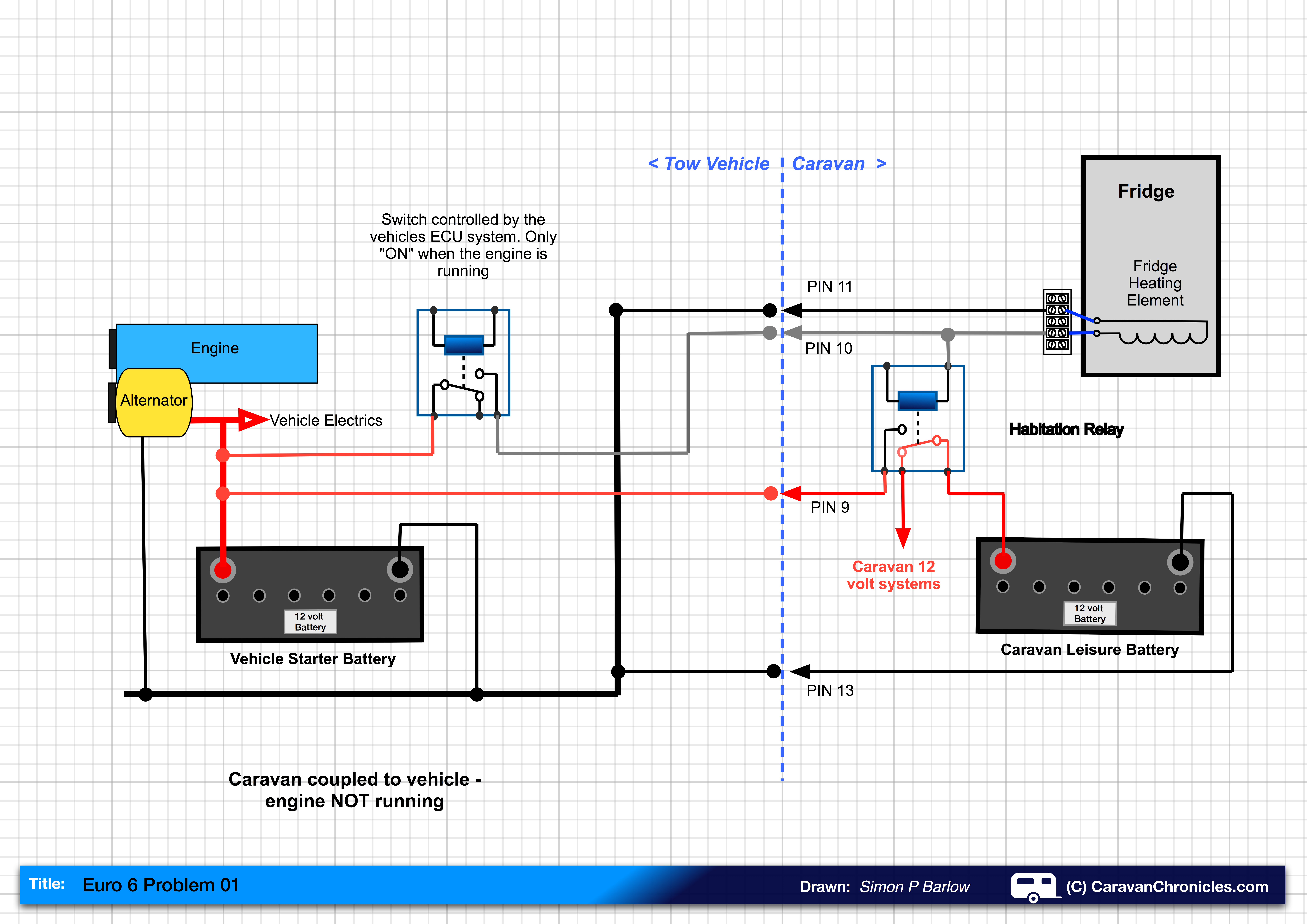
A picture is worth… you know the rest. Here’s one of my excellent drawings!

Euro 6 Problem 01

Right, here we go… The drawing shows a caravan plugged into a tow vehicle that has the engine-turned off. Pin 9 is live as it should be, and the habitation relay in the caravan is effectively off allowing the caravan’s leisure battery to connect and power the caravan’s internal 12 volt systems. As the vehicle engine is off, there is no power on Pin 10 the fridge circuit, as this is controlled by the vehicle’s ECU.

Really this could be any vehicle with any engine. Now let’s have a look at what happens with the engine running…

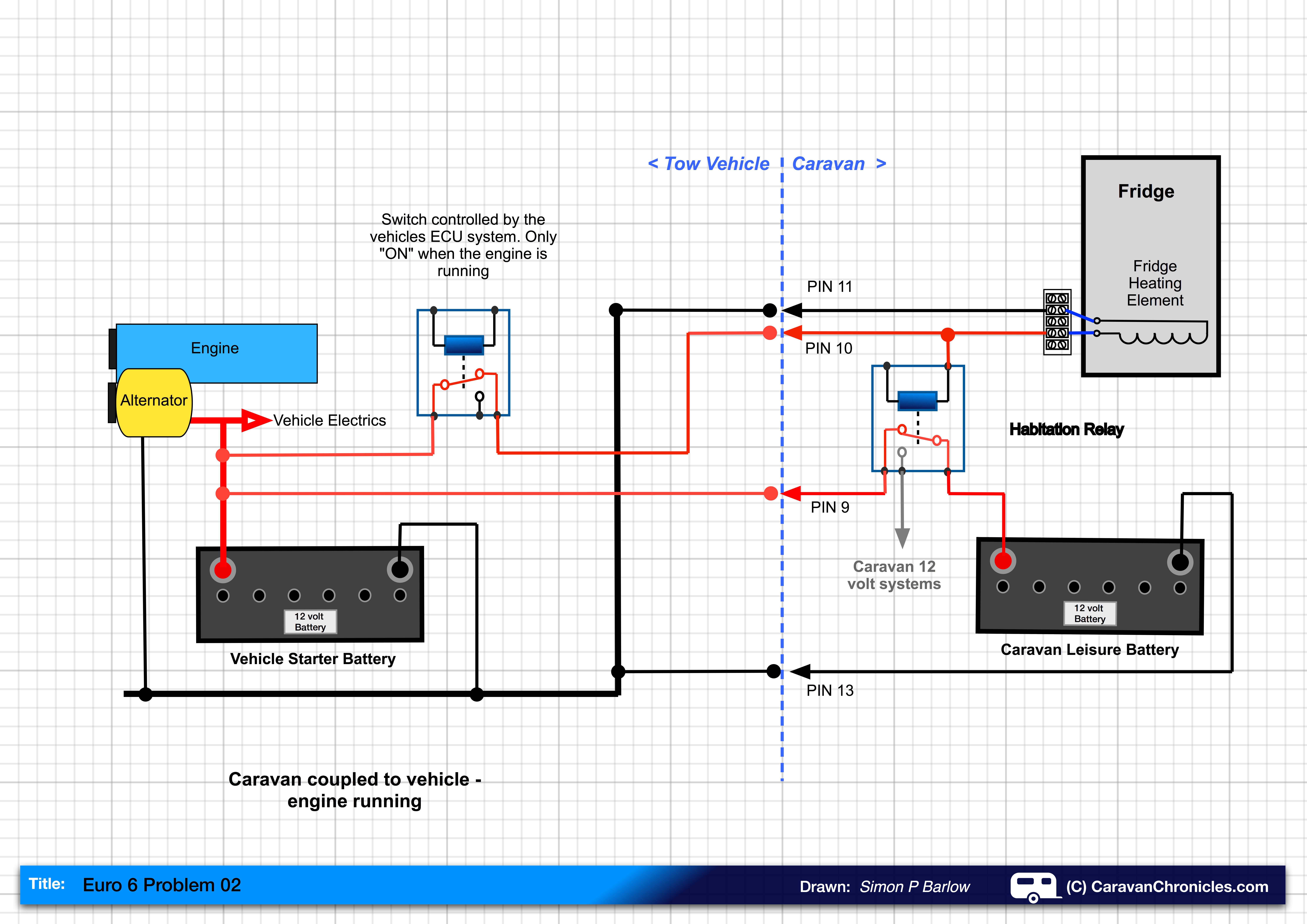
Euro 6 Problem 02

Pin 10 is live, turned on by the vehicles ECU and this powers the caravans fridge. It also operates the caravan’s habitation relay which now disconnects the leisure battery from the caravan’s 12 volt systems and connects it to Pin 9 so that the vehicle can start to charge it.

Again, this could be any vehicle with any engine. This is how our Land Rover Freelander works with our caravan. All straight forward.

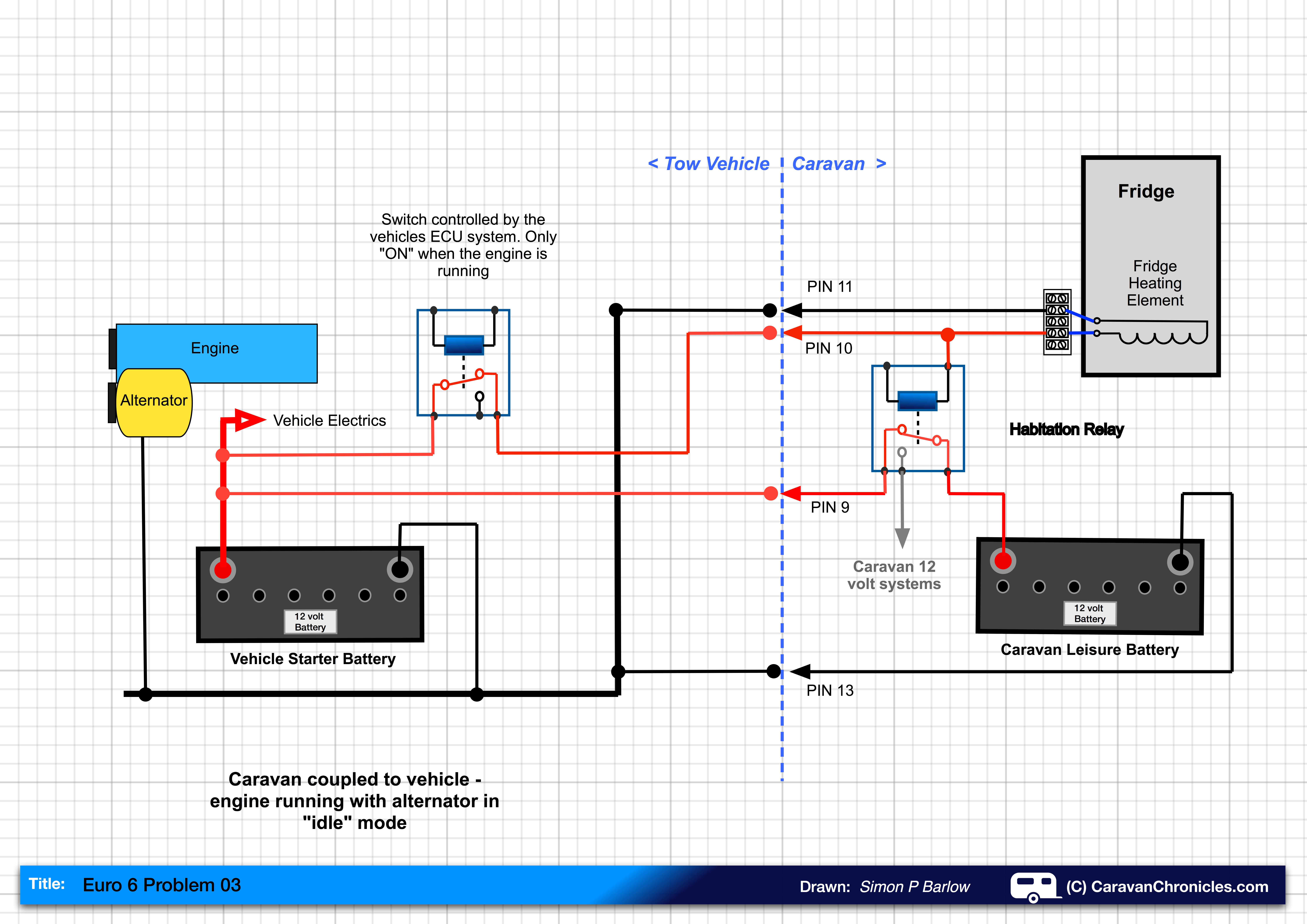
Now lets look at what happens when the Euro 6 engine puts the alternator into “idle” (or Eco mode etc.)

Euro 6 Problem 03

This is where it starts to get interesting. I have taken a few liberties here and made a few assumptions. I have shown the vehicle’s alternator disconnected. In practice the ECU doesn’t disconnect the alternator, it will reduce the field voltage and hence the output, not really disconnecting it but reducing the output to a negligible amount.

The ECU will also monitor the vehicle’s battery voltage and continue to allow the vehicles general electrical system to drain the battery to somewhere around 75% charge (this may be a bit of an arbitrary figure) The ECU will then turn on (or up) the alternators output to recharge the vehicle’s battery to about 80%. Why 80% well it needs the remaining 20% ‘free capacity’ so that when you brake, the excess energy of engine braking (regen) can be dissipated into the vehicle battery. Remember that on a Euro 6 engine the alternator is capable of generating round about 2Kw.

Now at this point it dawned on me that something could be happening here, but the idea was a bit ridiculous…. guys with far more agile grey cells than mine must have worked this out and I dismissed the idea. I must have missed a trick somewhere.

I did a bit more checking. I was using two 17Ah sealed lead acid batteries as my “leisure” battery simply because it was quicker to charge or discharge them than a 120Ah battery. For a fridge load I was using 3 x 50 watt light bulbs and it was all jury rigged to a 13 pin plug so I could just plug it in to either the Freelander or the Amarok to make comparisons. I was using a trusty old AVO 8 meter, a couple of digital multimeters and a clamp meter to measure current so really the whole set up was super sketchy for anything that I could write about. I thought that I must have been missing something somewhere and I actually kind of put it to the back of my mind. I just got on with installing the Wildside unit and writing it up.

“DING” You have mail……

I received an email from Charles Sterling with some very interesting information. During testing he had come across exactly the same issue I was pondering over but had put off further testing. I guess by now you have worked it out. Quite simply you can get current flow in the opposite direction… from caravan leisure battery to vehicle battery. In testing Charles had measured a current of around 6 Amps.

It dawned on me that maybe during my initial testing with my jury rigged set up I hadn’t missed something and the readings I had seen were correct. Both Charles and I quite separately had (in my case ‘stumbled’) on a potential issue with Euro 6 engines and caravans.

Back to the original email earlier. It now made sense. The sender of the email was setting off from their campsite to travel home with a fully charged battery (being on EHU while they were on site) and during the course of the drive home, the vehicles ECU was actually reducing the fully charged leisure battery down to 80% charge as it actually thought that the ‘vehicle’ battery was at 100% charge. Hence when he arrived home, the caravan’s leisure battery didn’t have enough charge to run the motor mover long enough to put the caravan away.

So what does this mean in practice?

Well effectively (give or take a bit of loss due to cabling) the caravan’s leisure battery will only get charged to about 80%. You can now think of the vehicle battery and caravan leisure battery as being one battery bank because that is how the vehicle sees it. If the leisure battery is fully charged its voltage will be higher than the vehicle battery so the vehicle will turn off (or down) the alternator so that the vehicles electrical system can drain it to about 75% ready for accepting the excess energy from regen braking. The caravan’s fridge helps the vehicle by draining the battery bank that bit quicker.

This also answers another question. While I was testing, sometimes I’d plug-in my jury rigged setup and if my two little 17Ah batteries were fully charged I’d get a low current drain indicated on my clamp meter. I’d dismissed this to a certain extent, but now I realise that as my two 17Ah batteries were fully charged and the vehicle battery would be at about 80% charge, there would be enough of a voltage difference for a short while, that the two 17Ah batteries would try to equalise with the vehicle battery by recharging it slightly..

Whats the answer?

Well thankfully I solved my problem when I installed the Wildside unit a few weeks ago.

Finally…

If you have had any electrical issues with a Euro 6 engine and towing please drop a comment below. I’ll try to help.

As an aside, I am trying to arrange attending a tow bar installers electrical course with a couple of the OEM electrical equipment manufacturers and one of the approved bodies so I can hopefully increase my knowledge base and widen the number of vehicles I can cover. It’s a bit up-in-the-air at the moment as it would appear its going to cost a small fortune! (Sponsorship deals gratefully received!)

Share this:

  • Share on X (Opens in new window) X
  • Share on Facebook (Opens in new window) Facebook
  • Share on Tumblr (Opens in new window) Tumblr
  • Share on Pocket (Opens in new window) Pocket
  • Share on Pinterest (Opens in new window) Pinterest
  • Share on Reddit (Opens in new window) Reddit
Like Loading...

Getting All Charged Up – Update

02 Sunday Jul 2017

Posted by Simon Barlow in Accessories, Caravan Electrics, Electrical, Off Grid, Product Review, Projects, Reviews, Technical, Towing, VW Amarok

≈ 20 Comments

Tags

Caravan Electrics, Leisure Battery Charging, Modifications, Sterling Power Wildside, VW Amarok

The best laid plans….

We had originally intended to spend a week down at Glastonbury which would have meant the 5 hour drive down would have been an excellent test for the Sterling Power Wildside unit’s first outing. However we had to cancel the trip literally the day before we were due to set off. In the few days between installing the Wildside unit and our planned trip to Glastonbury I had been exchanging emails and phone calls with Charles Sterling talking about some of the aspects of the Wildside unit and the direction that caravan electrics was heading in.

Continue reading →

Share this:

  • Share on X (Opens in new window) X
  • Share on Facebook (Opens in new window) Facebook
  • Share on Tumblr (Opens in new window) Tumblr
  • Share on Pocket (Opens in new window) Pocket
  • Share on Pinterest (Opens in new window) Pinterest
  • Share on Reddit (Opens in new window) Reddit
Like Loading...

Getting All Charged Up – Part 3 “The Install”…

30 Tuesday May 2017

Posted by Simon Barlow in Accessories, Boondocking, Caravan Electrical Fault Finding, Caravan Electrics, Caravan Fault Finding, Electrical, General, Modifications, Off Grid, Technical

≈ 16 Comments

Tags

Caravan Electrics, Leisure Battery, Leisure Battery Charging, Maintenance, Sterling Power, Sterling Power Wildside, Technical

There has been a bit of a delay since Part 1 and Part 2 due to Sue having a fall and breaking her arm in three places. This required over three hours of surgery to install enough metalwork and screws to keep a blacksmith happy followed up by a lot of trips back and forth to the hospital. However, on with the install of the Sterling Power Wildside unit. I think that this will be the first ever install of a unit in a caravan.

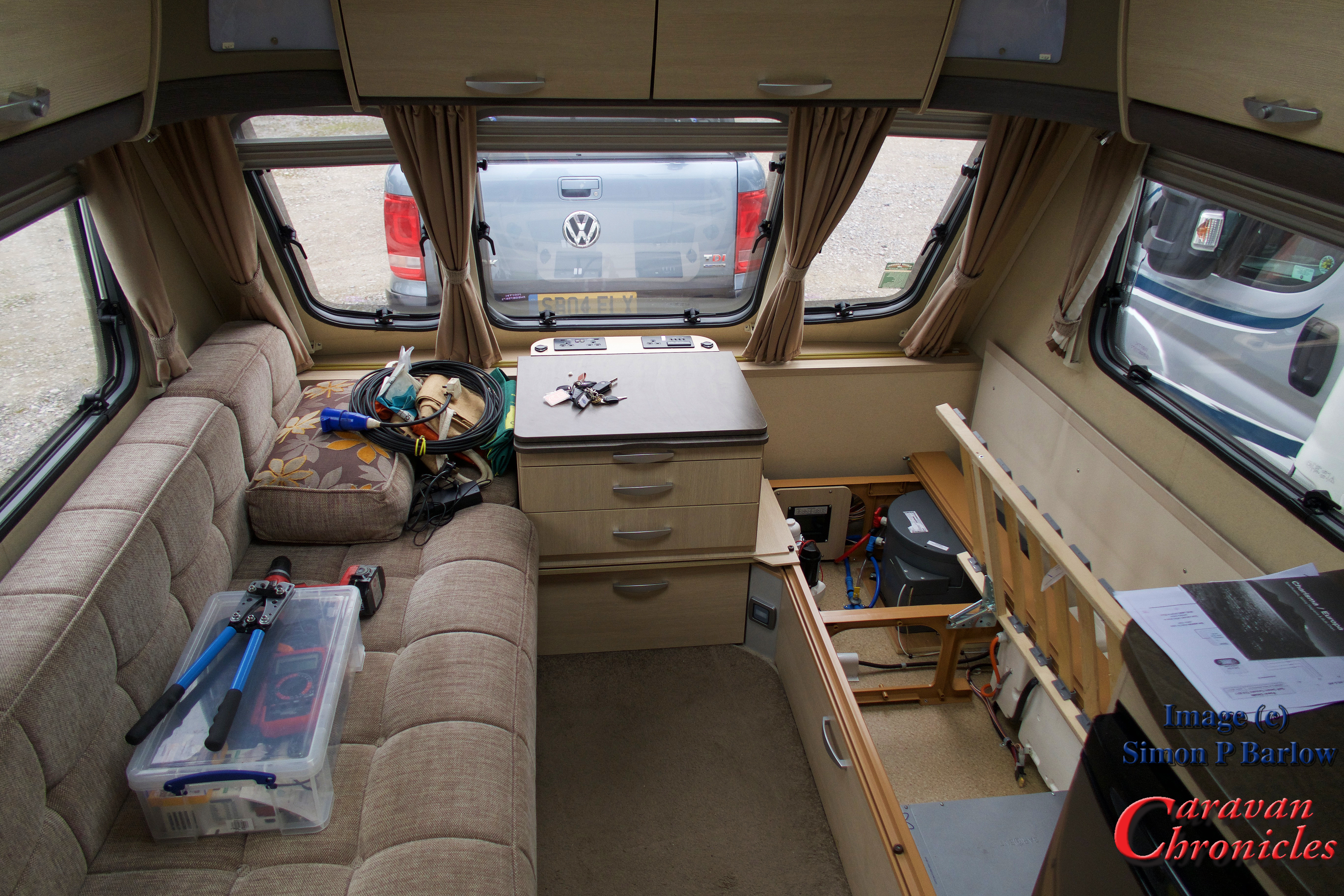
I printed out copies of the wiring diagrams and loaded up the Amarok with everything  I’d need and set off for the storage site. Arriving at the caravan everything was cleared out to give me some space to work.
IMG_1134

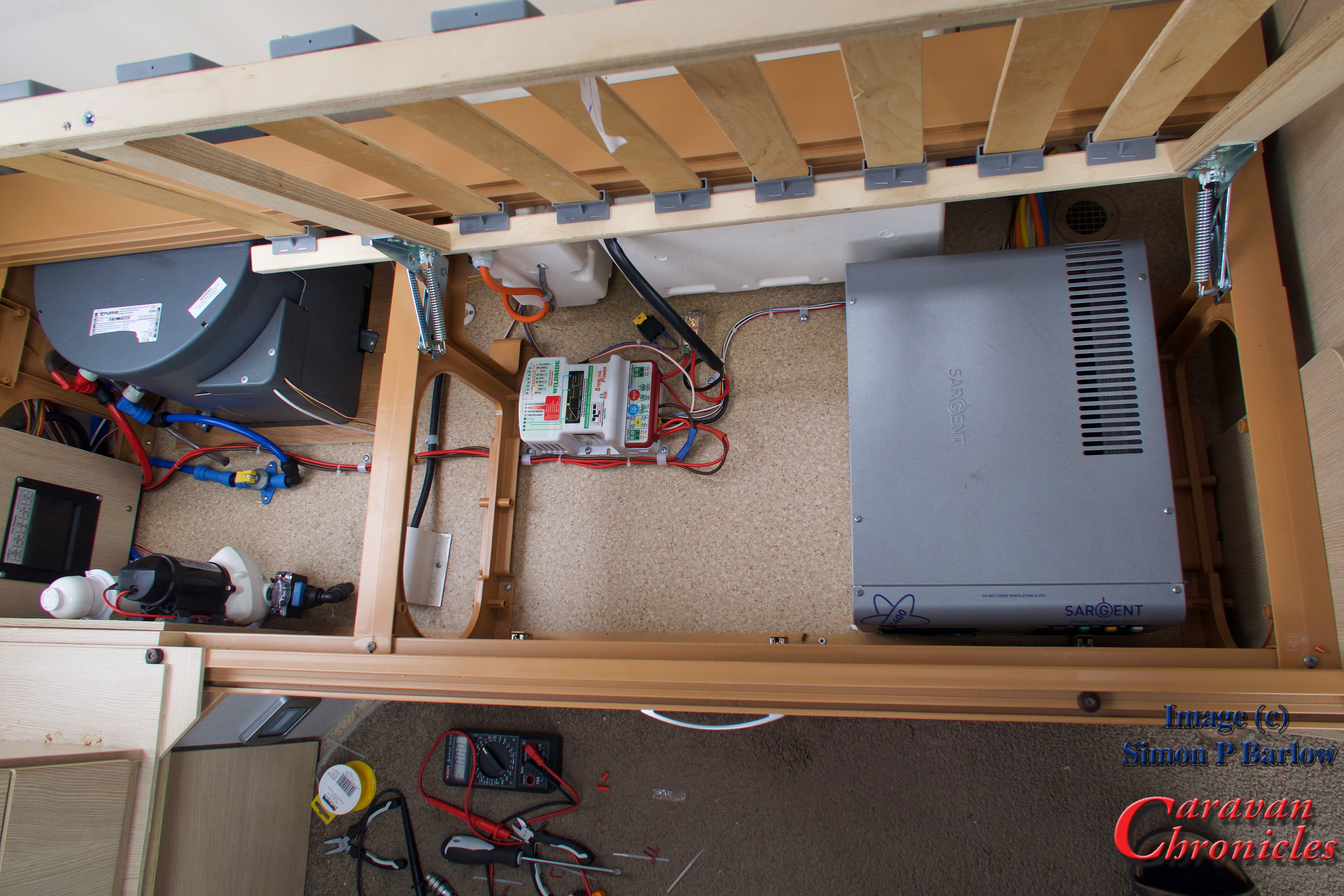
I’d planned to install the unit somewhere close to the Sargent control box as all the connections I’d need could be found here and it was close to the fuse box that connected the lead from the 13 pin plug to the caravan services.

IMG_1136

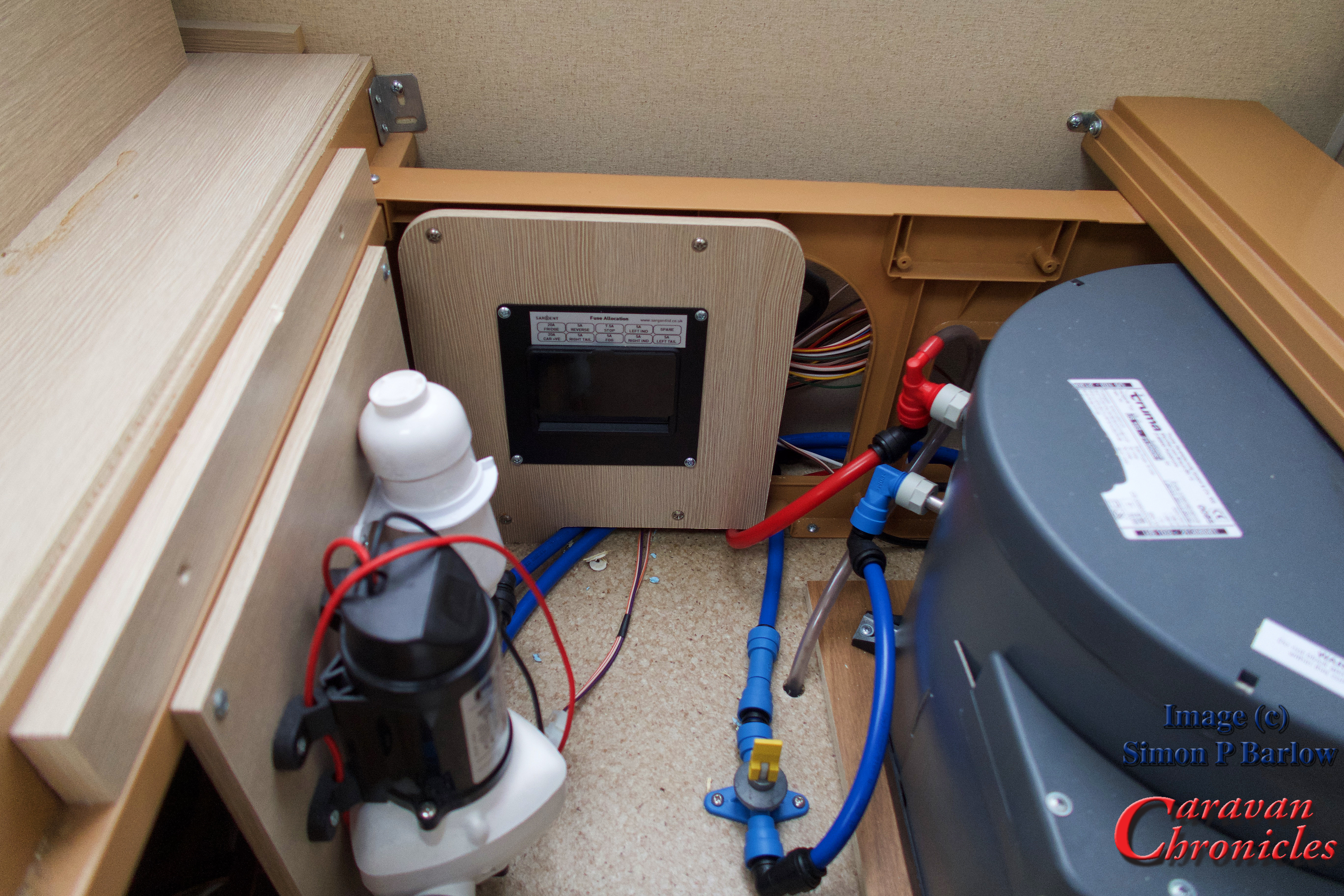
The fuse connection point for the lead from the 13 pin plug is in our caravan, located right at the front next to the centre chest of draws against the gas locker wall.
IMG_1135

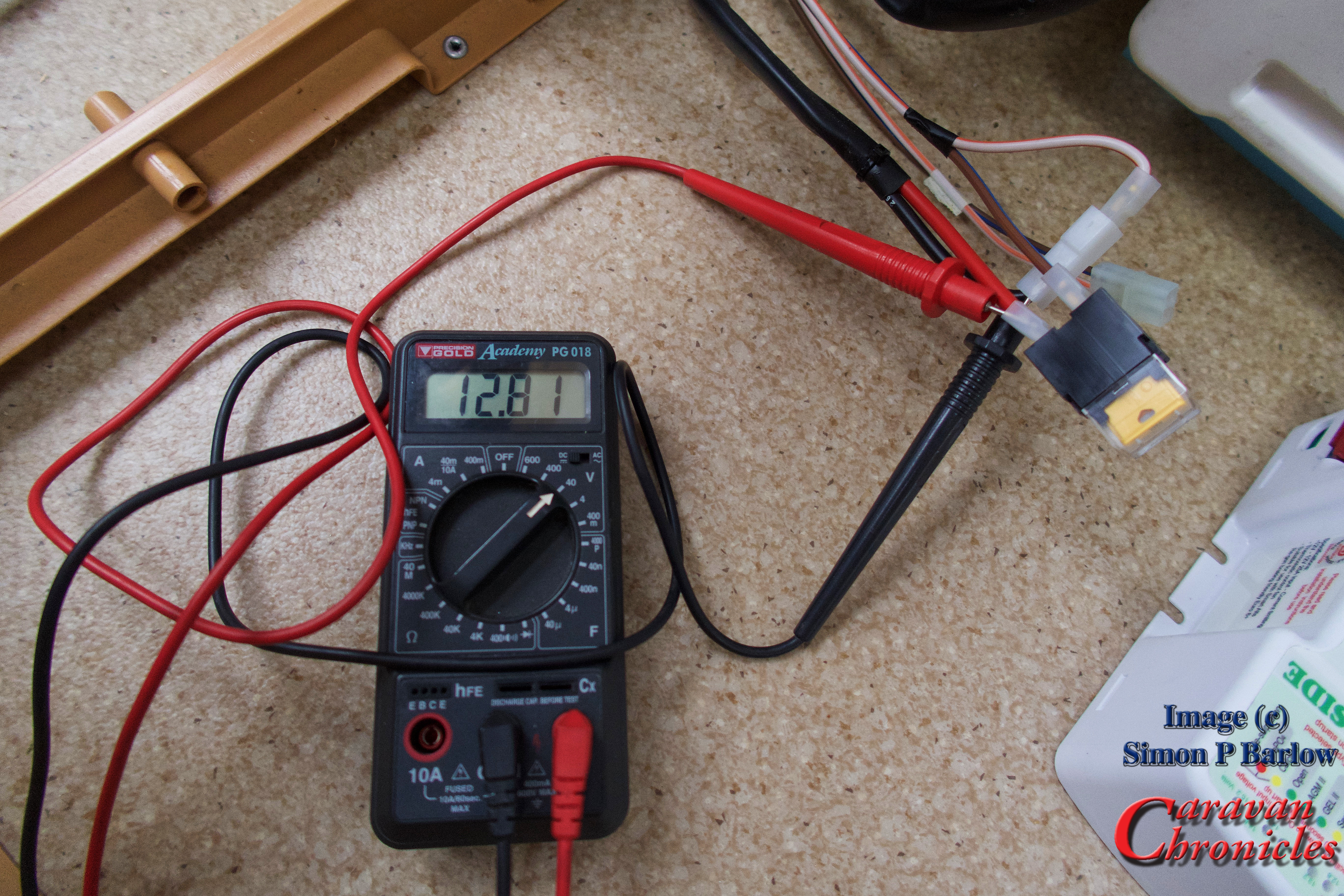
Before starting, I did a quick voltage check on the leisure battery…. 12.81 volts, which isn’t too shabby as we don’t have a solar panel and it had been February 25th when I left the Caravan show at the NEC and the battery was last charged up. Which was   about 13 weeks earlier.
IMG_1139

To gain access to the wiring going into the Sargent unit, I removed the 4 screws holding the top cover on and the lid simply lifted off revealing all the connections and as a bonus, service loops in the cable. This meant it should be possible to install the wild side unit without having to do any cable splicing. I did debate at this stage if it would be possible to install the Wildside unit inside the Sargent box… but I decided as I didn’t know the heat gain of the Wildside unit, it might be prudent not to attempt it.
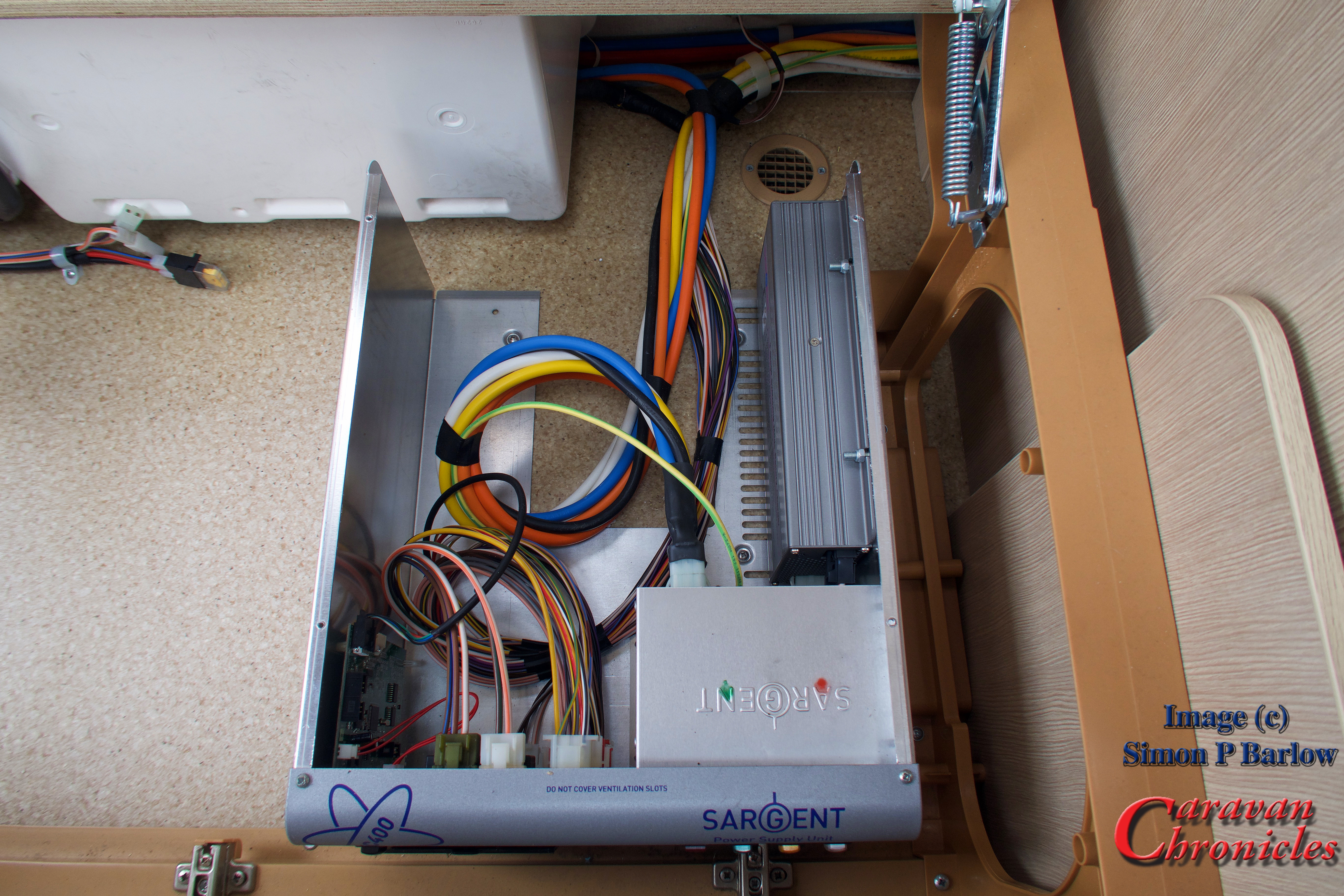
IMG_1137

The cables inside the Sargent box are basically separated into two looms. One 12 volt and the other 230 volt which keeps things easy and neat. Also the back of the circuit board within the Sargent unit was printed with each of the plug numbers, so doing all the planning paid off as I could simply find the plug number from my diagram and locate the correct cable easily.

I decided I was going to do a pre-install and connect the Wildside unit up and do a few tests, then once I was happy I’d go ahead and do a full more permanent installation.

It was simply now a matter of finding the plug I needed, unplugging it, locating the correct wire, cutting it and terminating it in the Wildside unit.

IMG_1140

I cut the cables about 4 inches away from the circuit board plug. This would give me plenty of length to crimp on a sleeve connector and heat shrink if I needed to remove the Wildside unit. As a backup I have also ordered some replacement pin inserts for the plugs so I could always re-terminate directly into the plug.

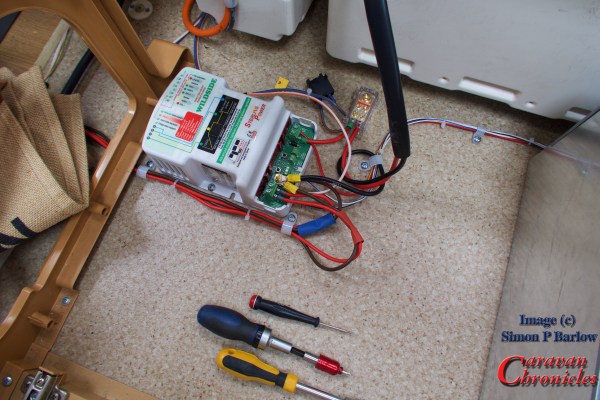
The next connections would be the incoming feed from the vehicle. 4 cables, two neutral and one positive fridge supply from pin 10 and one positive charging supply from pin 9.  These arrive from the 13 pin plug via the fuse box mounted on the front wall through two 20 amp fuses and to the Sergeant unit. I had trouble identifying the cables as the colours were not as indicated in the manufacturers drawings. So to double check I removed the fuse box to gain access to the 13 core cable where it terminates.
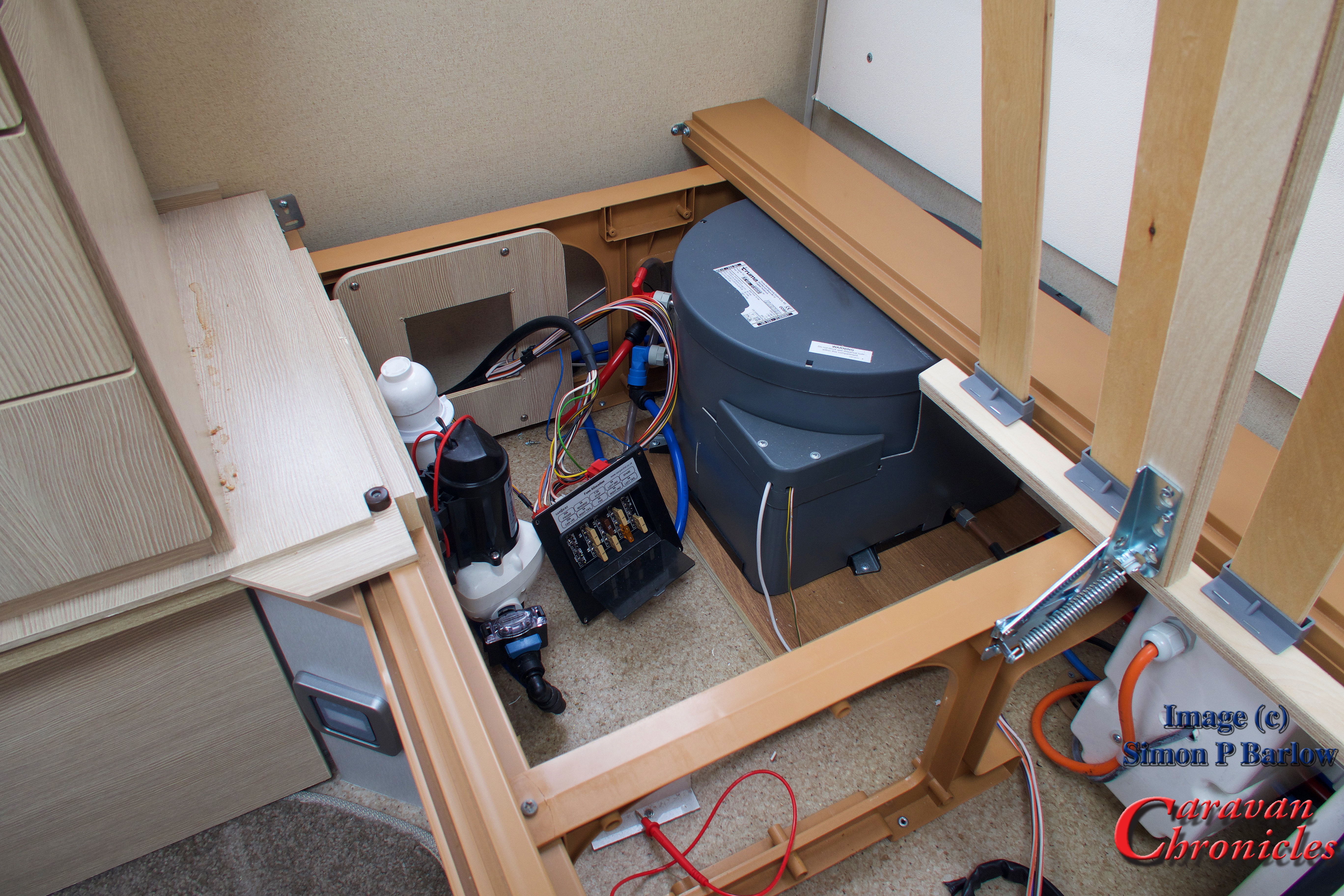
IMG_1141

It was easy enough now to trace the correct cables and confirm with my multimeter. So all the connections now made, albeit temporary, I could install the 20 Amp main battery fuse and make sure the Wildside unit powered up OK.

Don’t worry about the brass bolt holding together the three cables, it was so I could easily get a clamp meter on the cables to take current readings.
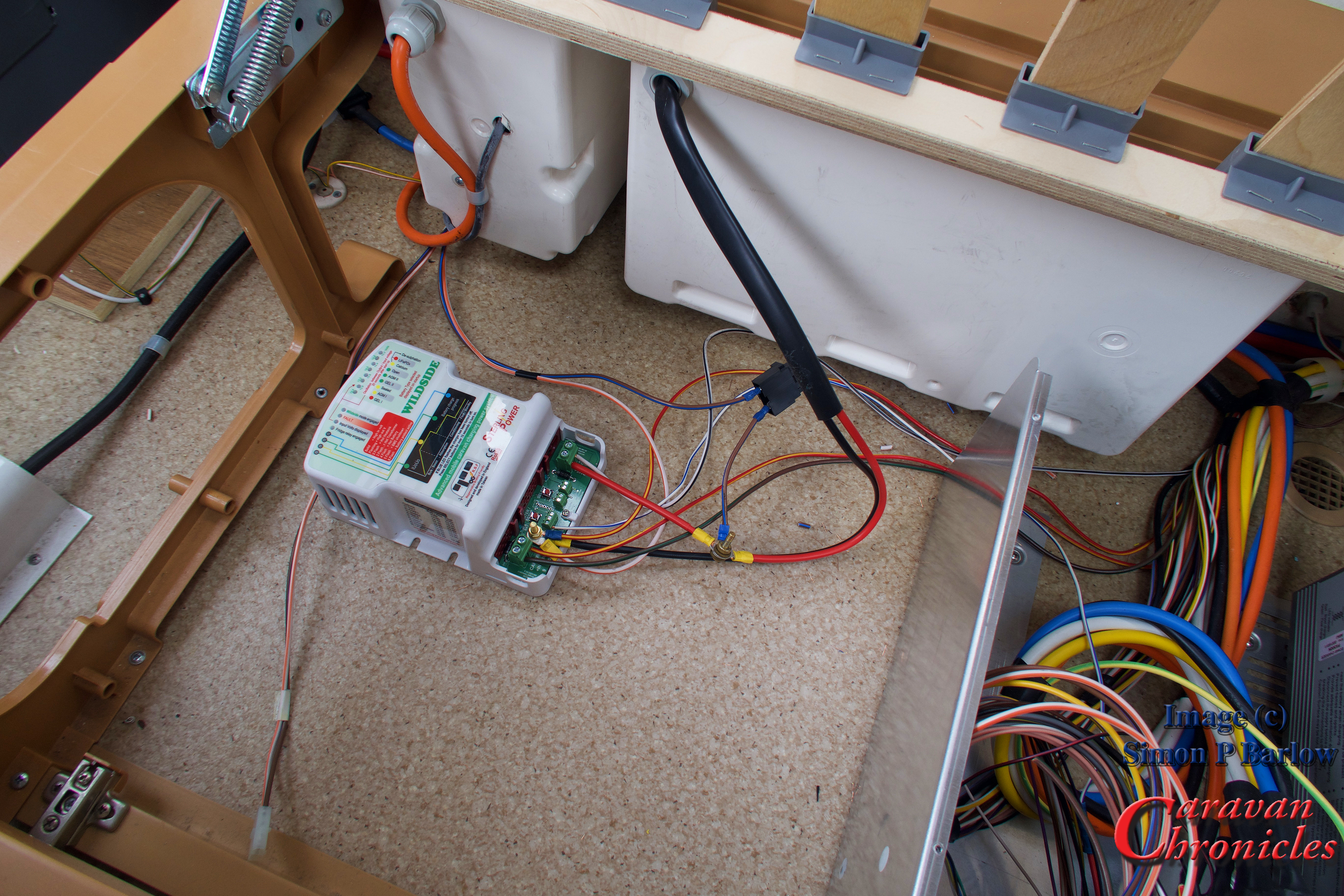
IMG_1142

It started up without any problems and so I could connect up the 13 pin plug to the Amarok and start the engine and take a few measurements.

I checked the vehicles voltage and it was sat at 14.5 with run/stop disabled and the engine ticking over. OK how come I had a voltage of 14.5 volts in the vehicle with a Euro 6 engine ticking over? Well the Wildside unit basically makes the vehicle’s ECU think that the vehicle battery requires charging (remember an Euro 6 engine cranking battery will only ever be charged to 80% of its capacity so that regen will always work).

The first reading I checked was the leisure battery incoming link. I had a reading of 9.96 volts and a current of 8.8 amps. That was quite a big voltage drop.
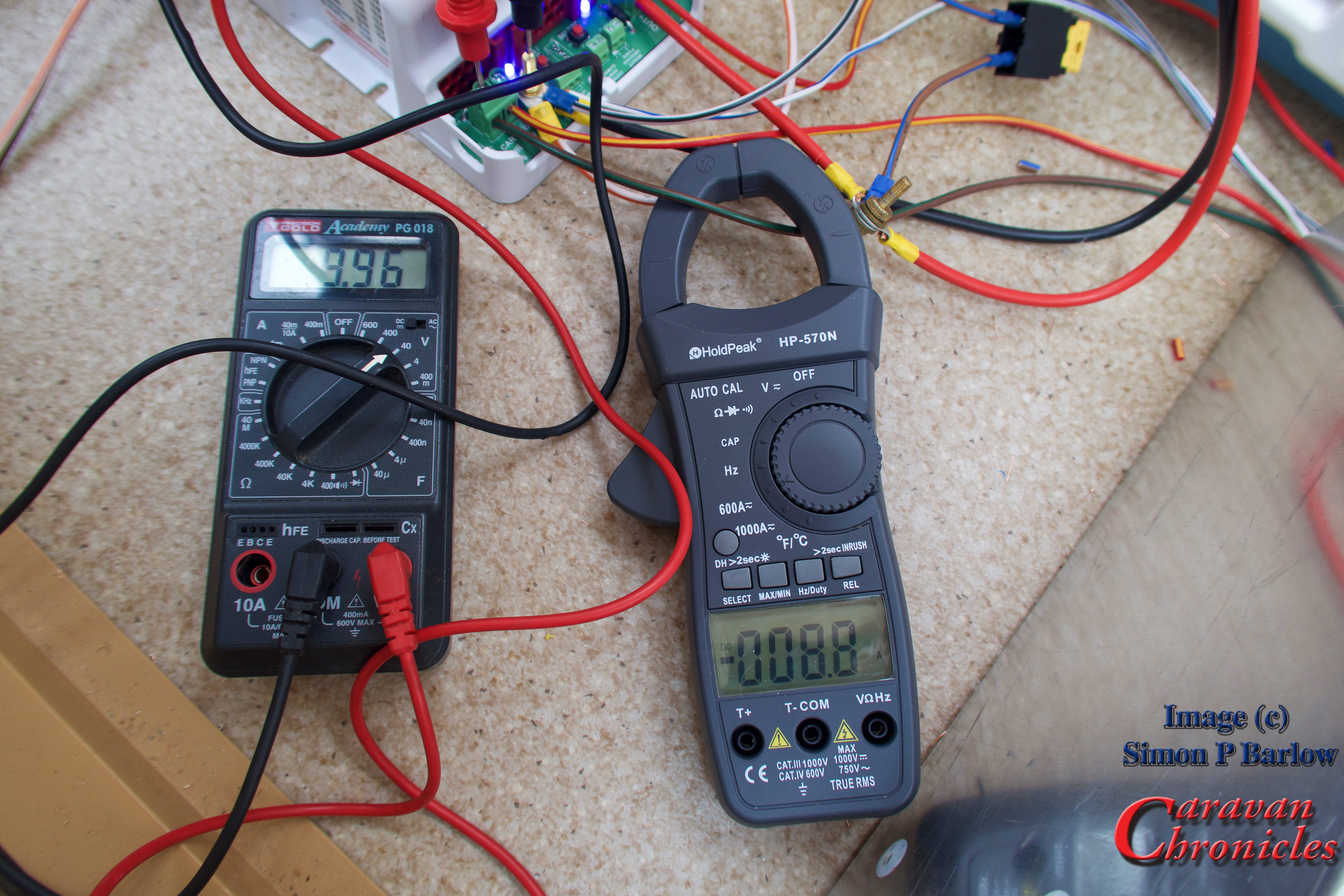
IMG_1143

I moved on to test the incoming fridge circuit. This was showing 9.99 volts and a current of 13.3 amps. I had a big voltage drop somewhere. I checked the voltage at the point the 13 core cable terminates and got a reading of 12.75 volts. somewhere between the incoming cable and the termination on the Wildside unit I was getting a  big voltage drop.

IMG_1144

Continuing with taking some readings, I checked the fridge output and it was stable at 14.35 volts, 9.9 amps.
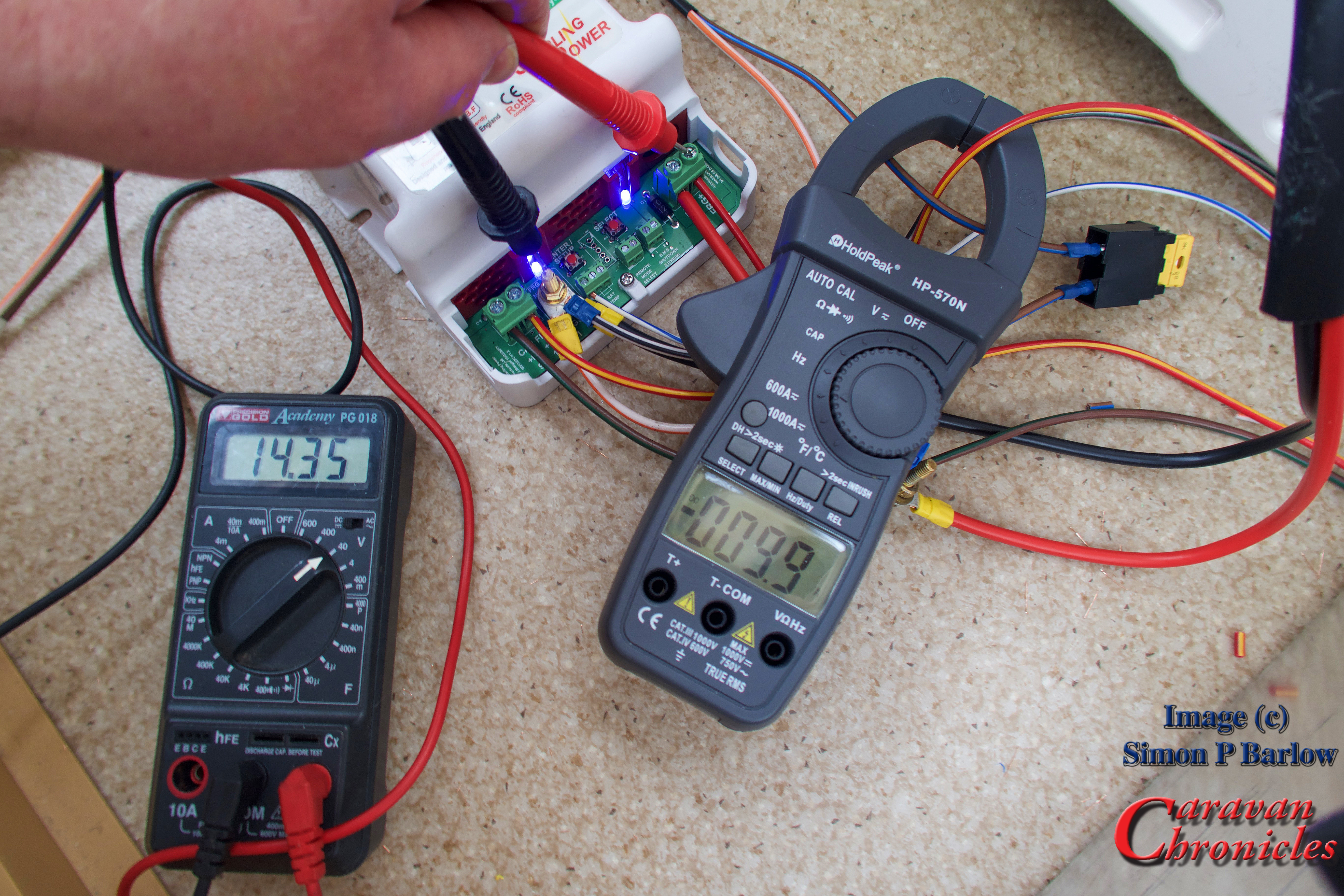
IMG_1145

A problem with the fridge…

On the original caravan wiring diagram it showed the fridge heating element connected with just two wires and on the face of it this looked simple enough. However when I first connected the fridge and powered up, the fridge came up with error code 10 – no power. There was definitely a supply voltage there and it was indicating a current draw of just under 10 amps. I wondered if the voltage detect circuit was polarity sensitive so swiped the connections round and this cleared the error code. So double check the polarity of the connection if you get an error code 10 don’t assume there is a connection fault.

Thinking cap on…

I decided to stop at this point. Unless I could eliminate that volt drop between the incoming cable and the Wildside unit it was pointless taking any further readings.

The next thing to do would be to eliminate the existing wiring for the leisure battery charging circuit and fridge circuit between where the incoming cable from the 13 pin plug terminated and the Wildside unit. I decided to replace the existing caravan wiring with some 2.5mm² cable.

First job was to terminate all the previously terminated cables on the Wildside unit correctly with the correct size ferrule crimped on. When ever you terminate a stranded cable in  a terminal block that compresses the wire, you should first crimp a ferrule on to the cable to ensure a secure connection.
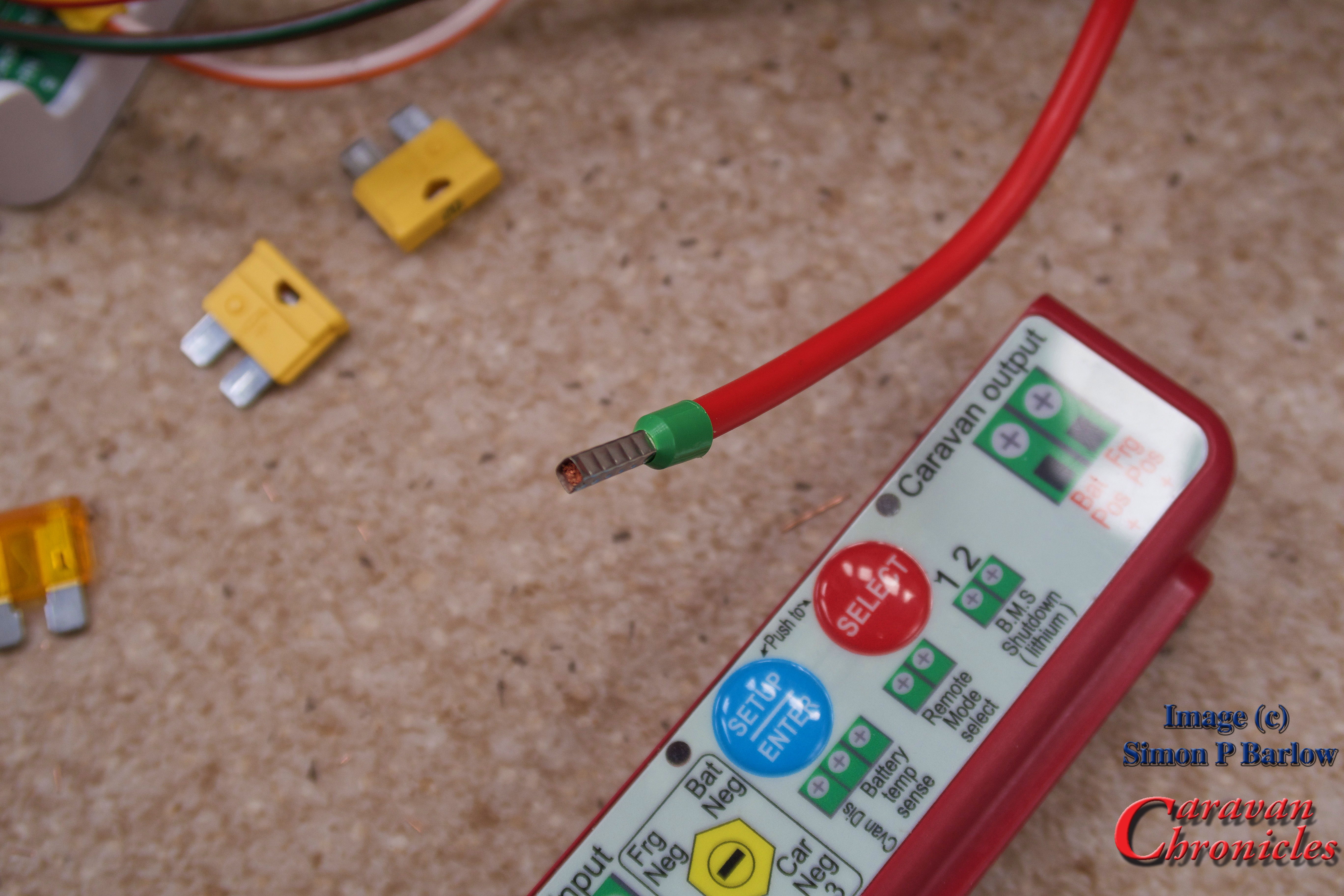
IMG_1148

Next I installed the four new 2.5mm² cables from the 13 core cable to the Wildside unit. I opted to use straight through sleeve crimp connectors to join to the cable coming from the 13 pin plug. I kept the length as short a possible – about 900mm, which resulted in not the best cable route option but I wanted to minimise voltage drop. (remember, the more current you draw through a cable and the longer the cable the bigger the voltage drop!)

All that done, and the correct terminal block installed for the battery positive lead rather than my brass bolt, I powered up everything and hooked up the Amarok and started the engine once again. With the engine running the vehicle was showing 14.7 volts and I was now getting 14.1 volts on the incoming charing circuit with a current draw of 8.2 amps. Note: the clamp meter in the picture is actually showing the charging current for the leisure battery… 5.0 amps.
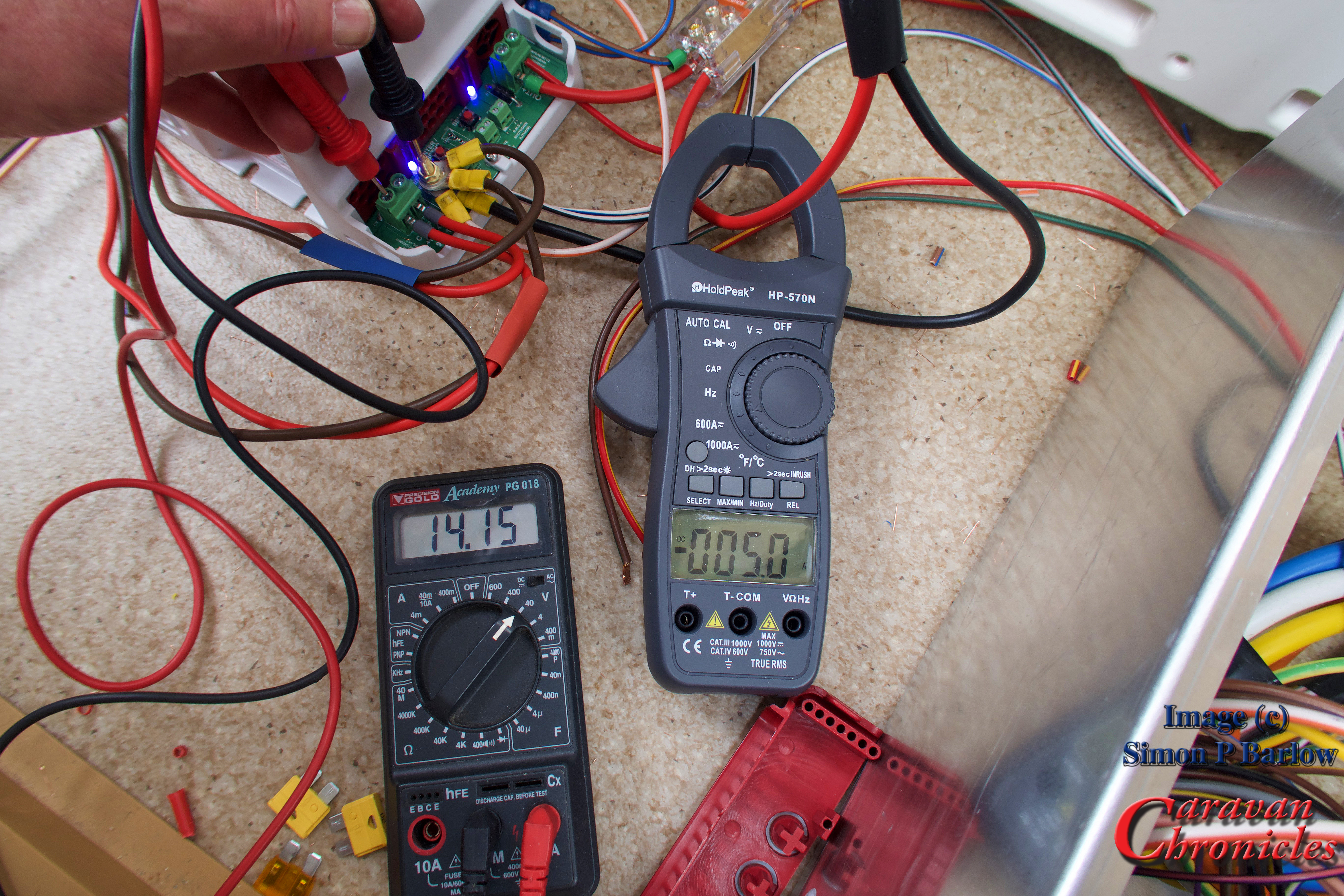
IMG_1149

Checking the incoming fridge feed I was reading 14.2 volts and a current of 8.6 amps. Which was a vast improvement over my previous readings. (Note: the clamp meter in the picture below is still showing the battery charging current)
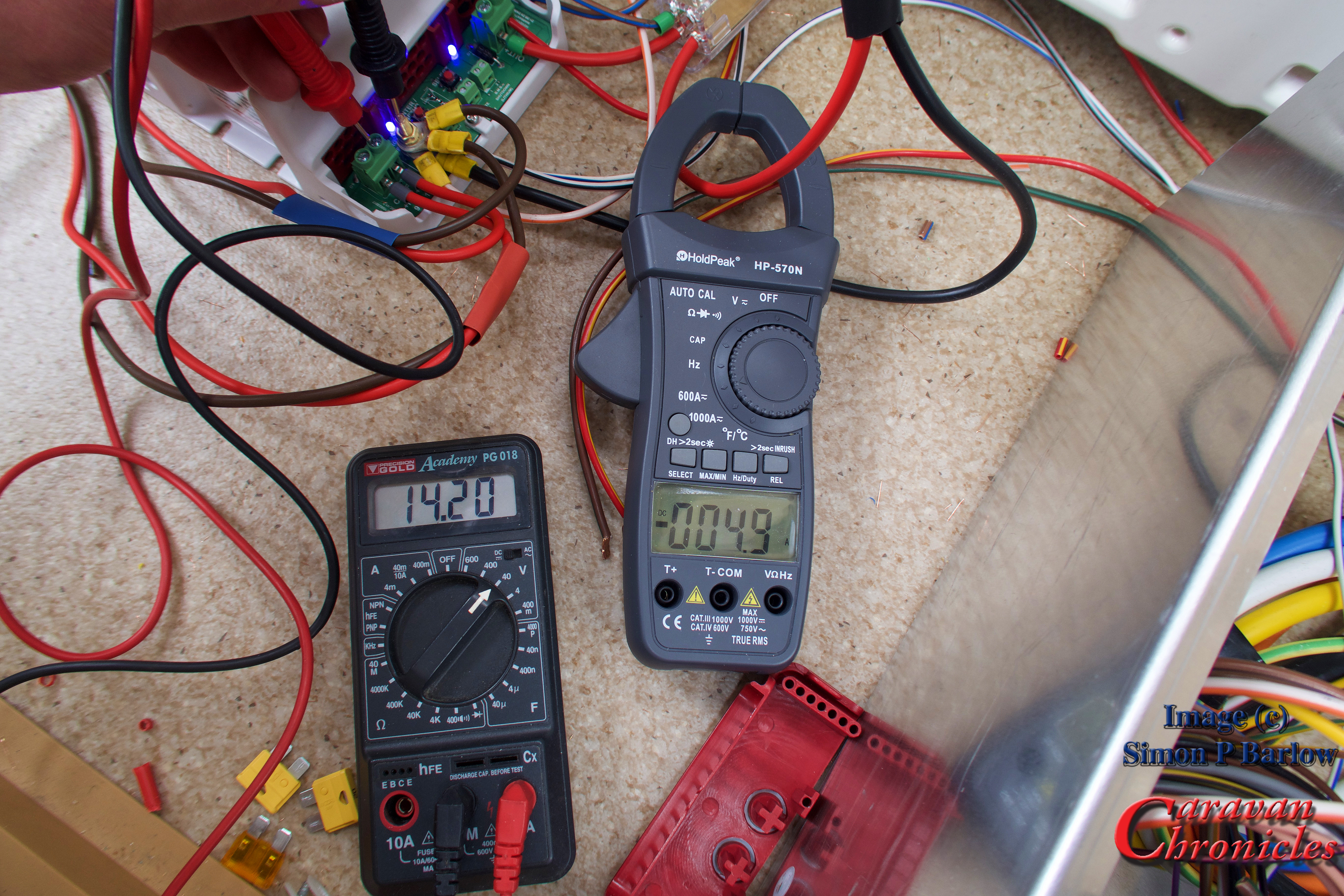
IMG_1150

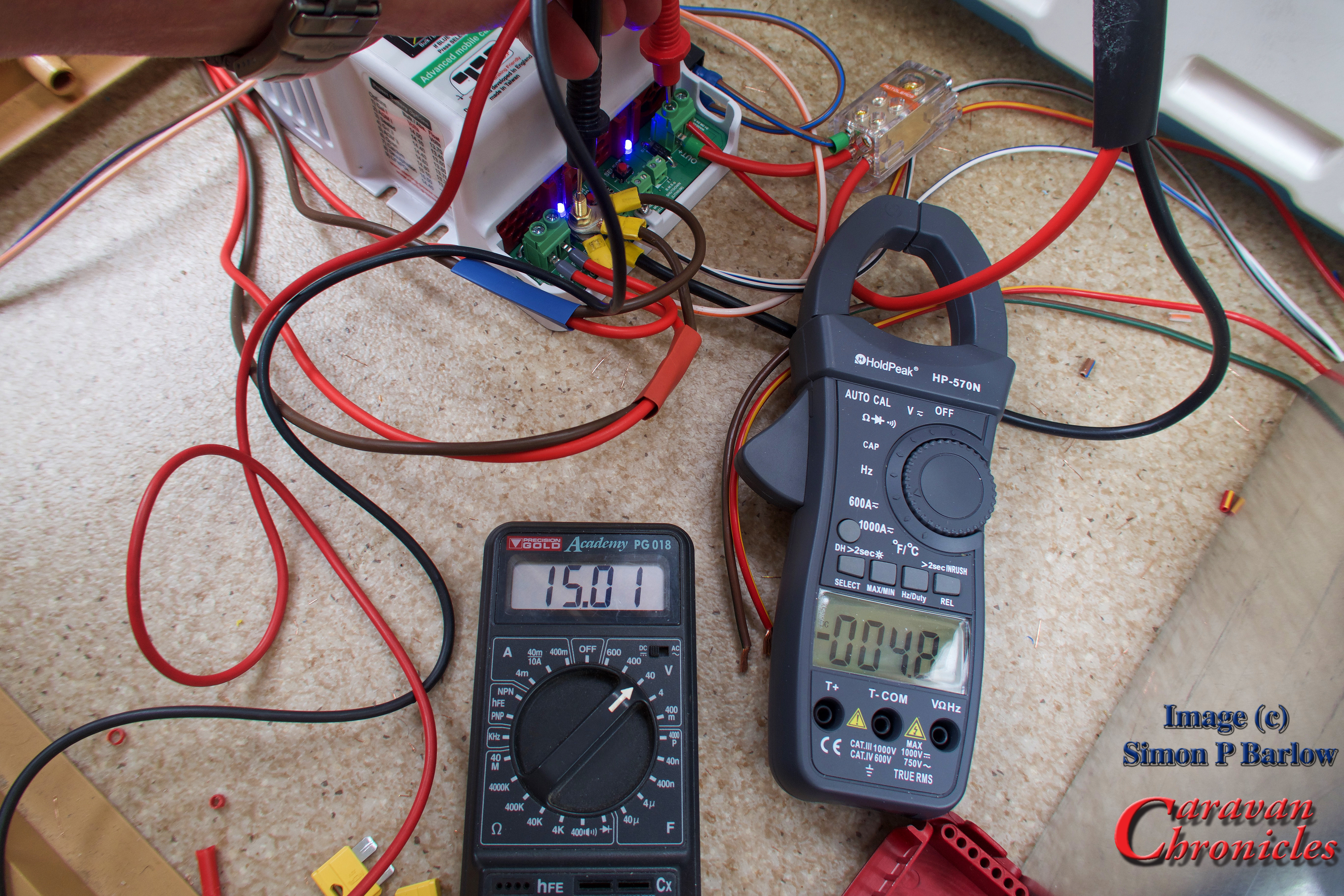
The battery charging voltage was showing 15.01 and 4.8 amps which meant I was at least charing the battery with just the engine on idle.
IMG_1152

Doing a little maths – I was pulling 8.2 Amps via the leisure battery charging circuit and 8.6 Amps via the fridge circuit giving a total of 16.8 Amps. I was supplying 9.9 Amps to the fridge and 5.0 Amps to the battery. A total of 14.9 Amps. The difference would be due to the losses due to stepping up the voltage being supplied by the vehicle to the output voltages of the Wildside unit. In terms of watts – the vehicle was supplying 237.74 watts and the wild side units was outputting 224.49 watts.

This did make me think. As the fridge was now consuming 149.49 watts (its rated at 150 watts) so it in theory should be at it’s max efficiency… did it need to be on all the time? Could the fridge be switched on a duty cycle of say…on for 75% and off for 25%? This would then increase the ability to put more back into the leisure battery, especially useful on short runs.

Speaking to Charles Sterling, I know this unit has been rated on the conservative side and in theory 20 amps can be pulled from each circuit. This would give around 560 watts of power… and in theory about 400 watts available for charging the leisure battery. Will that damage your vehicle? Well as most Euro 6 engines are fitted with 2Kw alternators, there is still plenty of power available.

Finishing up

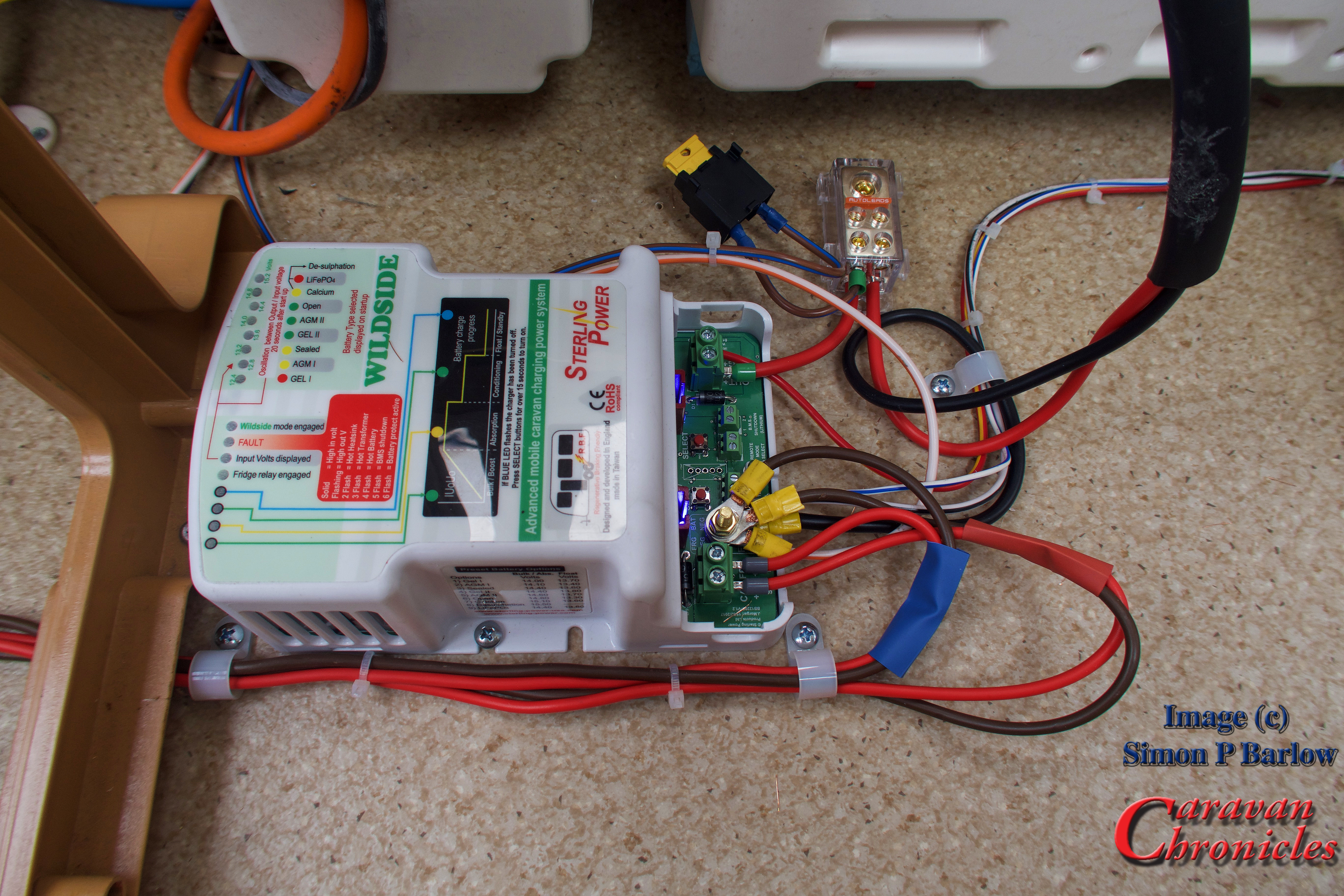
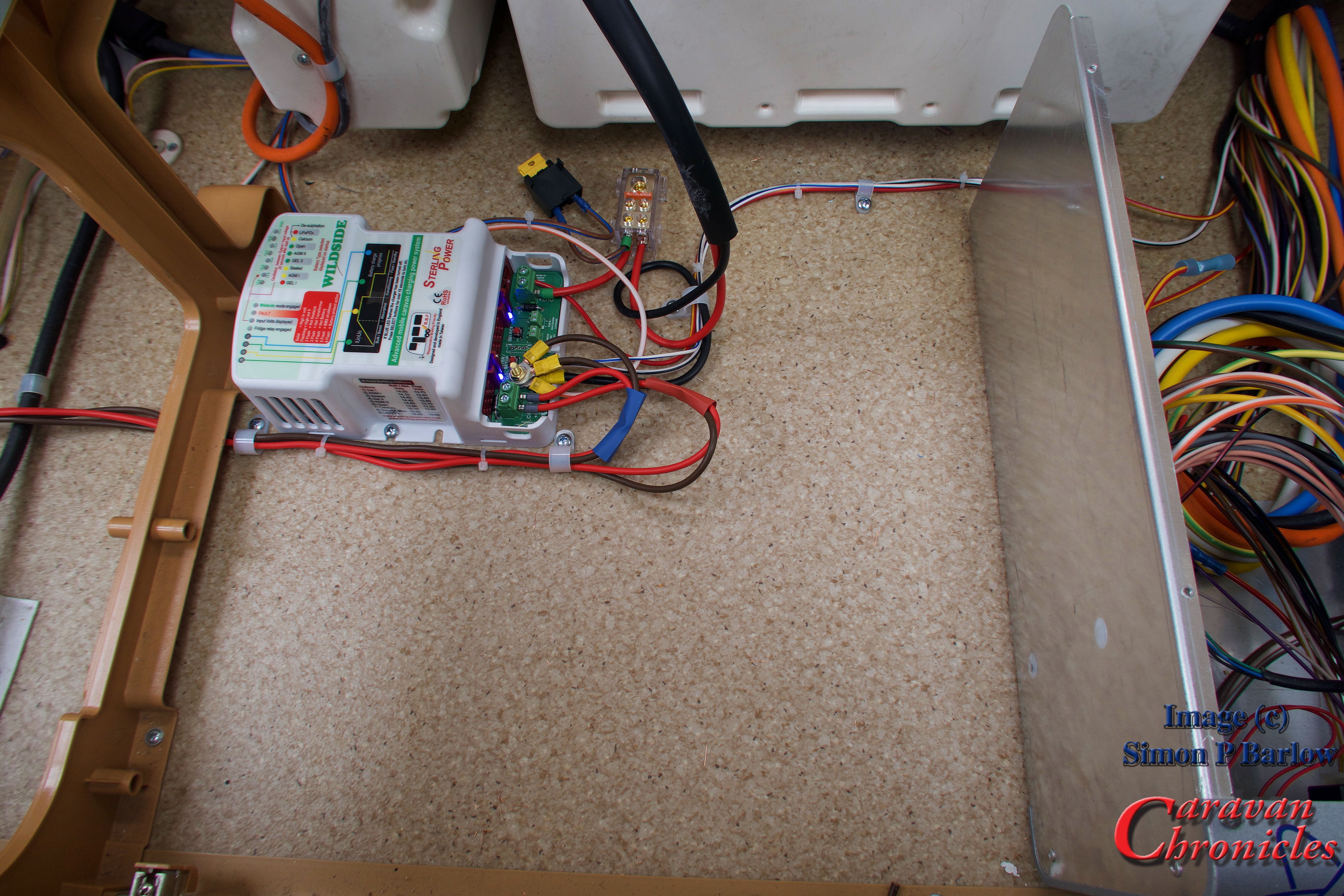
It was now a matter of tidying up my mess and installing some cable ‘p’ clips to secure everything to the floor. The two sleeves on the cables that come from the 13 core cable are there so I can identify each circuit. Red for leisure battery charging and blue for fridge circuit.
IMG_1157

The yellow fuse you can see is the leisure battery fuse. It’s rated at 20 amps and is in circuit between the leisure battery and the caravan services, so pull that fuse and the caravan will be isolated from the 12 volt system. I’ll probably replace that with a circuit breaker in the near future.
IMG_1156

IMG_1161

A couple of things I thought about while doing this install.

The Sargent control box is a lot of wasted space. I recon that it should have been shrunk down to ¼ of it’s current size and probably relocated to somewhere else… maybe under the draw unit at the front of the caravan.

The incoming fuse connection panel too seemed a little flimsy. All it consisted of was a circuit board with multi plug connectors on one side and spade connection soldered on the other for the blades of the fuses to slide into. Some of the soldering looked ‘dry’ and I wondered if this was causing some of the volt drop I was experiencing… that coupled with the multi-plug connections in the loom. I know it makes the build of the caravan easier on a production line and you only need semi skilled labour to install but hey sometimes things like this matter.

Its obvious that caravan wiring is done down to a cost and the minimum standard required. I would have liked to seen some slightly heavier gauge cable for some of the connections. It amazed me that the leads that connect to the battery are 6mm² but drop down to 2.5mm² once outside the battery box and the connection between the two is just a simple male/female spade connection.

The other thing that struck me was how inefficiently the plumbing was done. I’d never really looked at it before, but casting my eye over it I think I could have laid it out a bit better and saved three push-fit connectors.

Who’s this unit designed for?

Well anyone really that has a Euro 6 engine in their tow vehicle or motorhome (if you have a motorhome you need to look at the BB1230 which is a step up again from this) and cares about maintaining their leisure battery.

If you have a motor mover fitted and use it to get your caravan out from its parking spot before you set off and then find sometimes you don’t have quite enough power to position your caravan on your pitch when you arrive or the reverse… your motor mover always seems to run out of steam trying to put your caravan back in its storage area when you return home, the Wildside unit should make sure you always have a fully charged battery and I’m my opinion is something that should be classed as an essential item.

From a lot of emails I have received it would seem that generally people with motor movers seem to be changing their batteries more frequently. A lot of the time when the motor mover stope working or works erratically the advice from the motor mover manufacturer is “you need a new battery” or” its a problem with your battery”. I”m going to throw this out there… I think it may be down to the batteries never really getting a proper charge and sulphating, radically shortening their life.

Alternatively if you do a lot of “Off Grid” (Boon-docking) camping, this will make sure you maximise the charge in your leisure battery to allow you to get the most from it. Especially if you have a Euro 6 engine.

How easy is it to install?

Planning is the key and a modicum of skill in being able to trace cables and terminate correctly. However a lot is going to depend on your caravan, how it is connected and the quality of the original installation. For me it was quite straight forward but the location of the existing components made it easy. Depending on your particular caravan you may end up having to run some additional cabling. Whatever you do, do not cheap-out on cable termination! Buy the right terminals and a good ratchet style crimp tool and make sure any cable you install is a good quality brand of the correct gauge.

Were there any issues?

Nope, it worked straight out of the box.

What next?

Road test! In a few weeks we are travelling down to Glastonbury which is between a 5 and 6 hour tow and I’ll be taking readings during the trip to see how the battery is being charged and the fridge temp. Just for the pure fun of it….. I’m going to try to make ice cubes in the freezer so we have ice for our drinks when we arrive! I’ll let you know how I get on.

Looking forward.

The biggest problem really is the fridge. A three way absorption fridge is probably the single most inefficient way of chilling anything. Whether its powered from 12 volts, 230 volts or gas. Its far more efficient to use a compressor fridge.

Now a 230 volt compressor fridge is relatively cheap when compared to a three way absorption fridge, great for when you are on hook up, but now imagine being able to run it via an inverter while you are driving or off grid from your battery. As they only run short periods and take less power to run. Coupled with the fact they don’t run continuously like an absorption fridge. It would be possible to do away with a 3 way absorption fridge completely.  As we now have a sensible way of charging batteries, and given the fact the price of modern lithium battery technology is dropping all the time I don’t think technically we are far off making the transition. Its just down to the caravan manufactures…. so don’t hold your breath.

Contact:

Sterling Power

Stuff I used:

You can find links to all the crimp terminations and tools that I used in the Caravan Chronicles Shop
 

Share this:

  • Share on X (Opens in new window) X
  • Share on Facebook (Opens in new window) Facebook
  • Share on Tumblr (Opens in new window) Tumblr
  • Share on Pocket (Opens in new window) Pocket
  • Share on Pinterest (Opens in new window) Pinterest
  • Share on Reddit (Opens in new window) Reddit
Like Loading...

Getting All Charged Up – Part 2…

26 Wednesday Apr 2017

Posted by Simon Barlow in Caravan Electrics, Caravan Servicing, Electrical, General, Maintenance, Modifications, Projects, Technical, Uncategorized

≈ 10 Comments

Tags

Battery Charging, Leisure Battery Charging, Maintenance, Project, Sterling Power, Sterling Power Wildside, Technical

Planning the Install

Remember the Six P’s… “Proper Planning Prevents Piddling Poor Performance”… or something along those lines! Before we start hacking away at the multitude of cables (and my email inbox fills up with help requests) we need to pull out the relevant electrical schematics from the handbook. Our caravan is a ‘dealer special’ based on a 2011 Swift Europa 550 fitted with a Sargent PSU.

We can see from the schematic below that the 13 pin plug enters into the caravan and terminates with two connectors – FB6 and FB7 on fuse unit C44 which in our caravan is located just next to the front draws near the water pump. FB6 is all the road lights and we can ignore this.

Socket Connections

The cables we are interested in are from pins 9,10,11 & 13 which are coloured Orange, Slate Grey, White/Black and White/Red respectively and terminate in connector FB7. We need to now look for these leaving the Fuse Unit and heading off to the PSU.

The most likely candidate will be connector FB2 with four cables going to connector P1 on the PSU. If they are all 2.5mm²  it’s a good clue these are the ones we want. We will need to check these with a multimeter though to be sure. The colours have changed too so we will need to confirm what the new colour is for each circuit.

Socket Connections 2

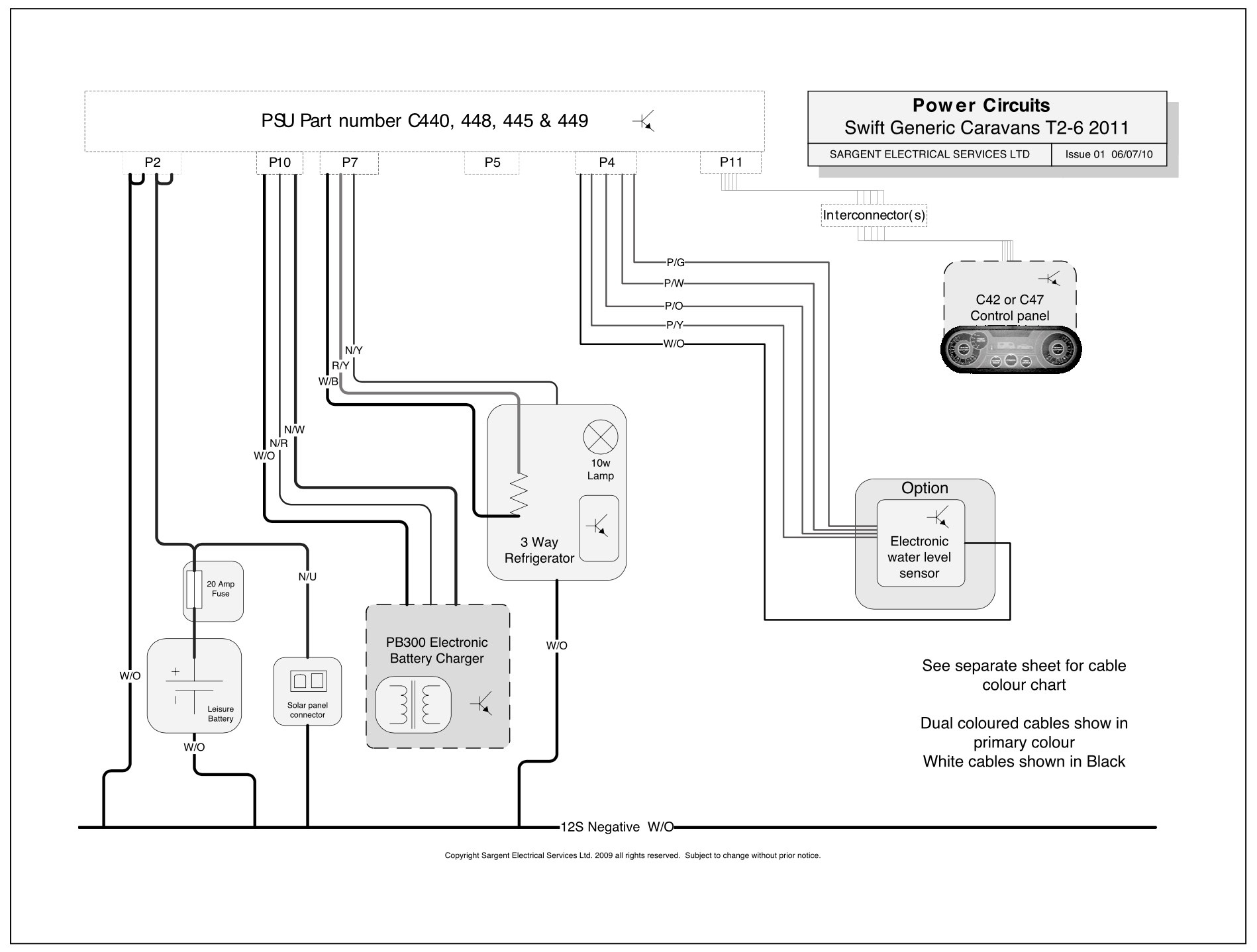
So that’s the input side of the Wildside potentially sorted out, now we have to find the fridge connections. Looking at the schematic for the Power Circuits we can see that the fridge is connected via four cables. One directly to Neutral and the other three to P7. We can also see from this schematic that the leisure battery is connected to P2 via a 20 Amp fuse. This tells us two things – the wiring is rated for 20 amps and we will have to upgrade the cable size from the Wildside unit to the leisure battery.

Fridge Circuit

For the fridge… We are interested in the two cables that power the heating element and on the drawing they are coloured W/B and R/Y (White/Black and Red/Yellow) and originate from connector P7 on the PSU.

Fridge Circuit 2

We have now identified on the schematics the cables we need to look for and where they run from and to. Next step is to create a new schematic using the information from these two drawings to show how we are going to connect in the Wildside unit.

To The Bat Cave…. err Drawing Board!

If you are handy at using a drawing package such as Sketch-Up or similar (I use “AUTODESK® Graphic” on my MAC) you can have a go at drawing it out, or simply just use a sheet of paper. The important thing here is you DO draw it out.. this is not an option, its a mandatory task!

TIP: If you are drawing this out by hand on a sheet of paper, it might help to photocopy your caravan schematics and cut out the relevant sections… like the fridge and stick them to your drawing to make it easier.

So here’s my efforts….

Wildside Wiring 01

If you remember in part 1 I said we will need to make five connections…. not including the neutral. Well we have the five connections. After looking at the layout I decided not to cut the current leisure battery connections to upgrade, but to install a new Positive and Neutral cable alongside the original cables. This will mean however I will need to drill a new hole in the battery box and install a sealed cable gland.

The three cables that we cut on P1 that are now unconnected should, in theory not be part of any circuit. However to be sure I’m going to terminate both the neutral cables (originally connected to Pin 11 and Pin 13 to the neutral point on the Wildside unit.

The cable that was originally connected to Pin 9 I’ll just crimp on a blind connector and secure out of harms way. I am not sure if this might need to be connected to a +ve supply. There are a couple of things that I’ll need to check, for example, the toilet flush always works when the caravan is connected to the tow vehicle – with or without the engine running ( handy if a quick P(it) stop is required!).

Now… To The Bat Cave!

Well it might be a couple of days as I have just ordered a few bits and pieces I don’t have in stock in the workshop… and I’m still procrastinating whether to do the install as a video to accompany my written ramblings.

Coming up in part 3. I attempt not to destroy our caravan, do a lot of crimping, consume a lot of coffee and I may be swearing a lot on camera!

Share this:

  • Share on X (Opens in new window) X
  • Share on Facebook (Opens in new window) Facebook
  • Share on Tumblr (Opens in new window) Tumblr
  • Share on Pocket (Opens in new window) Pocket
  • Share on Pinterest (Opens in new window) Pinterest
  • Share on Reddit (Opens in new window) Reddit
Like Loading...
← Older posts
Newer posts →
Buy Me A Coffee

Blog Stats

  • 45,910,279 hits
Follow Caravan Chronicles on WordPress.com

Follow Caravan Chronicles and receive notifications of new posts by email.

Some previous posts you may like...

My last post….

Many thanks to all my friends. As I write this I’m in the Christi hospital hoping to go home in a few days. I was told about a week ago that I had about 3 months to live and should start preparing my affairs. Which Sue and I are trying to do. I have some…

A Bit Of A Tour…

Well not really a tour, only two locations. The first leg was down from Manchester to Glastonbury and a stay at The Old Oaks. We first went there in 2012 and had five or six more visits in the next four years. So it had been quite a while really. We were located in the…

What’s The Question I Get Asked a Lot?

“What’s in your toolbox when travelling?” Tricky one… I don’t have a tool box anymore. I recently started mooching around the internet for a smaller tool box… or rather a tool bag. I used to use up until a few months ago a Stanley Tool Bag. It was lighter than a tool box, I could…

#Tourfest North West

Tourfest North west was our first time attending anything like a gathering of bloggers, vloggers and the generally like minded. It was organised by The Caravan Addys with a little help from others I’m sure as it must be a time consuming task and hard work to bring everything together. We opted to arrive at…

More Jobs Ticked Off…

OK we are still working on a few bits and pieces but the weather on Friday and Saturday was ideal for cleaning the outside of the 5th Wheel. So while Sue made a start on the cleaning of the nose cap, I finished the first stage of the water pump relocation project and upgraded the…

A Few More Jobs Ticked Off The List…

Like any project, ticking the small stuff off a list is the way to move forward even if it seems like sometimes you have ground to a halt. A bit lacking on photos…. I’m temporarily unsure of their location… pilot speak for I’ve lost them! I’ll correct that in due course. I built a new…

A Few Little Jobs Done…

It seems such a long time since I posted anything. Last time out with the Dreamseeker I noticed that the charging voltage when we were hooked up to the truck was only about 12.1 to 12.3 volts as measured in the Dreamseeker battery box. I know that the VW Amarok puts out 14.6 to 14.8…

Happy New Year…

Happy New Year to everyone, I hope you have a great touring year ahead. I’d like to take this opportunity to give you a bit of an update on my personal circumstances and a look forward to a couple of projects I’m planning to kick off our year. First… … A HUGE thank-you yo everyone…

Sutton-on-Sea In September

Just like to say a huge thank you to so many people that have commented or emailed me over my last post. It has cheered me up no end…. it really has. Enough to rattle this post off! We recently went back to Cherry Tree Springs at Sutton on Sea for an 7 day break.…

This Might Be My Last Post…

Not clickbait…. Three weeks ago Sue and I were cycling between 8 and 10 miles each morning to get a morning coffee. Arrived back home and…. well time stopped. I had received notice that my test sample for Bowel Cancer screening had come back positive. Two days later I underwent a colonoscopy procedure which didn’t…

Something went wrong. Please refresh the page and/or try again.

  1. Dave Hart's avatar
    Dave Hart on How to: Connect two batteries in parallelAugust 27, 2024

    brilliant and so well explained! Thank you, love your work!!

  2. Simon Barlow's avatar
    Simon Barlow on Caravan Road Lights – Basic Fault FindingAugust 25, 2024

    Please look at my very last post on the blog

  3. Martin's avatar
    Martin on Caravan Road Lights – Basic Fault FindingAugust 25, 2024

    martin here caravan lights worked fine for two stop overs I had then hooking up again for my third trip…

  4. Emmy’s Camper Travels's avatar
    Emmy’s Camper Travels on My last post….August 25, 2024

    I’m so sorry. My sincerest sympathies go to you and your wife Sue. Your ideas and advice have been so…

  5. Steve Walsh-Jones's avatar
    Steve Walsh-Jones on My last post….August 22, 2024

    very sorry to hear this. Your posts have been very informative and enlightening providing an in depth view on different…

  6. thetwinaxletouringscouser's avatar
    thetwinaxletouringscouser on My last post….August 22, 2024

    Good heavens above Simon I am ever sorry to hear of such devastating news for both you yourself and Sue.…

  7. Eileen's avatar
    Eileen on My last post….August 22, 2024

    Simon and Sue, thank you both for sharing your passion for caravans with us. The news is extremely sad, our…

  8. Philip Parkes's avatar
    Philip Parkes on My last post….August 22, 2024

    Simon. So sad to read you last post today. Our thoughts are with you and Sue at this time. Whilst…

  9. Philip Parkes's avatar
    Philip Parkes on My last post….August 22, 2024

    Simon. So sad reading your post today. Our thoughts are with you and Sue at this time.

  10. Philip Parkes's avatar
    Philip Parkes on My last post….August 22, 2024

    Simon our thoughts are with you and Sue.

  11. Luke Tarrant's avatar
    Luke Tarrant on My last post….August 22, 2024

    Very sorry to read this and my thoughts are with you both at this time.

  12. Alan Smith's avatar
    Alan Smith on My last post….August 22, 2024

    Dearest Simon. I have never met you, but I feel as though I have some (limited) knowledge of you and…

CaravanChronicles.com Tag’s…

5th Wheel Caravan 13 Pin Plug Accessories AL-KO Avtex Bear Extender Bike Rack Blackpool Blackpool Illuminations blogging Cadac Camping & Caravanning Club Canterbury Caravan Caravan Blog Caravan Club Caravan Electrical Caravan Electrics Caravanning Caravans Caravan Show Caravan Talk Cheltenham Chirk Christmas Market Christmas markets Cleaning design Event City Factory Visit Fiamma France Freelander Glastonbury Glossop Caravans Humor Insync Jonic Bedding Lady Heyes La Tournerie Ferme Leisure Battery Leisure Battery Charging LPG Refilling Maintenance Manchester Caravan & Motorhome Modifications NEC North Western Caravans Ltd OLPRO One Hairy Caravanner Oswestry Oxford Product Review Project Review Safefill Sat Nav Sterling Caravans Sterling Power Wildside Swift Factory Swift Group Swift Talk Technical The Old Oaks Touring Towing Tow Vehicle Trafford Centre travel Travel Trailer Travel Trailers vacation VW Amarok Warwick Racecourse WiFI

Website Powered by WordPress.com.

  • Subscribe Subscribed
    • Caravan Chronicles
    • Join 672 other subscribers
    • Already have a WordPress.com account? Log in now.
    • Caravan Chronicles
    • Subscribe Subscribed
    • Sign up
    • Log in
    • Report this content
    • View site in Reader
    • Manage subscriptions
    • Collapse this bar
 

Loading Comments...
 

    %d