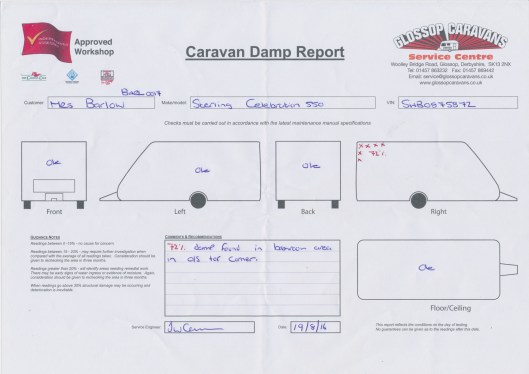
We went to pick up our caravan yesterday from Glossop Caravans after it has had its annual service. Unfortunately we received some bad news… we have damp.
It’s at the rear in the top offside corner. Glossop Caravans have been pro-active and already submitted a warranty claim. This is why it’s so important to get your caravan serviced in line with the manufacturers guidelines.
It appears we have a crack at the top of the rear end cap. While we were there, they positioned a ladder platform next to the caravan so we could both go up and have a look, and indeed there is a crack right on the radius of the corner, about 75mm long and when you pass your finger across it you can feel a slight step, which to me indicates something is causing one side to be pushed out… either something underneath or a slight twisting pressure on the corner.
I’m not sure how long the warranty claim will take to be accepted (or rejected… but that’s a potential nightmare) but the work apparently will take around three to four weeks.
So, hopefully we will still be going to the NEC in October with the caravan and I’ll keep you updated on progress.
A lot of new caravans now have the ability on a ‘super pitch’ to be able to attach a mains water feed directly to the caravan without having to have an Aquarol as a water reservoir, and this seems like a good idea. I started looking at the options available and was surprised at the cost of the only suitable system for our caravan. I also wasn’t keen on the plastic regulator. This got me thinking, maybe it was time for a little Caravan Chronicles DIY project.
I wanted to come up with some sort of contrivance that was assembled from stock components that were easily available anywhere. After a brief search on Amazon I came up with my shopping list and ordered everything (see links below).
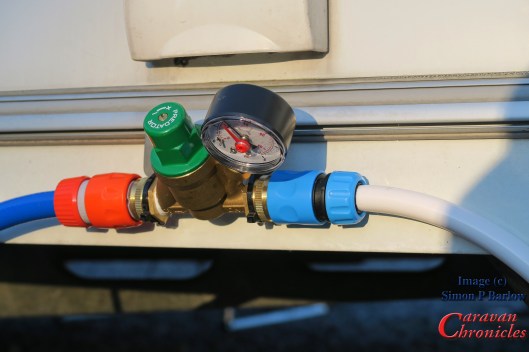
The result was a simple to use commercial pressure regulator that I could use our existing blue water hose that originally connected to the Aquarol and standard hose fittings that allow me all the options for connecting up.
As a temporary mount I used a couple of the small plastic hangars that Fiamma sell that slide into awning rails allowing you to hang things from. In this case a couple of cable ties held it in position. I’m currently in the bat cave folding a small aluminium plate to mount the regulator on that slides into the rail and has a foam padded back to protect the caravan. I opted to use brass fittings for the hose connections rather than plastic just for durability.
So how did it work out?
Well on a recent trip to Southport Caravan Club site (where the photos were taken) it worked extremely well. The initial set up was easy and to start with I reduced the pressure using the small screw on top of the unit to about 0.5 bar (7 PSI) to ensure I didn’t over-pressure the caravan plumbing. I increased this to about 1.5 bar and this gave an excellent flow rate with the added feature of not having to run the internal water pump.
Something that was in the back of my mind however was what if the regulator failed and full mains pressure was allowed through to the caravan’s internal plumbing? As I’d used a commercial unit, hopefully the chances of this would be very slim to non-existent as these units are designed to be permanently installed in commercial and domestic plumbing installations however I also added another little handy gadget at the tap end…
This ‘Y’ fitting has two small ball valves, one of each outlet. So when we go out, I simply turn off the appropriate ball valve. Having a ‘Y’ adaptor also allowed us to fill up our Brita filter jug or draw water off without having to turn the tap off and disconnect the caravan hose. All in all everything worked out perfect. (note I have since changed the blue hose adaptors shown for brass ones for durability).
One last thing…
If you are at all worried about water quality in your caravan, connecting up this way will allow you to thoroughly flush out your caravans water system and give you clean water from your caravan’s taps, (especially In summer too, when the sun has been warming up the water in your Aquarol all day) all you need to do is just run the tap for a minute or so to get cold fresh mains water.
I am often asked where to buy some of the products we use. Here are the links to the products. If you click on the links and purchase any of the items, a few pennies will go to helping the cost of running CaravanChronicles.com
It’s that time of year again… the mornings are getting lighter, the evenings longer and planning for the first trip of the year is well under way. But, what about your caravan or motorhome? It’s time for the de-winterising and annual deep clean. The easiest way we find to do it is to first create a list of the jobs to be done and make sure you have all the bits and pieces you need for the tasks. Our “go-to” shop for cleaning supplies is OLPRO, it’s easy to order everything for the season for both cleaning stuff and loo stuff. We have been using them for at least a couple of years now and haven’t come across any problems and have genuinely been satisfied with their products.
Arriving at the storage site with a trailer full of water and cleaning supplies!
I receive a lot of emails asking where people can buy some of the tools – especially some of the crimp tools and terminations I use in my posts and articles. In the past I have just emailed people back with the details and maybe links. However my last post about cable termination brought on a rather large amount of requests. So I have decided that I will include links to the products on Amazon. So from now on you will see a section at the bottom of any posts called….
Any specific items used will be listed, and by clicking on the link to the item you will be taken to the Amazon store page. If you do decide to purchase anything, it will be from Amazon (or their associates) and delivered by them. It’s just like buying from Amazon directly.
The price you pay is exactly the same as it would be by going directly to Amazon. All I receive is a few pennies from each sale that will help towards keeping the wheels of Caravan Chronicles turning.
I have also created a shopping page that lists the products under a link to the original article. There aren’t any photos, just descriptions to keep the page neat and quick to load. If you want to go back to the article, just click on its title.
I hope you don’t mind me doing this, but it will save you having to email me asking where to get things from and save me a bit of time in replying to everyone.
As it’s now the ‘off season’ for a lot of caravaners and thoughts turn to sorting out those problems that we put up with on the last couple off trips, I thought I’d look at cable terminations. One of the problems that I’m asked about revolves around cable termination in trailer sockets and plugs. Like most things there is a right way and a wrong way of doing it and there is also the compromise.
So what’s the problem?
Well the problem is terminating a cable to a solid metal part. You will most likely see cables that are striped down to the copper conductors and the individual strands twisted together then inserted in a hole with a screw tightened down to hold the conductors. So whats the problem with this? When you tighten the screw it’s turning obviously and the end of the screw twists down on to the strands of cable, often breaking a few off and pushing quite a few out-of-the-way, usually in an average termination about a quarter of the strands are not held under the screw tip. The 2.5mm square cable you thought would reduce volt drop for the battery charging circuit is now reduced to something less and its current carrying capacity is reduced. Is there a solution?
The obvious one would be to solder the ends of the cable to stop this happening and it’s a great solution, but is does have drawbacks. When you solder the end of a flexible cable the point where the solder stops becomes a weak point and is susceptible to vibration and flexing stress and the thin copper strands transition from being flexible to a solid mass. This is why in aviation, marine and military applications soldering is not usually permitted.
The correct way that flexible conductors should be terminated is by crimping on a “boot lace ferrule”. These are simple brass tubes, sometimes nickel-plated that are slid over the untwisted strands of the conductor and crimped tightly. Some ferrules are just small tubes or ‘U’ shaped section machine crimped and some have a plastic insulator to help isolate the conductor when several are installed in close proximity.
Here’s a simple step by step guide to crimping and terminating a 13 pin trailer socket. It could equally apply to a trailer plug.
For the photos I used a spare socket and short length of standard multi core cable. I have links to all the items, including tools used in the article in “Caravan Chronicles Shopping” at the end.
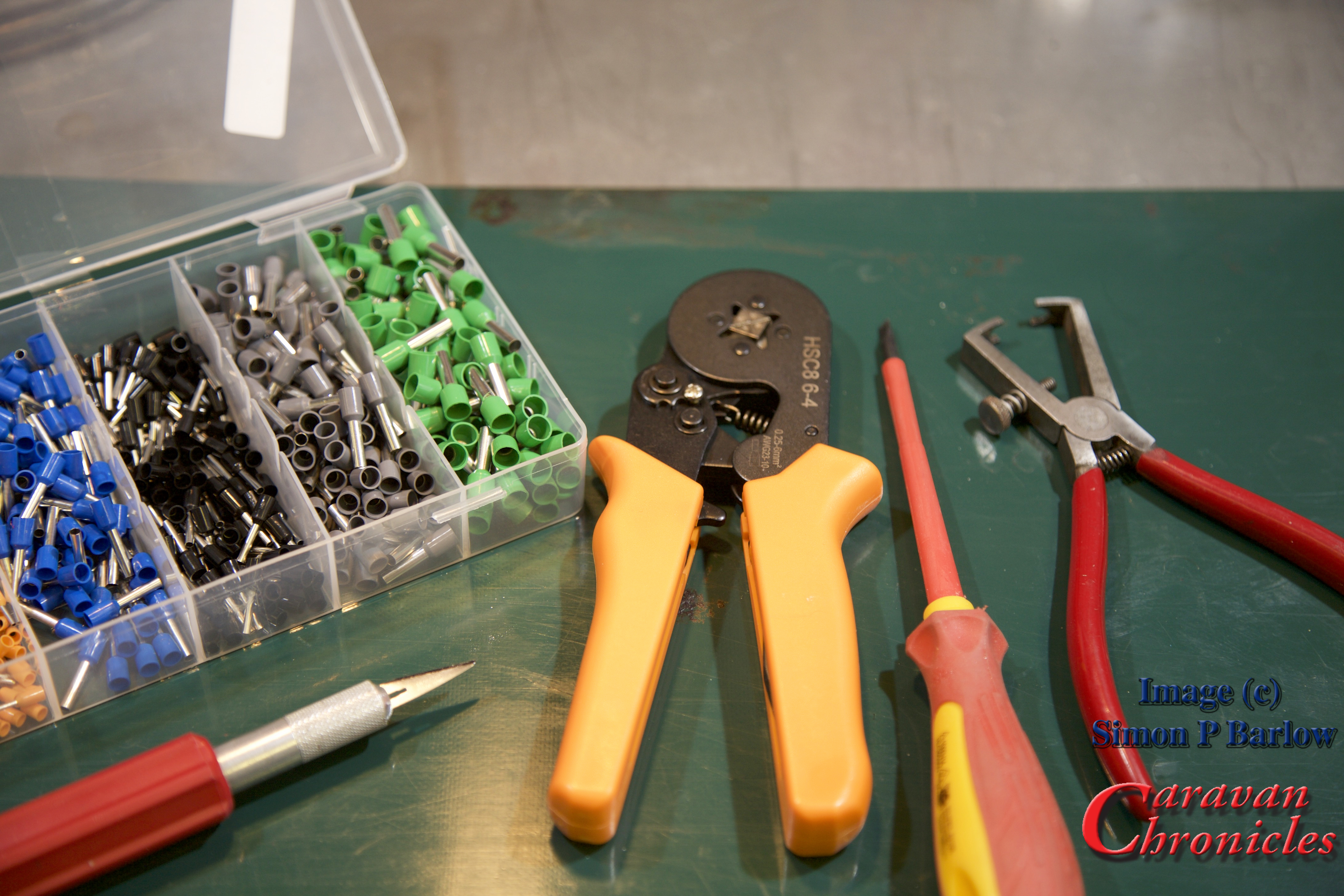
The tools required are a sharp knife, cable strippers, screw driver, ferrule crimps and the ferrules. (tip: make sure your screw driver is a ‘terminal driver’ with flat parallel faces and if fits snugly into the screw head. As the screws are brass, it’s easy to damage the head using the wrong screwdriver)
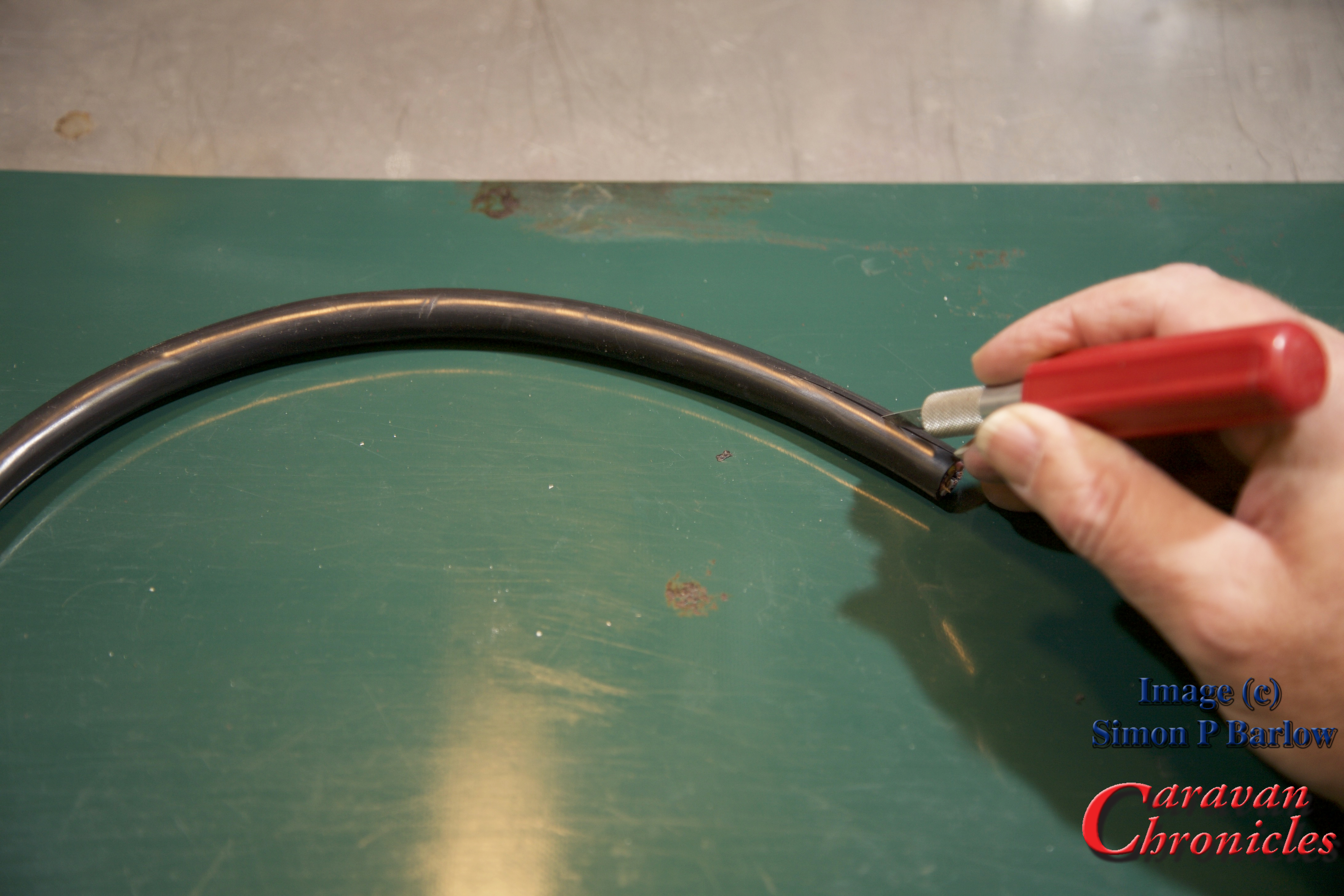
The first step is to trip back the outer cover for the cable. Strip back enough so that the individual cables are long enough to trim to length:
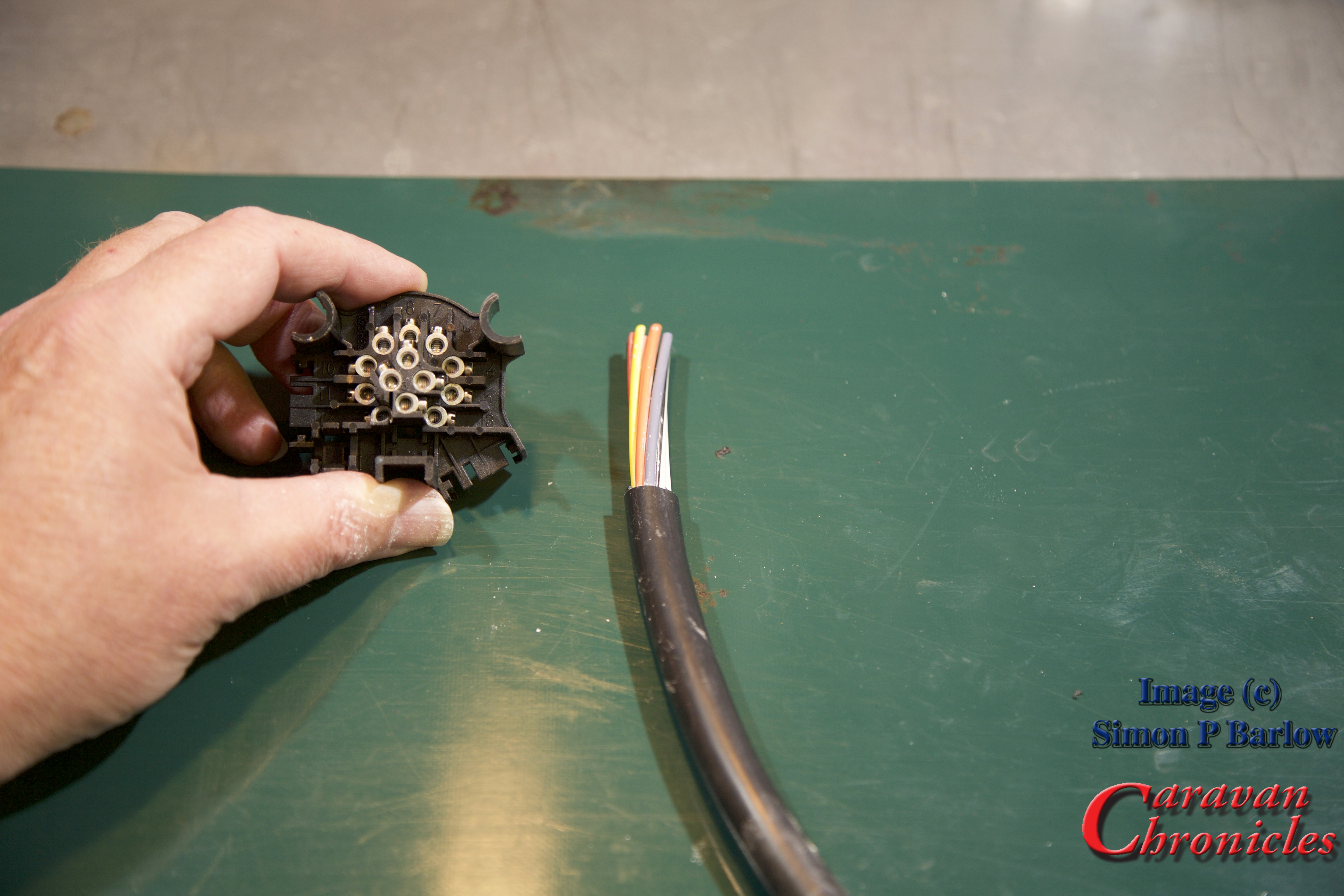
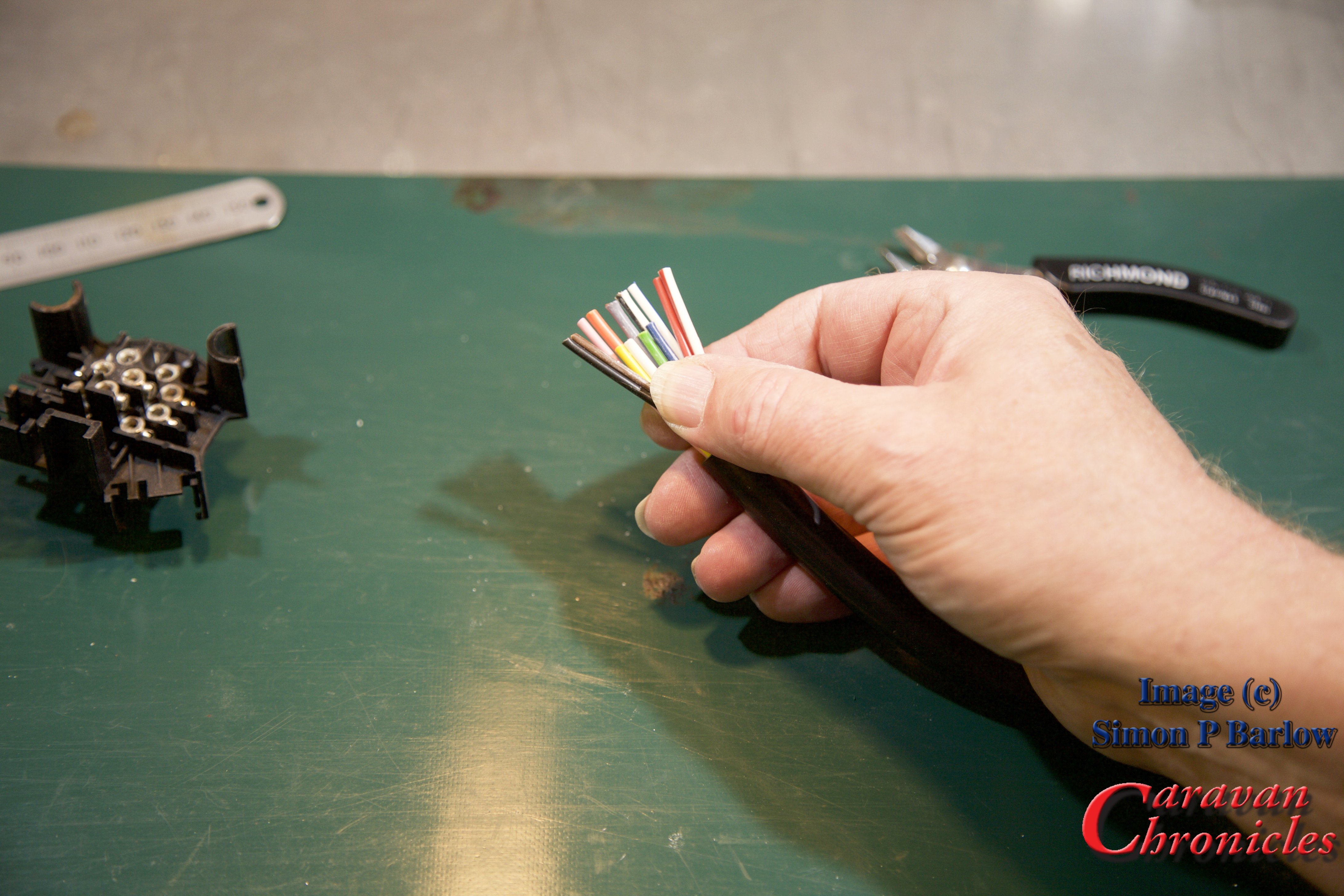
The next thing to check is have you got the right end of the cable? The cable manufacturers lay the individual conductors in a specific pattern so that when stripped, the pattern of colours is in the right order for the end you are terminating. If you have the incorrect end of the cable you will have to cross all the colours over each other to install them correctly in the plug (or socket) As you can see, this is the wrong end for a socket:
Ok, I’ve stripped the other end and you can see the colours are in the right ‘order’ for terminating a socket:
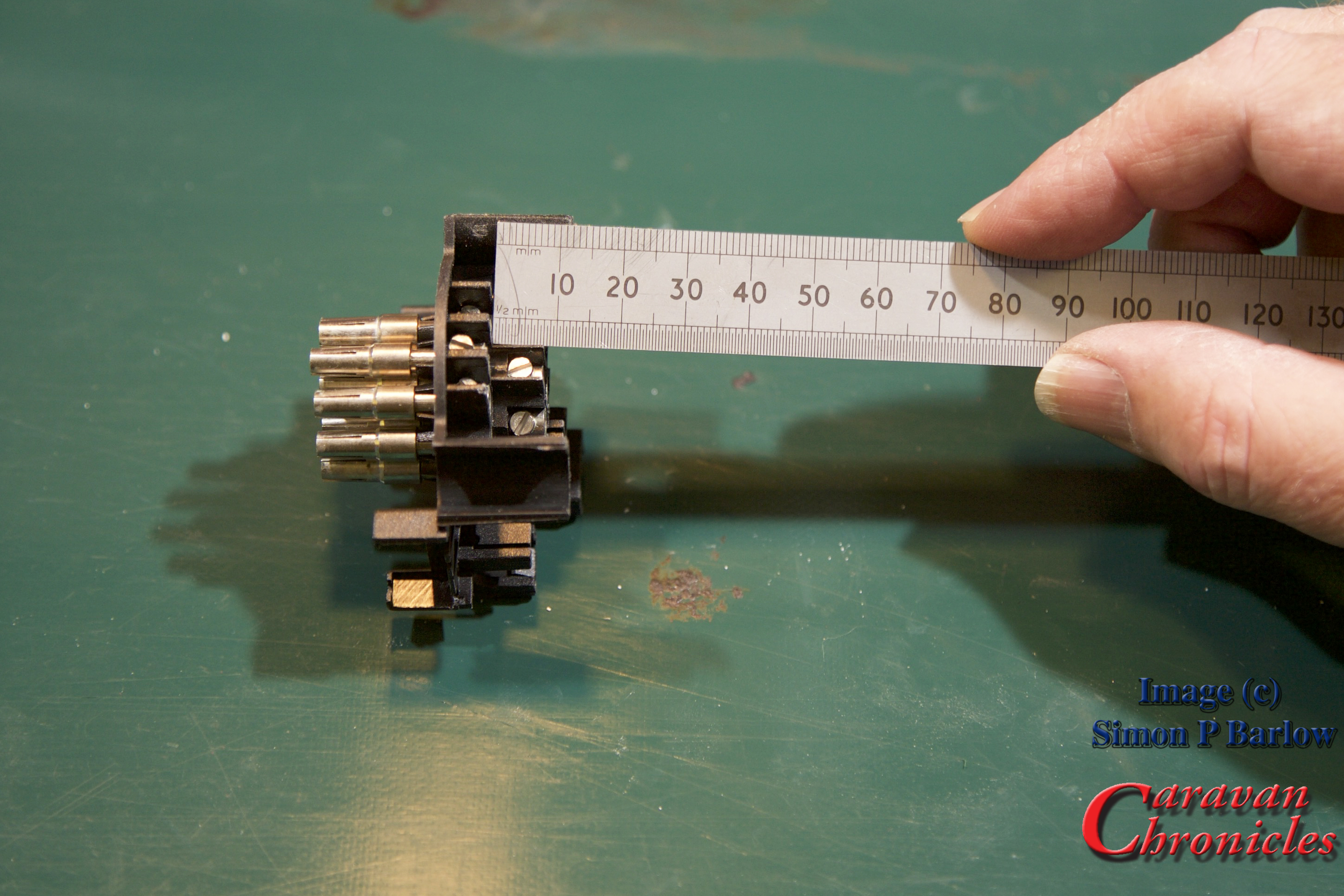
Next we need to measure the difference in termination length between the four centre line and the 9 outer pins… here it’s about 8 mm:
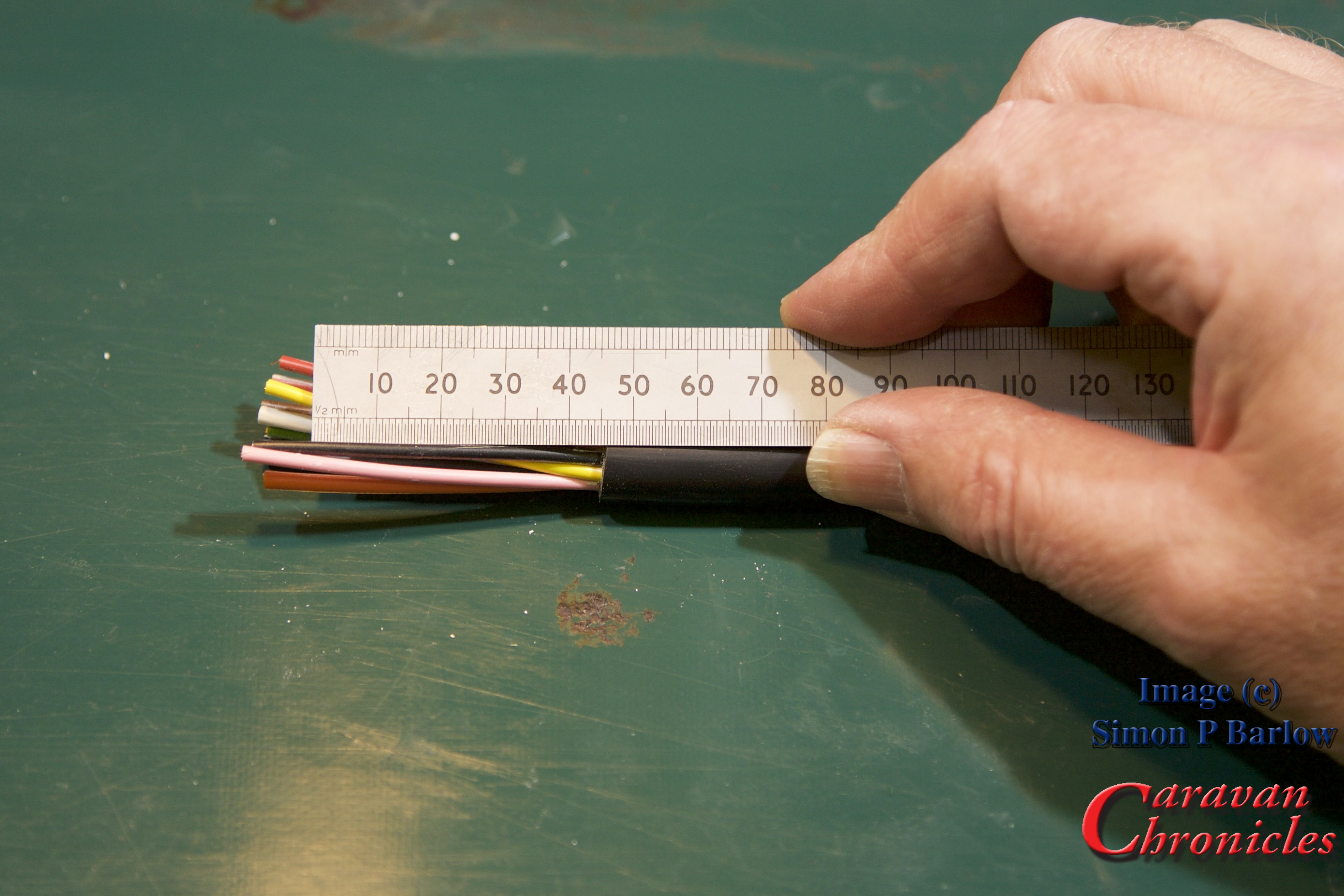
Measuring the back waterproofing cover I know the outer jacket needs to be a maximum of 45 mm from the 9 outer pins and the 4 inner pins need to be trimmed back to 37mm:
Now the cable is cut to the right length so there should be no short or long cables causing problems when assembling the socket:
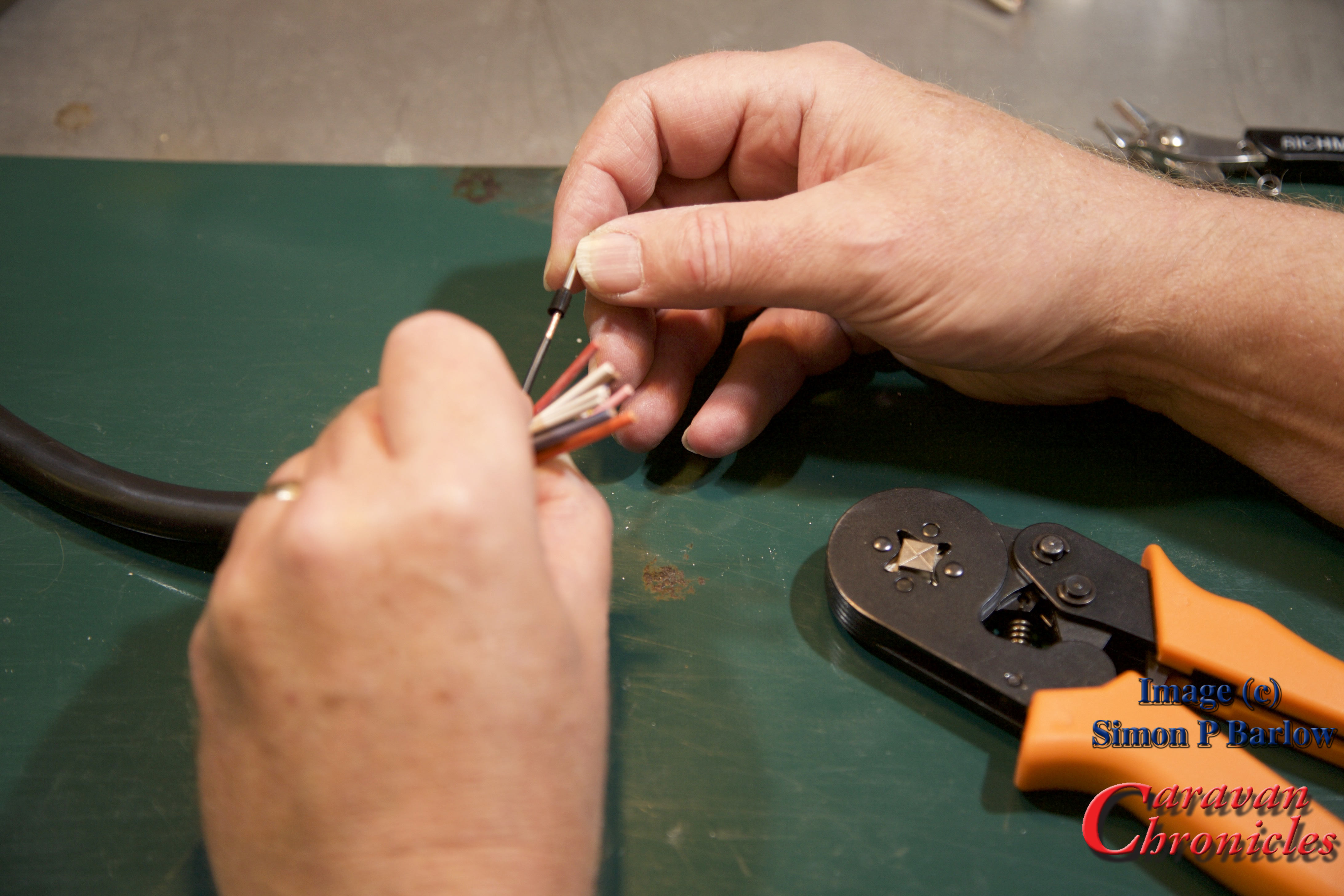
Strip back the individual cables so the exposed conductors are the same length as the ferrules:
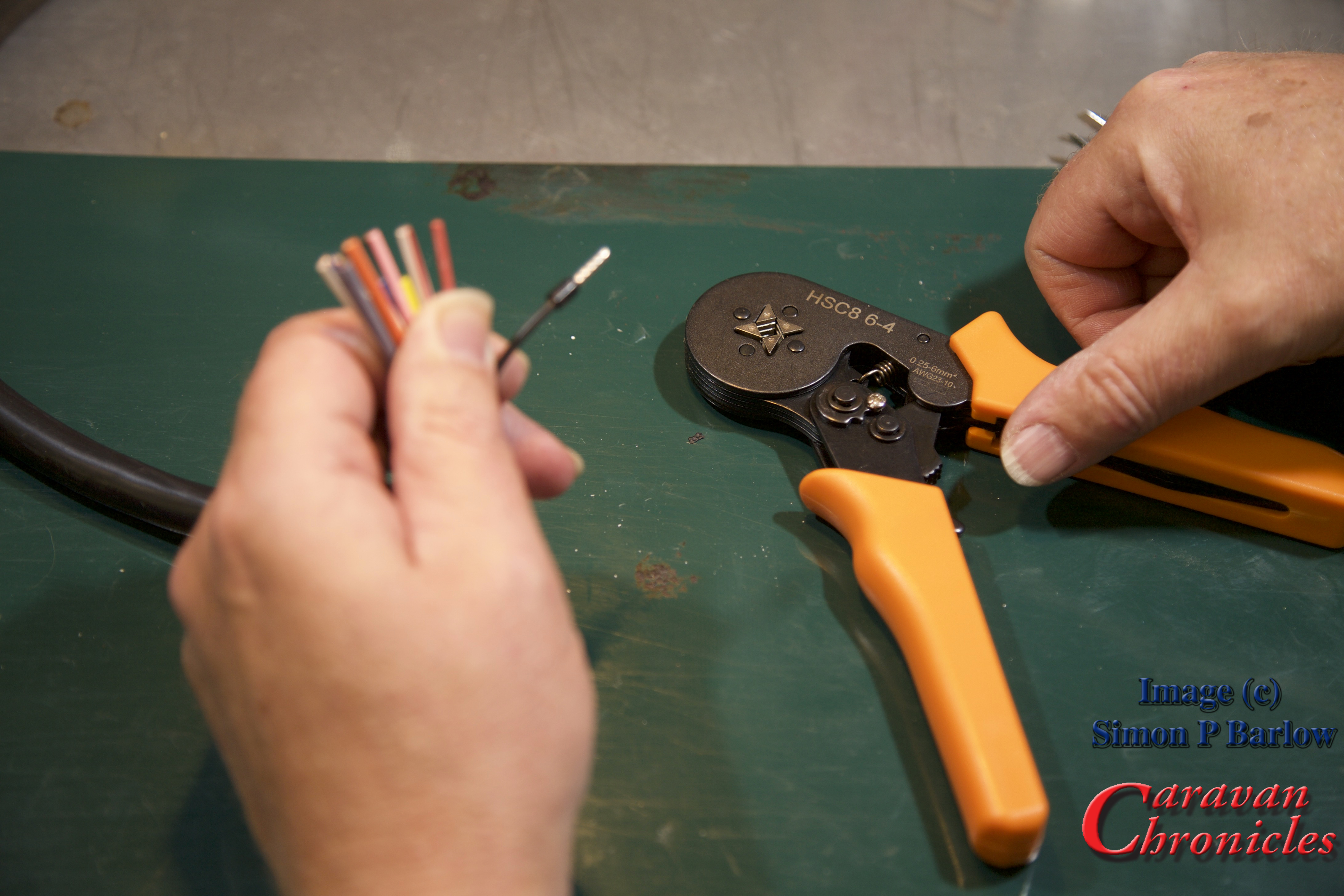
Slide the correct diameter ferrule on to the exposed conductors:
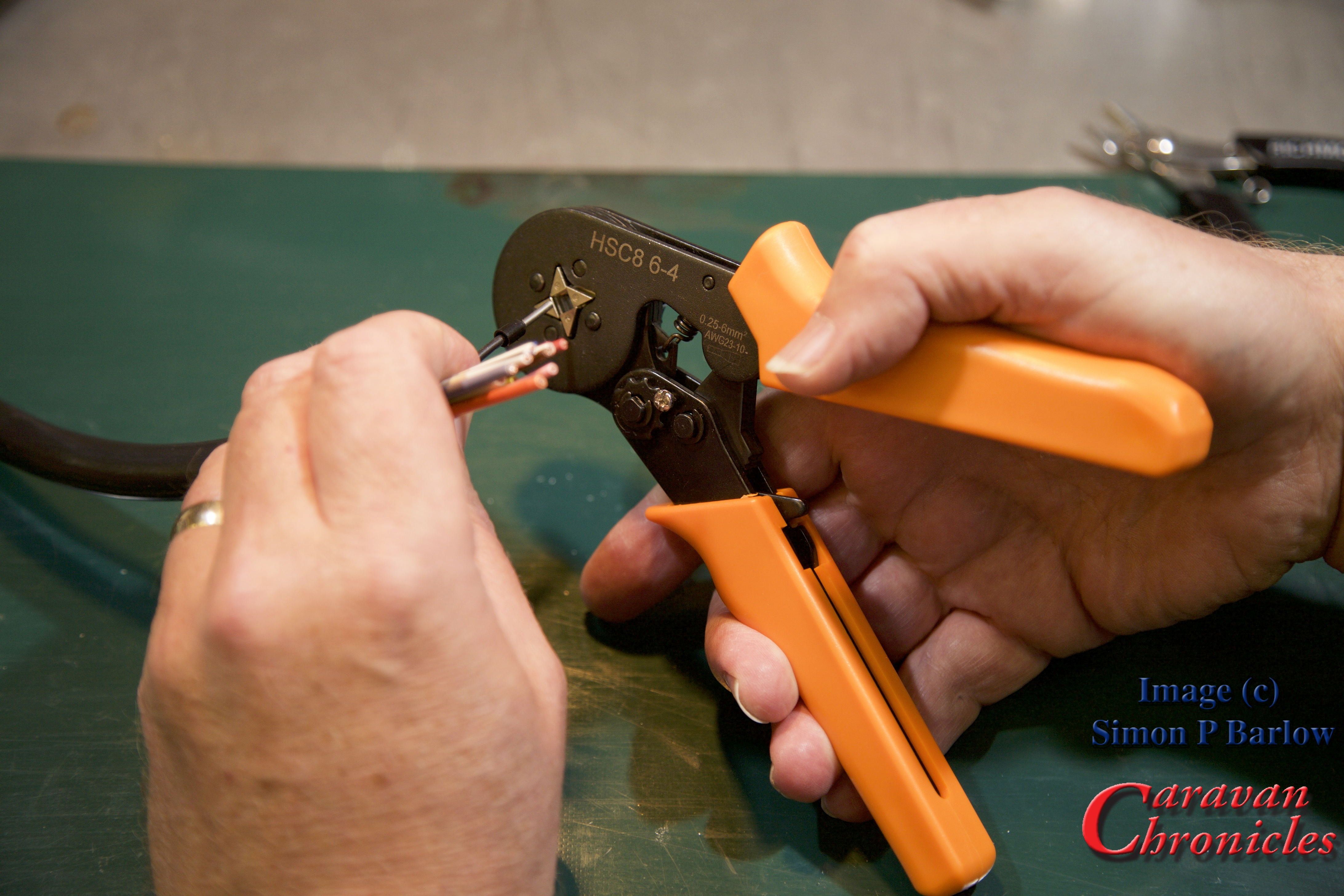
Crimp into place:
The crimp tool is set so that it will only apply the correct pressure to compress the exposed conductors the required amount. Squeeze the handles and the four jaws close on the ferrule and compress it, continue squeezing and once the jaws have attained the right pressure the ratchet mechanism in the handle releases.
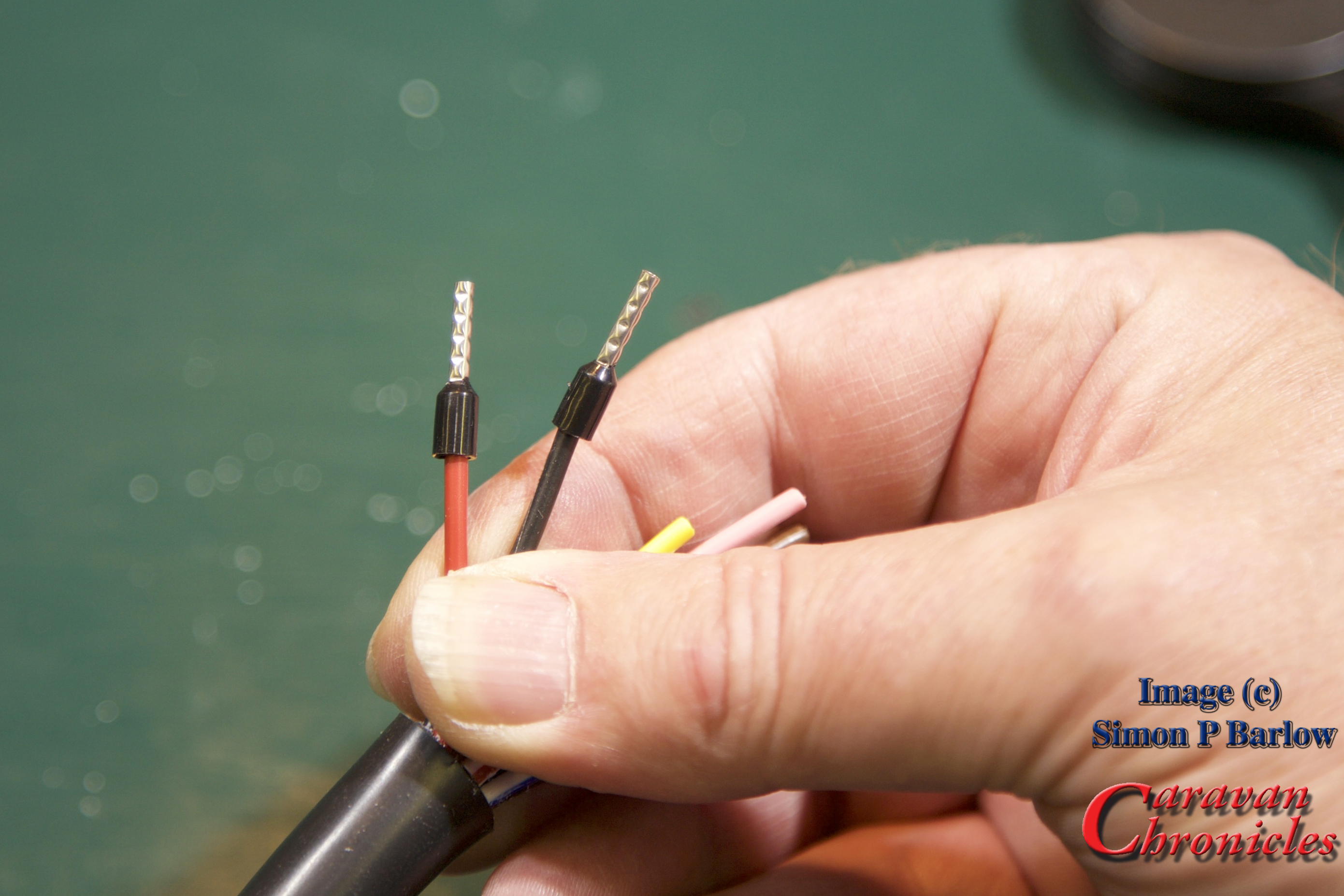
If you look at the picture below you will also see that the crimp tool also presses several ridges into the tube, this is to increase the mechanical grip on the conductors and help stop the tube distorting under the pressure of the terminal screw tip:
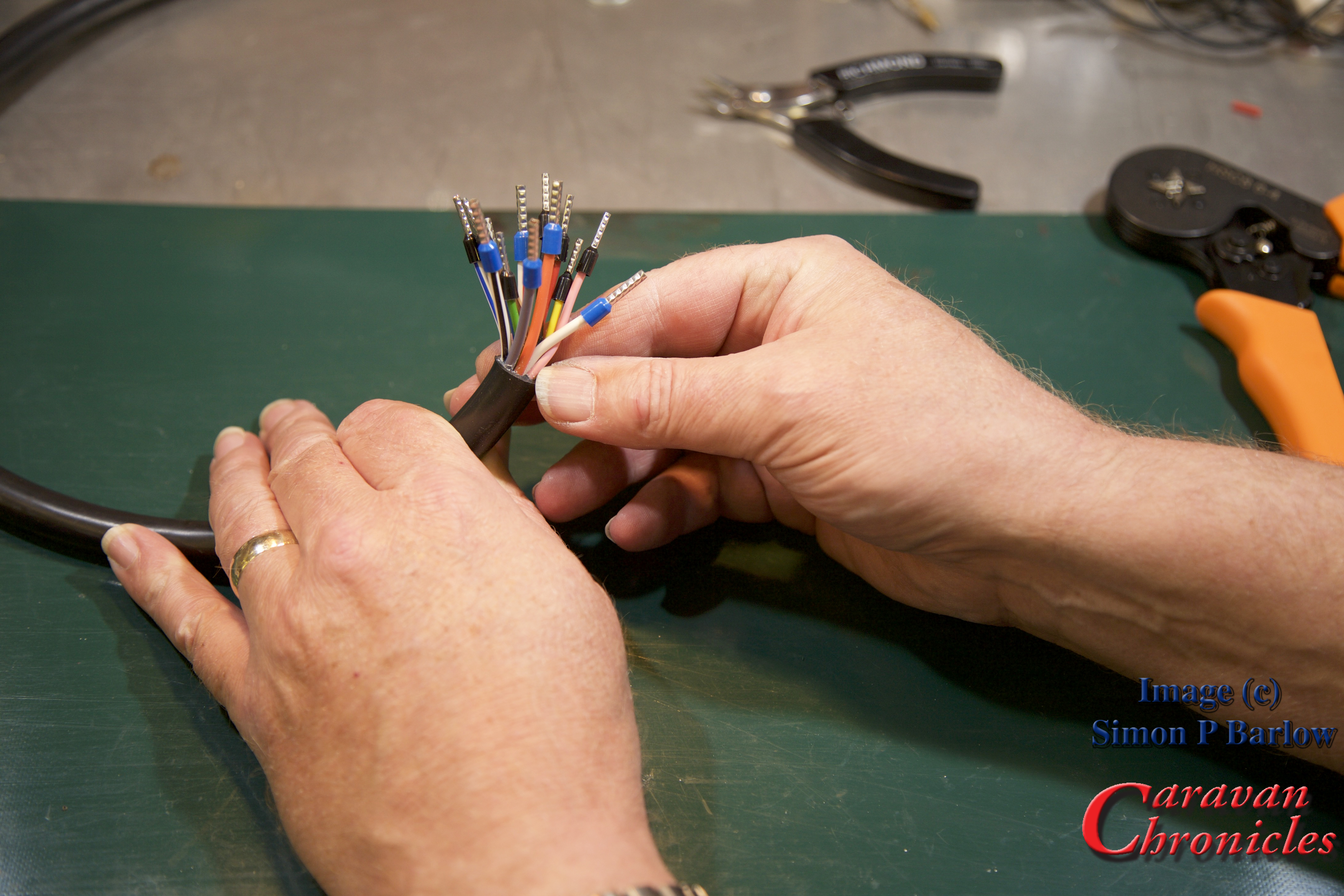
Continue until you have all the cables completed:
One last check… look for stray strands and anything that doesn’t look as though its crimped correctly… give them the ‘tug’ test if in doubt.
I always like to back off the screws so the ends are just visible in the holes:
The next thing you might need to do is correct the length of the ferrule. I have used standard length ferrules and as the holes in the socket terminals are not as deep, I had to trim off the excess. The ridges pressed into the ferrule body help gauge how much to trim off. In this case I only had to snip off to the first indent:
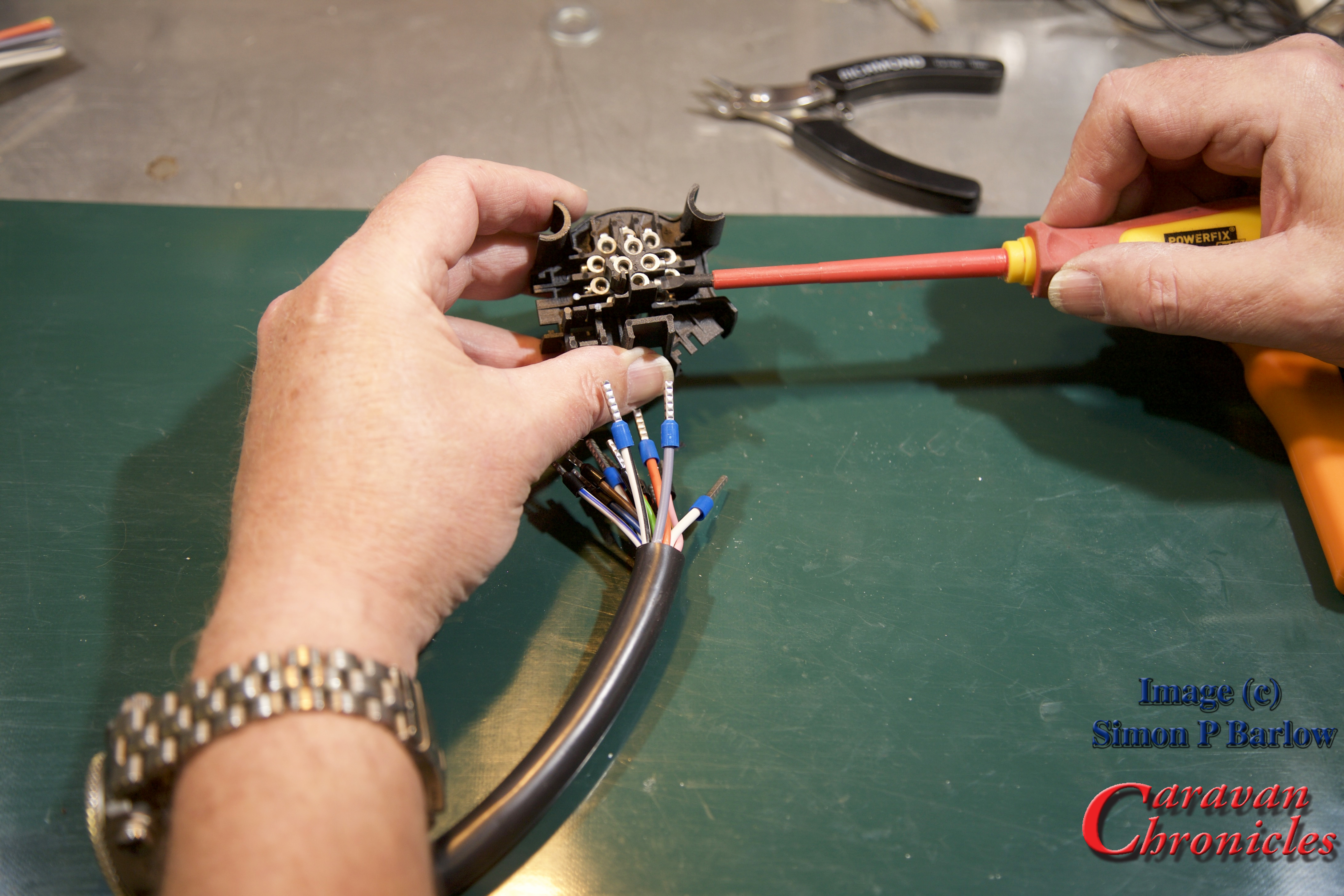
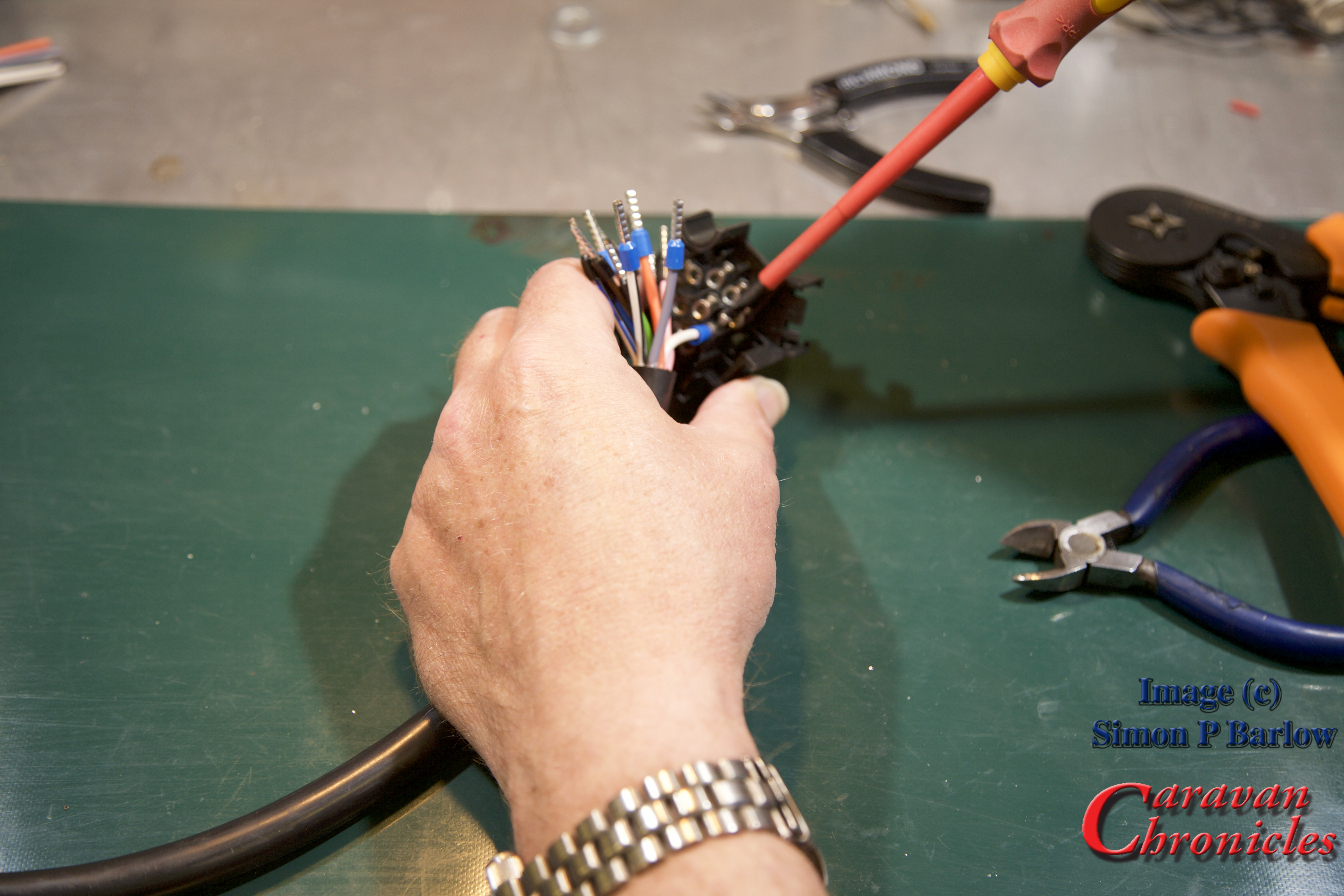
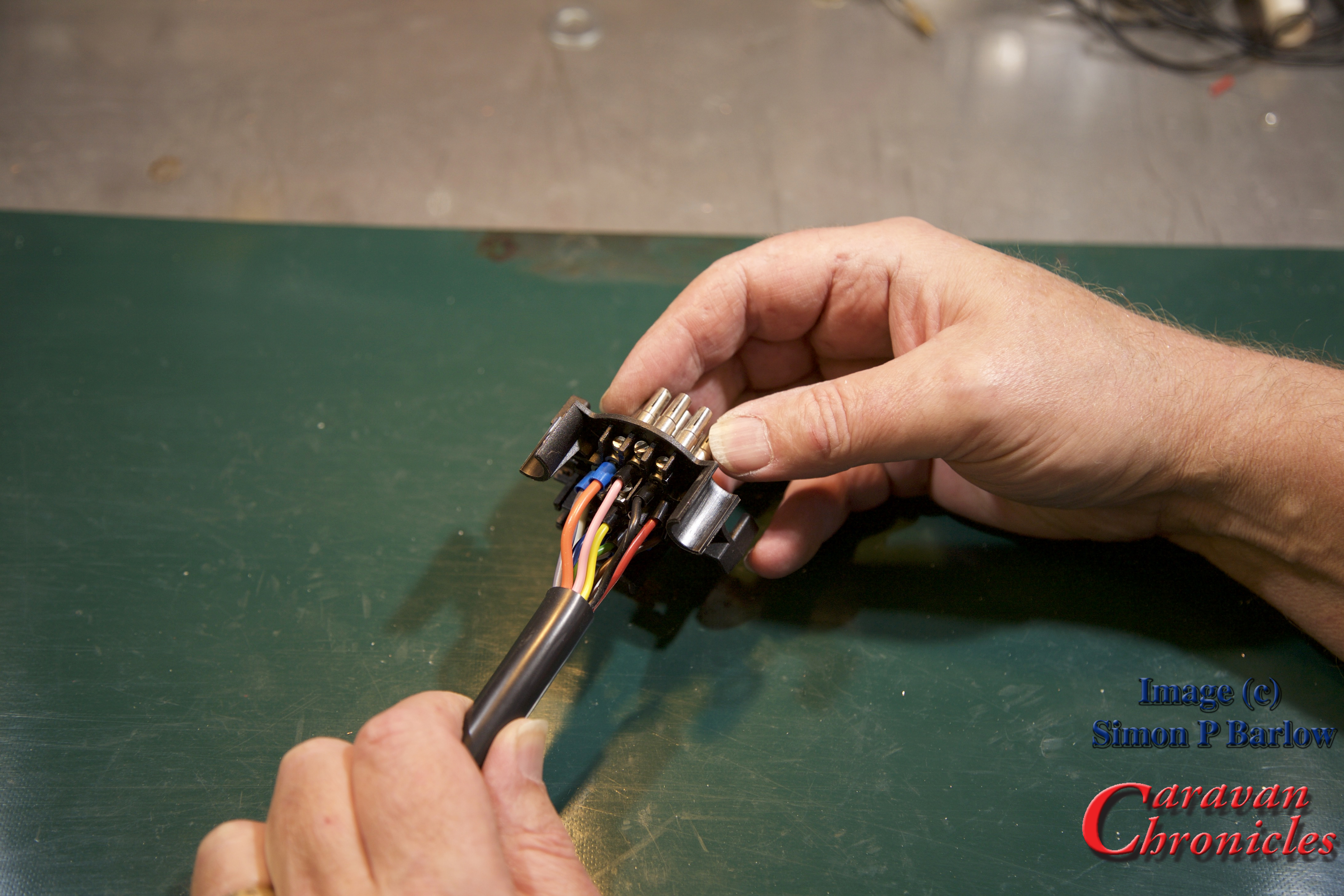
Once trimmed to length, it’s a simple matter of following the colour coding and inserting each cable and tightening the screw. I always start with the four pins in the middle:
Once all the cables are terminated, have a good look to see if all the screws are tight, and of course check the colours are in the right place!
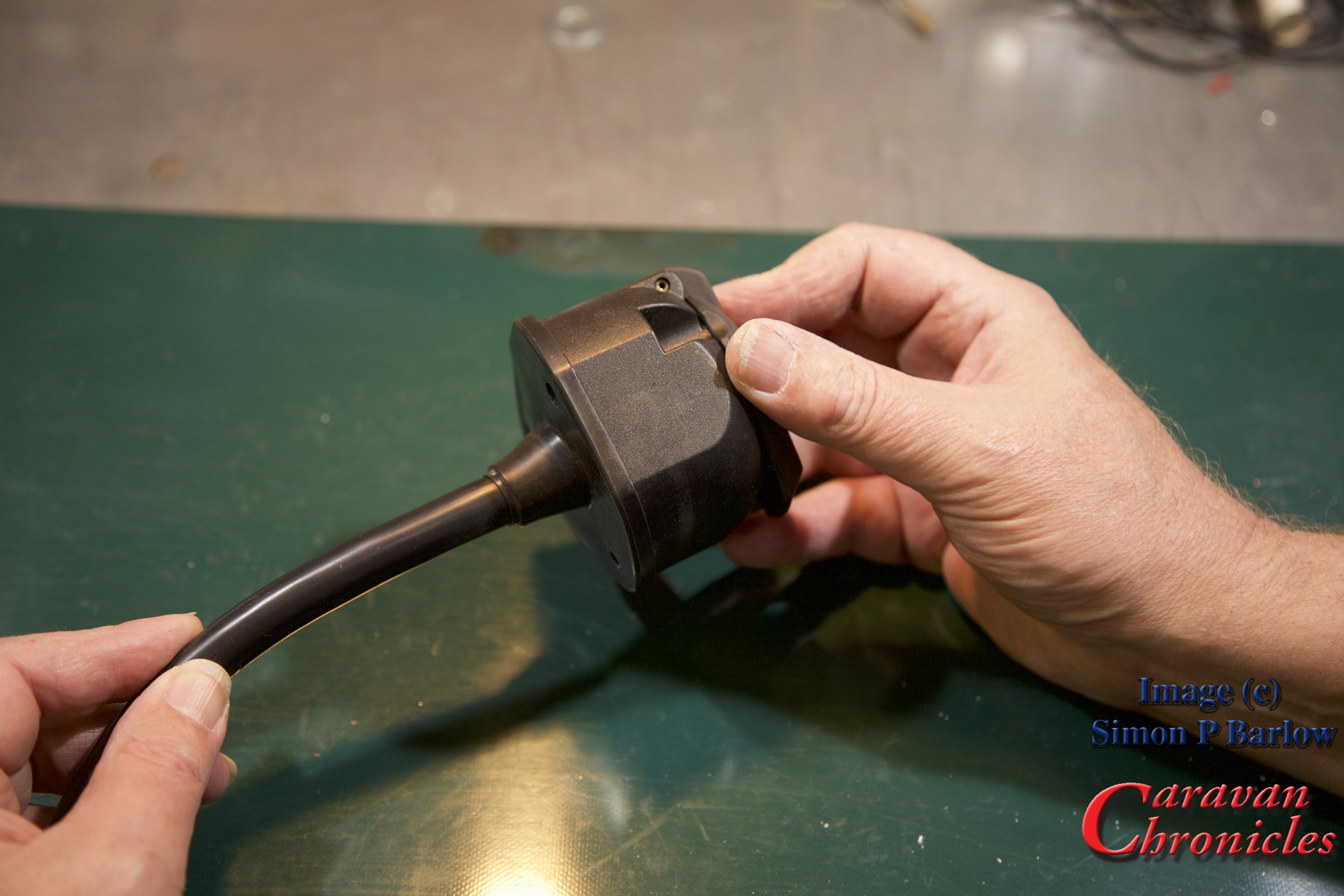
Because the cable was trimmed to the right length before we started there are no loops, so the cover can slide on neatly:
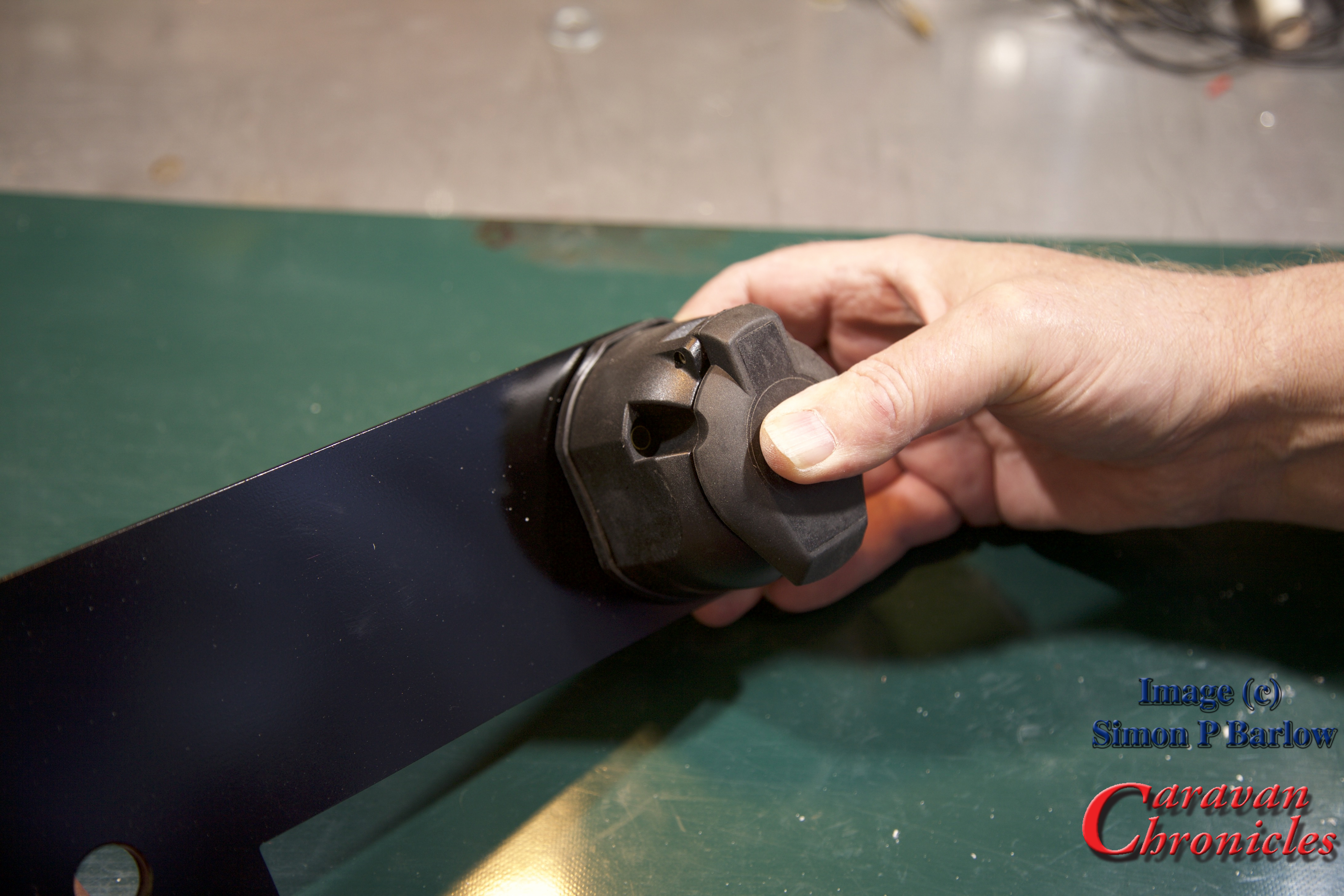
There we go, a finished socket all ready to mount onto the bracket:
To terminate the socket from start to finish and while Sue (thanks `Sue) took all the photos took no more than 25 minutes. Ok it was on a bench and doing outside at the back of a vehicle will take a bit longer, but it’s not that difficult to get a professional result.
The ‘Compromise’
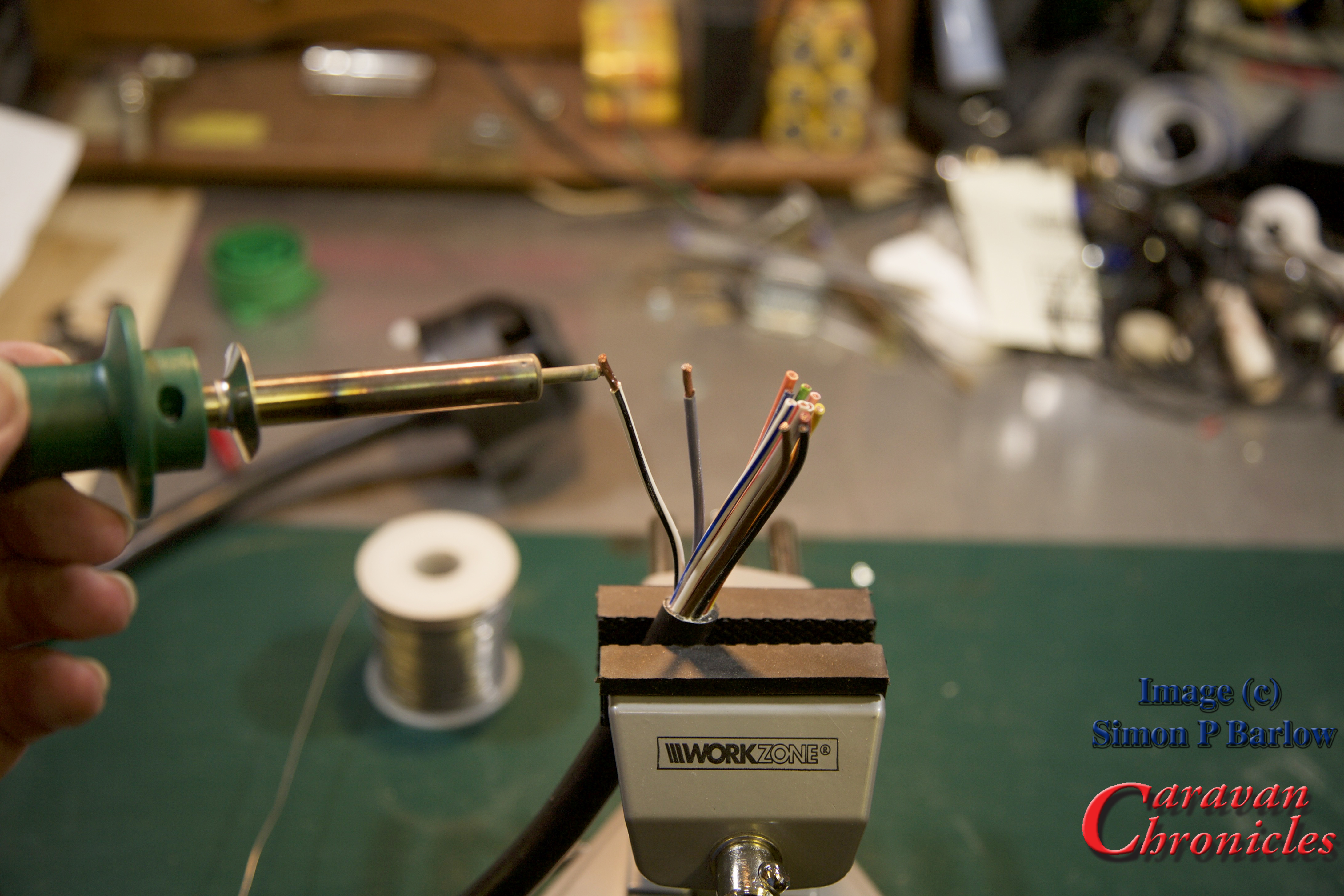
Right back at the start I said there was a compromise – soldering. It’s not difficult to do and achieve and end up with a professional result.
Practice makes perfect and its worth having a go on a scrap length of cable first.
Here’s a few of my tips for successful soldering:
Don’t apply too much heat to cause the insulation to melt (turning down the temperature of the soldering iron or reducing the contact time between the soldering iron and cable helps)
Don’t try to melt solder onto the tip of the iron and run it in to the cable you will burn off the flux too fast… instead touch the solder onto the hot strands of the conductor. Capillary action will pull solder into the strand bundle.
Don’t allow too much solder to be drawn in. You are looking for just enough to still be able to make the outlines of the strands of cable, not a big ‘blob’ of solder on the end.
The solder should look shiny not dull. If it’s dull, the solder cooled too soon as the conductors were not hot enough, this is commonly known as a ‘dry joint’ the solder sits on the surface of the copper.
Avoid breathing in the fumes given off from the flux and the solder. Solder is an alloy of tin and lead… and the flux is pretty nasty too. ( I have an old computer cooling fan that I use to blow the fumes away if I’m doing a lot of soldering).
If you have made the soldered cables too long, you can always trim them back to the correct length. Soldering all the conductors in a caravan cable like this usually takes me no more than five minutes from start to finish.
A few practice runs will soon get you producing good results.
Finally to finish off, I usually give the finished connections a spray of ‘liquid plastic’. It comes in an aerosol can and when sprayed on form a thin plastic coating over everything. You can usually find it in motorbike and automotive shops for waterproofing electrics and HT leads.
It easy to get a good professional result, and I still can’t understand why some tow bar fitting companies don’t either crimp or solder their connections. They usually do when it comes to connecting the other end of the cable to the vehicle. The cynic in me wonders if they are hoping for repeat custom when sockets or plugs start to have problems in the future.
I have been asked where you can purchase some of the products featured above. Here are the links to the products in the Amazon store. If you click on the links and purchase the items, a few pennies will go to helping the cost of running CaravanChronicles.com
Just finding time to catch up on a few things that I haven’t had time to write about over the past few months.
One of the things we bought a while ago – sometime last year I think, was a cheap de-humidifier from ALDI. I was a little sceptical about the performance of such a small and low priced device initially but it seems to work as advertised. We haven’t been leaving it plugged 24 hours a day but just using it when we are out for the day and in the evening. Usually we just plug it in when we get up are and leave it running stood on in the bedroom area on a low shelf near the bathroom door and in the evening move it into the bathroom and put it on the floor. We don’t leave it running overnight.
Each day it averages just over two cups of water. Now that doesn’t seem much, but that water was in the air and it has to go somewhere, usually in the form of condensation. One thing we have noticed is that in the morning when we open the blinds, even when it’s down to a few degrees above freezing outside there isn’t any condensation on the lower edge of the windows or window frame. In the colder months usually we put the towels used from showering over the heated towel rail in the bathroom to dry and I’ve always worried about condensation forming in the caravan, but I think this little unit might have eased my concerns somewhat. I don’t think a de-humidifier is worth running 24 x 7 in a caravan as there are so many vents, but taking the moisture out of the ‘van from day to day living can’t be a bad thing!
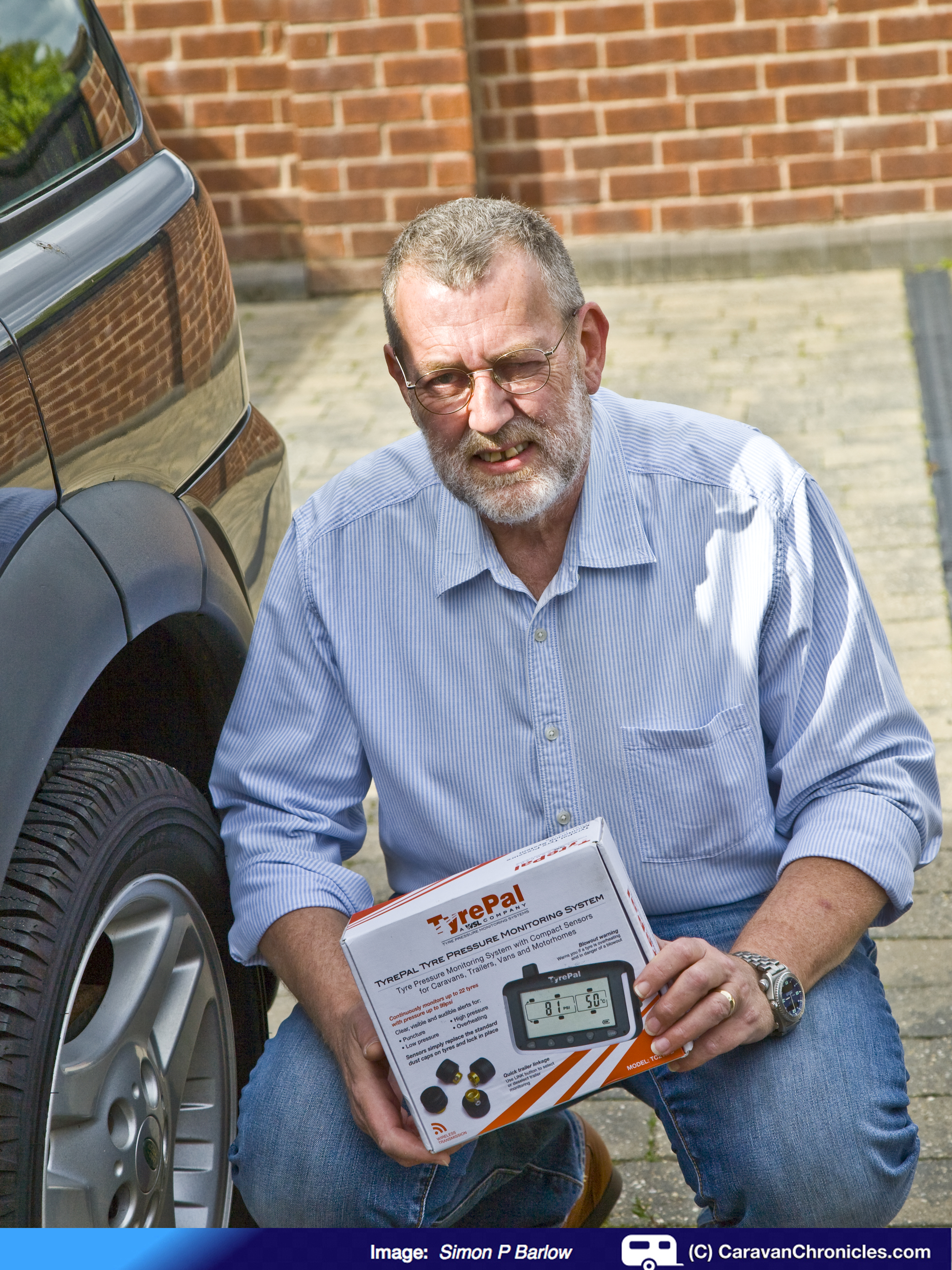
We had chance to test the TyrePal TPMS on a recent trip. The unit lent to us for review by Tyre Pal was the TC215B and included wheel sensors for the car and caravan.
If you are a regular reader you may remember that on our last trip out we had a bit of an issue with tyre pressures with the caravan (“When Things Don’t Go To Plan…”). Well, a few days ago I was contacted by Charlotte from Wheel Solutions Ltd the people who make Tyre Pal – the tyre pressure monitoring system, asked me if I’d like to test out and review one of their pressure monitoring systems.
With the recent trip still in my mind and especially the difference that just 10 PSI can make in the towing experience I jumped at the chance. Charlotte arrange for one of their TC215B units with 6 sensors to be delivered on loan for a few weeks while we try it out on our next trip. From saying “Yes”, the package containing the TC215B unit, mounting bracket, charging lead, accessories and sensors arrived the following day.
So, this weekend I’ll mainly be unboxing, evaluating and installing the unit and sensors and posing about the install and setting it up which, from my brief scan through the comprehensive user manual, looks like it’s going to be a breeze.
In a few days time we will be setting off for Plough Lane Caravan Site, one of the Tranquil Touring sites and I’ll report back on how it performed on the trip and giving my thoughts about it.
Now, “in a bit of an exclusive” (I’ve always wanted to say that!) for Caravan Chronicles we will have a special offer from Tyre Pal at the end of the review… just in time to get yourself an early Christmas present… so keep checking back.
In my last post I discovered that the caravan tyre pressures were low and didn’t have a portable means of inflating them. I’d looked at the offerings from a well know auto store and reading the blurb on all the boxes discovered that getting an inflator that would be capable of inflating above normal vehicle pressures would not be a straight ‘off the shelf’ item… well not off the shelves of the auto store I was in at the time.
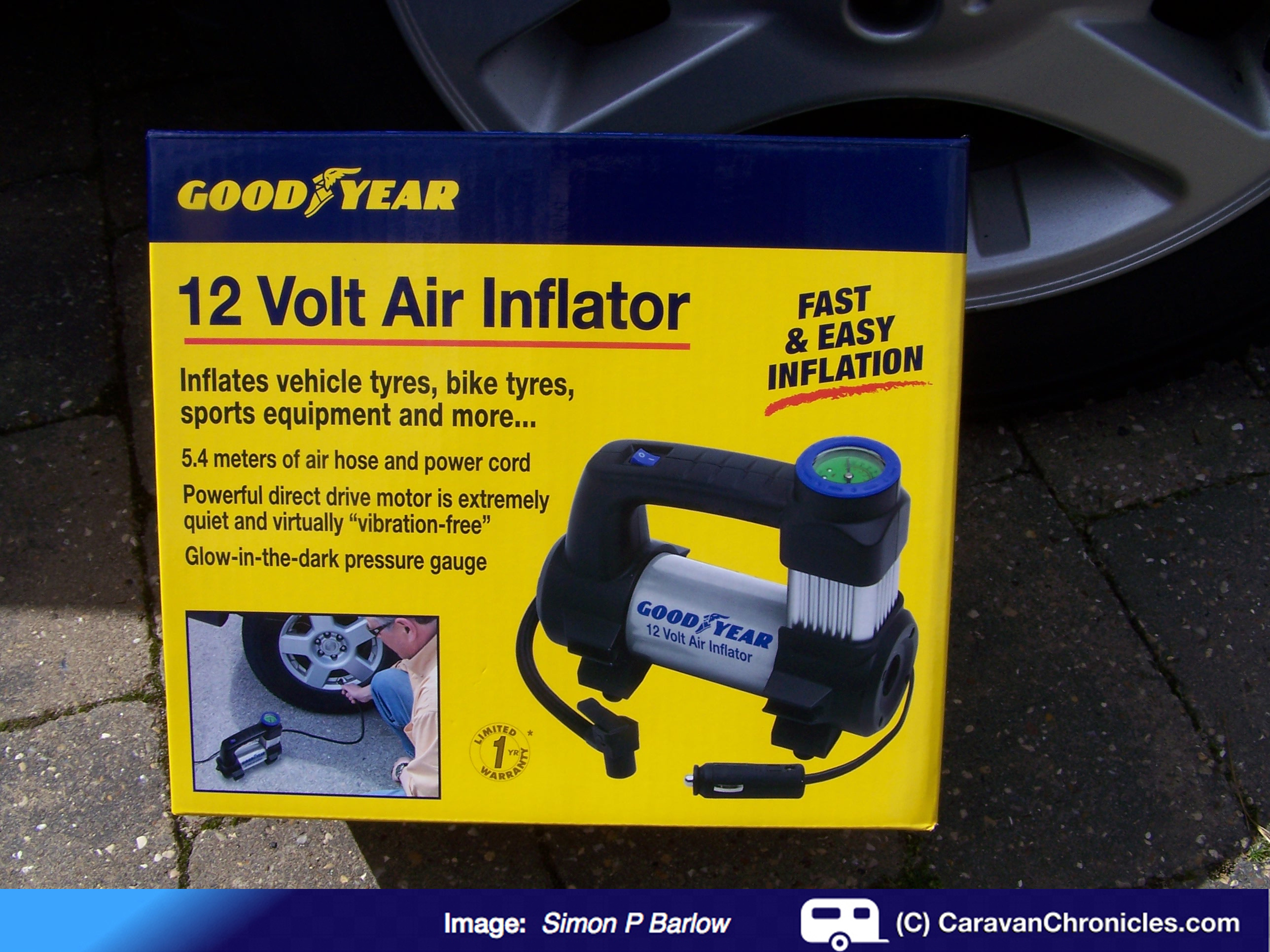
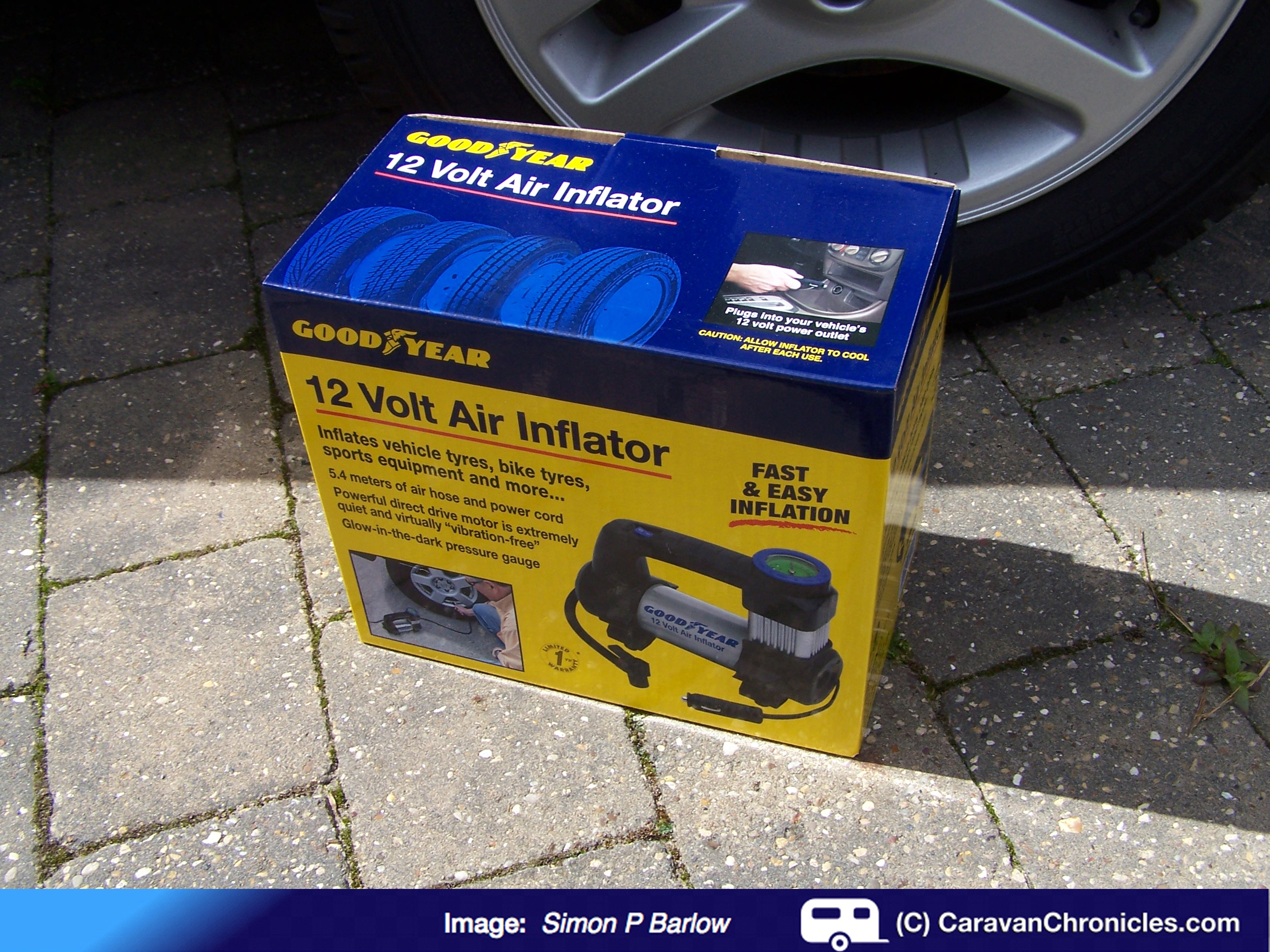
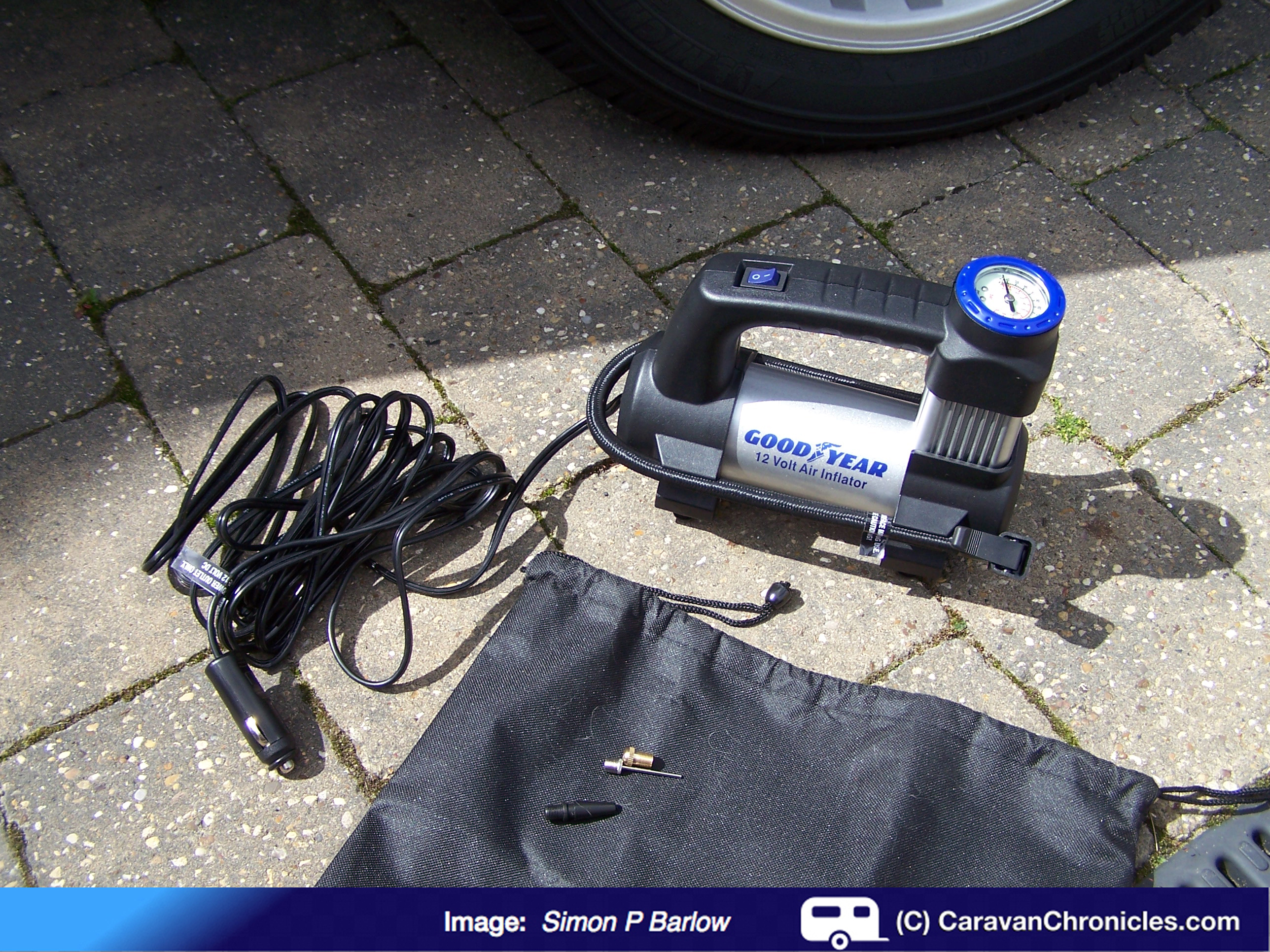
However on a recent trip to Costco I came across a pallet full of Goodyear 12 Volt Tyre Inflators priced at £21.99 + VAT. Reading the box and looking at the model out on display, it seemed well made (like quite a few things in Costco, they are generally made for the US market) it was a well-known brand at a price level that seemed very competitive to others I had looked at on line.
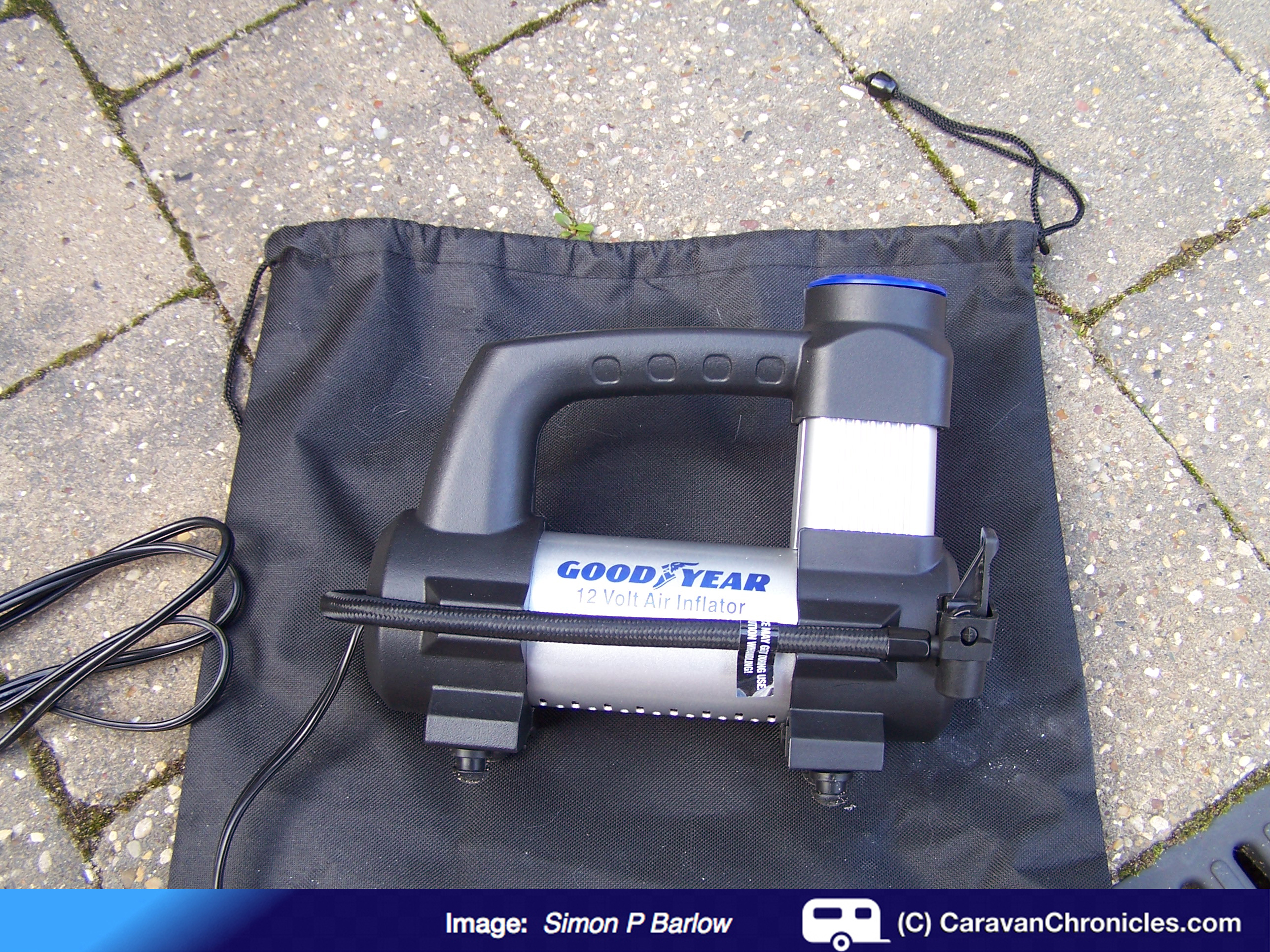
The unit comes with 5.4 metres of cable and the airline is long enough to reach the tyre valve, even if it is at the top of the wheel on a large 4×4 tyre. I think it would reach our caravan wheels when hitched up to the caravan with the unit plugged into the accessory socket on the dash. In the box there is also a bag to keep it in along with adaptors for presto valves, dingy and sports balls.
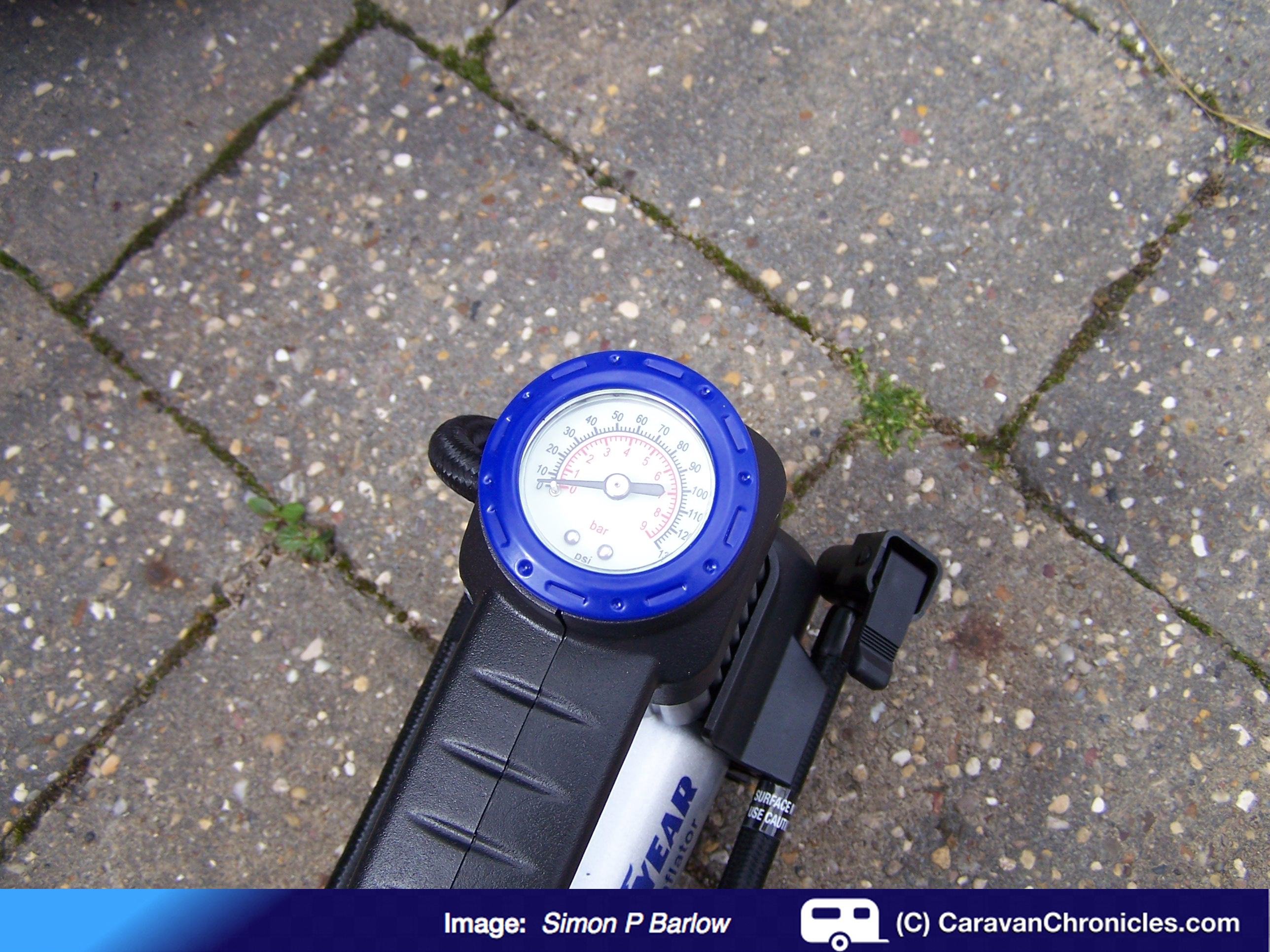
The unit has a direct drive motor which does make it quieter than some that I have heard and the pressure dial is a ‘glow in the dark’ luminous one, so at least you don’t have to hold a torch on the dial if you are using it at night. The makings on the dial are calibrated every 2 PSI (outer black markings) and every 0.2 BAR on the inner red scale and were clear to see.
For its first test, I dropped the Freelander’s tyre pressure to 16 PSI and timed how long it would take to inflate it back up to 32 PSI – the normal pressure I use when towing the caravan. It took a bit longer than I expected – about 4 minutes, but it is capable of inflating to a lot higher pressures than that, so I guess the CFM rate is lower. To see what it would inflate to pressure wise, I dumped the air out of my small prattle mains compressor that has a 2.5 litre air tank and rigging up a connector turned the unit on. It managed to get to around 95 PSI after a while. The instructions caution you to only use it in 10 minute bursts then allow it to cool, the first couple bursts it didn’t get particularly warm, but on the last one to raise the pressure from about 60 to 95 it did get hot, but not ‘flipping heck that hot” when you touched it! As the caravan tyres should be inflated to 62 PSI, thesis well within its operating range.
The 12 volt plug that fits in the accessory socket is a good close fit, so I’m not anticipating it keep dropping out or overheating. The plug contains a 15 amp fuse… which I must get a couple of spares.. just in case. . I’ve used it four or five times now and it seems to work OK. It seems well made, there is enough cable on it so it should reach most situations and the air hose is long enough. I would have liked to see a metal rather than plastic tyre valve fitting though. The gauge seems accurate, I checked it against my normal tyre inflator on my airline and a digital tyre pressure gauge and it was always within 1 PSI of them both across a wide range of pressures.
The instructions are in English… English English, not translated third or fourth hand into English and are fairly clear. The plastic moulding is well finished, not like some of the cheaper units you can buy and when running it doesn’t want to vibrate off on a walk. I’ve not used it on the caravan yet, but hopefully I won’t have to in September before our next trip.
Generally I always think you get what you pay for and 99% of the time this is definitely true but for £21.99 + VAT (£26.38) maybe I have just got that 1% bargain. So for now it’s back in its bag, in the boot of the Freelander… I’ll let you know how it’s holding up next time I have to use it.


 (I bought one of these so I could keep my existing one intact. You will need the correct model for your caravan water inlet).
 The pressure regulator comes complete with a pressure gauge.
 (these were used to adapt the size of the fitting on the pressure regulator so I could fit the female quick release adaptors.
 An option, but very handy.
 I bought two of these for the regulator.









 Just finding time to catch up on a few things that I haven’t had time to write about over the past few months.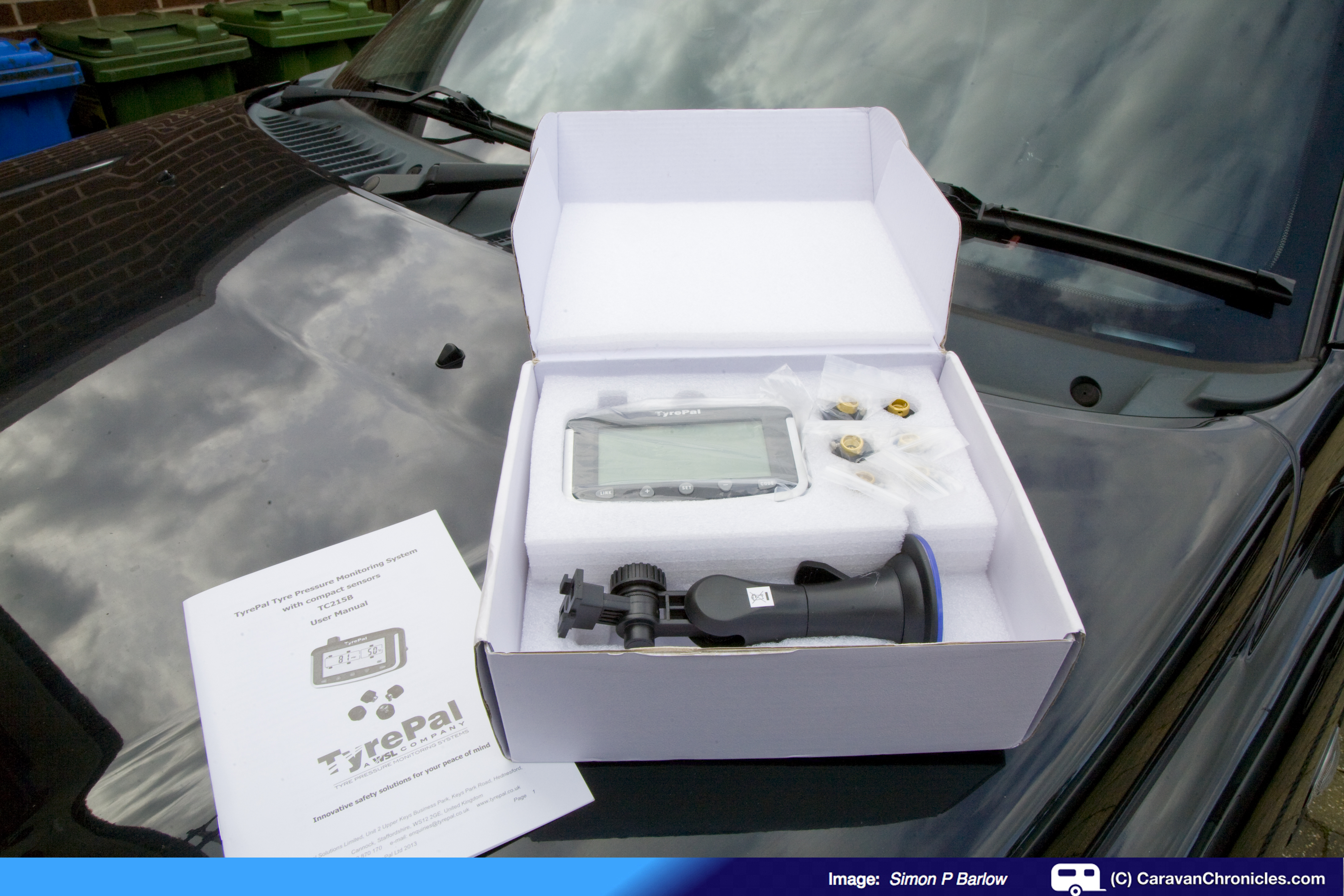

 Caravan Chronicles